This Stock Is Vital to the Tech Industry and Could Be a Huge Winner This Year
Key Points
Taiwan Semiconductor controls 72% of the pure foundry semiconductor market.
Its revenue totaled $122.4 billion in 2025, up 36% year over year.
The company sees high profit margins despite the capital-intensive nature of semiconductor production.
When you talk about the global tech industry, there are two companies it cannot do without. One is ASML Holding N.V. (NASDAQ: ASML), which I've covered before and whose lithography machines are absolutely critical in semiconductor manufacturing.
The other is Taiwan Semiconductor Manufacturing (NYSE: TSM) which, as of Q3 2025, controls a whopping 72% of the pure foundry semiconductor market.
Where to invest $1,000 right now? Our analyst team just revealed what they believe are the 10 best stocks to buy right now, when you join Stock Advisor. See the stocks »
I've also covered Taiwan Semiconductor in comparison to Intel, but this company is worth getting an article all its own.
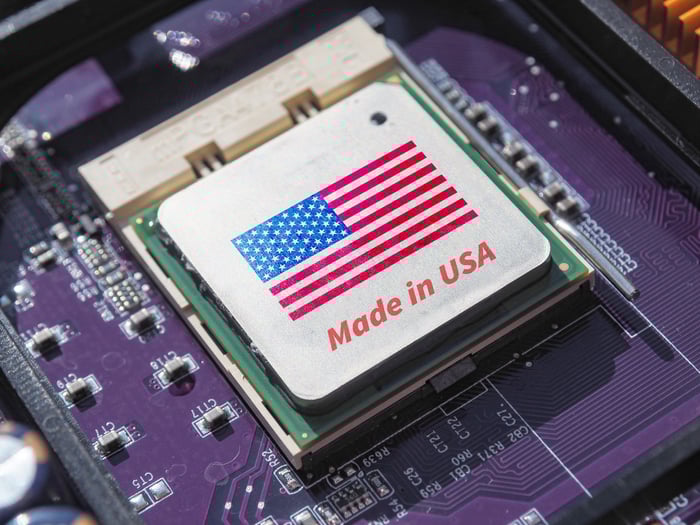
Image source: Getty Images.
The world's semiconductor factory
Now, there are lots of companies in the semiconductor industry that design chips but don't produce them. They're called "fabless" because of that.
Taiwan Semiconductor isn't one of them.
As a pure foundry company, it produces chips other companies have designed, like Apple and Nvidia, which account for 25% and 11% of Taiwan Semiconductor's revenue, respectively.
Speaking of revenue, Taiwan Semiconductor brought in $122.42 billion in revenue for 2025, up 36% over 2024.
It also managed a gross margin of 59.9% and an operating margin of 50.8%, up 3.8 and 5.1 basis points, respectively, over 2024, which is particularly impressive for an industry as capital intensive as semiconductor manufacturing.
And, despite those expenses, it actually drove down its capital expenditures by 1.3% in Q4 2025 from Q4 2024, and its free cash flow grew by 42%. For the whole of 2025, the company grew its operating cash flow by 24.6%.
Taiwan Semiconductor also expects its profitability to improve and has targeted a gross margin of 63% and 65% and an operating margin of 54% and 56% for Q1 2026.
The company holds a net cash position of $88 billion to a total debt of $31.6 billion. It's not simply sitting on that cash either, as it's working to expand its global footprint rapidly.
Taiwan Semiconductor's expansion into Phoenix
Taiwan Semiconductor has already invested $165 billion in a gigantic semiconductor factory in Phoenix, Arizona and is currently working on an expansion to the plant targeted for completion in 2028.
That plant already helped Taiwan Semiconductor get around some of the Trump administration's tariffs. But then in January 2025, Taiwan Semiconductor was part of an agreement with Washington that would see tariffs on Taiwan reduced from 20% down to 15%.
In return, Taiwan Semiconductor and other Taiwanese chip and technology companies will invest $250 billion in their American production capacity. For Taiwan Semiconductor's part, it purchased another plot of land in Arizona to expand its footprint in the state.
Once complete, those factories will help Taiwan Semiconductor get past the lowered tariffs and bring more of the strategically vital semiconductor industry stateside. That is something the U.S. government has been trying to do since at least the 2022 CHIPS and Science Act under the Biden administration, if not earlier. Not to mention that it also allows Taiwan Semiconductor to manufacture more semiconductors.
Taiwan Semiconductor isn't an effective monopoly like ASML is. It does have to compete with Samsung and Intel, but neither comes close to Taiwan Semiconductor's manufacturing capabilities.
That makes Taiwan Semiconductor absolutely critical to the tech industry, and makes the continuation of its growth streak very likely.
Should you buy stock in Taiwan Semiconductor Manufacturing right now?
Before you buy stock in Taiwan Semiconductor Manufacturing, consider this:
The Motley Fool Stock Advisor analyst team just identified what they believe are the 10 best stocks for investors to buy now… and Taiwan Semiconductor Manufacturing wasn’t one of them. The 10 stocks that made the cut could produce monster returns in the coming years.
Consider when Netflix made this list on December 17, 2004... if you invested $1,000 at the time of our recommendation, you’d have $450,256!* Or when Nvidia made this list on April 15, 2005... if you invested $1,000 at the time of our recommendation, you’d have $1,171,666!*
Now, it’s worth noting Stock Advisor’s total average return is 942% — a market-crushing outperformance compared to 196% for the S&P 500. Don't miss the latest top 10 list, available with Stock Advisor, and join an investing community built by individual investors for individual investors.
*Stock Advisor returns as of February 2, 2026.
James Hires has no position in any of the stocks mentioned. The Motley Fool has positions in and recommends ASML, Apple, Intel, Nvidia, and Taiwan Semiconductor Manufacturing. The Motley Fool has a disclosure policy.
Mentioned In This Article
Latest News
| 7 min | |
| 12 min | |
| 13 min | |
| 43 min | |
| 1 hour | |
| 1 hour | |
| 2 hours | |
| 2 hours | |
| 3 hours | |
| 3 hours | |
| 3 hours | |
| 3 hours | |
| 3 hours | |
| 4 hours | |
| 4 hours |
