This $58 Billion Merger is Creating a New U.S. Oil and Gas Giant
Key Points
Devon Energy is merging with Coterra Energy.
They're creating the second-largest U.S. independent exploration and production company.
The larger scale should enable the company to deliver significant cost savings.
Consolidation continues in the U.S. energy sector. Oil and gas companies Devon Energy (NYSE: DVN) and Coterra Energy (NYSE: CTRA) recently announced that they're combining in an all-stock deal. The $58 billion transaction will create the second-largest independent exploration and production (E&P) company in the U.S. by production volumes behind ConocoPhillips (NYSE: COP).
Here's a closer look at the deal and what it means for oil stock investors.
Where to invest $1,000 right now? Our analyst team just revealed what they believe are the 10 best stocks to buy right now, when you join Stock Advisor. See the stocks »
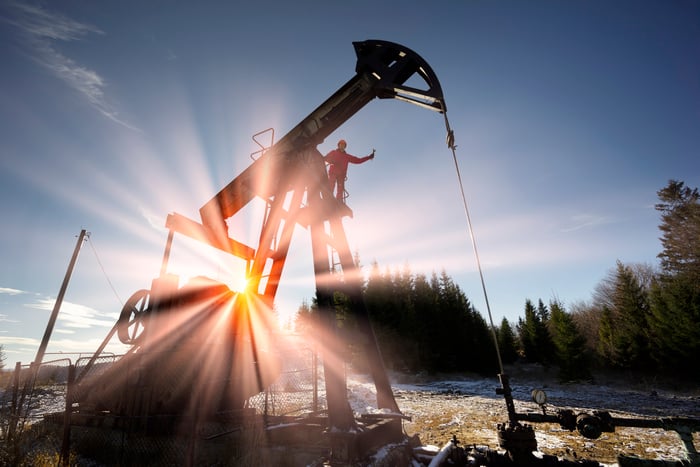
Image source: Getty Images.
Drilling down into the deal
Devon Energy is acquiring Coterra Energy in an all-stock deal that will see it exchange 0.7 of its shares for each Coterra share. Existing Devon shareholders will own roughly 54% of the combined company upon closing, which should occur during the second quarter.
The transaction will create a premier large-scale U.S. shale operator. The combined company will have a production base of over 1.6 million barrels of oil equivalent per day (BOE/d), second only among U.S. independent E&P companies behind ConocoPhillips at over 2.2 million BOE/d. The much larger Devon Energy will have one of the industry's top positions in the world-class Delaware Basin, which will contribute more than half of its production and free cash flow. It will have a more than 10-year inventory of top-tier drilling locations, with a sector-leading amount of sub-$40 inventory. Additionally, it will have operations in the Anadarko, Eagle Ford, Marcellus, and Rockies regions.
The scale advantages
Devon Energy expects its larger scale following the merger will enable it to achieve $1 billion in annual pre-tax synergies by the end of 2027. It anticipates delivering these synergies by optimizing its capital program, improving operating margins, and streamlining corporate costs. The company also expects to leverage its combined AI capabilities to become a technology-focused leader in the U.S. oil sector by using AI to optimize operations, capital efficiency, and decision-making at scale.
Larger rival ConocoPhillips has been a big beneficiary of merger synergies following its $22.5 billion all-stock acquisition of Marathon Oil in 2024. The company initially expected to achieve $500 million of merger synergies within the first year of closing that transaction. It boosted the total to over $1 billion by the time it closed the deal and now expects to capture an additional $1 billion in cost and margin enhancements from that acquisition by the end of this year.
The cost savings will enable Devon Energy to generate higher free cash flows, allowing it to return more money to shareholders. The company plans to pay a quarterly dividend of $0.315 per share ($1.26 annualized) after closing the transaction, a more than 31% increase from its current level of $0.24 per share ($0.96 annualized). That will boost the oil dividend stock's yield to more than 3%, rivaling ConocoPhillips. Additionally, Devon Energy plans to approve a new share repurchase program of more than $5 billion.
Creating a new leader in the oil patch
Devon Energy's merger with Coterra Energy will create the second-largest independent E&P company in the U.S. after ConocoPhillips. That increased scale should enable the combined company to save over $1 billion annually, allowing it to return more cash to investors. That positions it to create meaningful value for shareholders, making it a compelling oil stock investment to consider.
Should you buy stock in Devon Energy right now?
Before you buy stock in Devon Energy, consider this:
The Motley Fool Stock Advisor analyst team just identified what they believe are the 10 best stocks for investors to buy now… and Devon Energy wasn’t one of them. The 10 stocks that made the cut could produce monster returns in the coming years.
Consider when Netflix made this list on December 17, 2004... if you invested $1,000 at the time of our recommendation, you’d have $450,256!* Or when Nvidia made this list on April 15, 2005... if you invested $1,000 at the time of our recommendation, you’d have $1,171,666!*
Now, it’s worth noting Stock Advisor’s total average return is 942% — a market-crushing outperformance compared to 196% for the S&P 500. Don't miss the latest top 10 list, available with Stock Advisor, and join an investing community built by individual investors for individual investors.
*Stock Advisor returns as of February 2, 2026.
Matt DiLallo has positions in ConocoPhillips. The Motley Fool recommends ConocoPhillips. The Motley Fool has a disclosure policy.
Mentioned In This Article
Latest News
| Oct-08 | |
| Oct-08 | |
| Oct-08 | |
| Oct-08 | |
| Oct-08 | |
| Oct-08 | |
| Oct-08 | |
| Oct-07 | |
| Oct-07 | |
| Oct-06 | |
| Oct-05 | |
| Oct-05 | |
| Oct-04 |
These Energy Companies Put Oklahoma City on the Map. Now They're Moving to Texas.
DVN
The Wall Street Journal
|
| Oct-02 | |
| Oct-01 |
