Why AppLovin Stock Lost 30% in January
Key Points
The adtech company faced another short-seller attack.
Investors panicked over a new AI game-creation platform from Google.
The stock is still expensive based on its price-to-sales ratio.
Shares of AppLovin (NASDAQ: APP), the volatile, mobile game-focused adtech stock, were moving lower last month as the company faced another short-seller attack, software valuations came under scrutiny due to threats from AI, and Google unleashed a new platform for AI game creation, which was seen as a threat to gaming stocks.
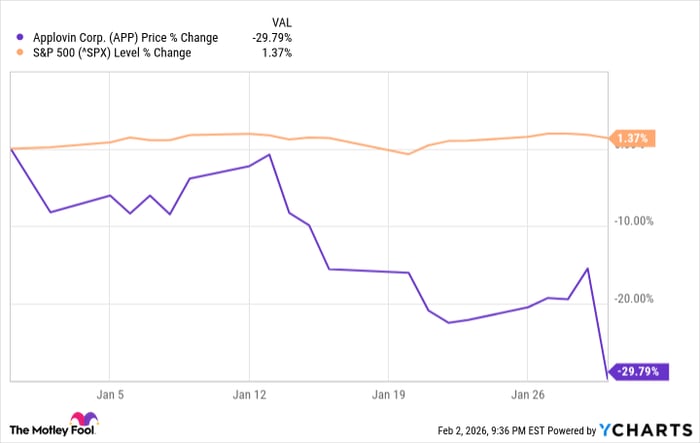
As a result, AppLovin stock fell sharply last month, closing January down 30%, according to data from S&P Global Market Intelligence. As the chart below shows, the stock traded lower throughout most of the month, but fell especially hard on the last day of January following the launch of Google's new Project Genie.
Where to invest $1,000 right now? Our analyst team just revealed what they believe are the 10 best stocks to buy right now, when you join Stock Advisor. See the stocks »
What happened with AppLovin
AppLovin entered 2026 after a blowout year, with the stock doubling in 2025 on the back of strong growth. However, that's led to doubts about its valuation, especially as software stocks endured a brutal sell-off last month, which seemed partly based on fears of AI and partly based on valuation. Even after last month's decline, AppLovin is trading at a price-to-sales ratio of 31.
While most of the analyst coverage on the stock was positive, that wasn't enough to push AppLovin higher, especially as reports of an SEC investigation into its data collection practices are hanging over its head.
Those fears increased when the stock got hit with another short-seller attack on Jan. 20 after CapitalWatch said that the company had skirted anti-money-laundering controls, among other improprieties. However, AppLovin has faced similar short-seller allegations in the past, and none of them seem to have stuck. It pushed back on the claims, calling them "false, misleading, and nonsensical."
Finally, the stock plunged 17% on Jan. 30 in response to Google's launch of Project Genie, an AI game-creation platform that some feared could disrupt the gaming industry. AppLovin was one of several gaming stocks that fell on the news.

Image source: Getty Images.
What's next for AppLovin
The sell-off in AppLovin stock last Friday seems misdirected, as the company is no longer in the business of mobile games after selling off its apps business last year.
Instead, it monetizes mobile games through adtech, which means that more games overall could be a tailwind for the company. It's too early to judge the impact of Project Genie, and the market seems to be jumping to conclusions too fast here.
AppLovin will report fourth-quarter earnings next week on Feb. 11, which will be a major test for the growth stock. Analysts are expecting revenue to grow 17% to $1.61 billion, which includes a headwind from the sale of the apps business, and they see adjusted earnings per share jumping from $1.73 to $2.95.
The bottom-line results will be key for AppLovin as it can justify its high valuation with strong profit growth.
Should you buy stock in AppLovin right now?
Before you buy stock in AppLovin, consider this:
The Motley Fool Stock Advisor analyst team just identified what they believe are the 10 best stocks for investors to buy now… and AppLovin wasn’t one of them. The 10 stocks that made the cut could produce monster returns in the coming years.
Consider when Netflix made this list on December 17, 2004... if you invested $1,000 at the time of our recommendation, you’d have $450,256!* Or when Nvidia made this list on April 15, 2005... if you invested $1,000 at the time of our recommendation, you’d have $1,171,666!*
Now, it’s worth noting Stock Advisor’s total average return is 942% — a market-crushing outperformance compared to 196% for the S&P 500. Don't miss the latest top 10 list, available with Stock Advisor, and join an investing community built by individual investors for individual investors.
*Stock Advisor returns as of February 2, 2026.
Jeremy Bowman has positions in AppLovin. The Motley Fool has no position in any of the stocks mentioned. The Motley Fool has a disclosure policy.
Mentioned In This Article
Latest News
| Oct-09 | |
| Oct-08 | |
| Oct-07 | |
| Oct-07 | |
| Oct-05 | |
| Oct-05 | |
| Oct-04 | |
| Oct-03 | |
| Oct-02 | |
| Oct-02 | |
| Oct-02 | |
| Oct-01 | |
| Sep-30 | |
| Sep-30 | |
| Sep-27 |
