Where Will Tesla Be in 1 Year?
Key Points
Tesla's latest update focuses the company on robotaxis and Optimus.
The company sees the transportation market inexorably marching toward robotaxis and autonomous driving.
Tesla's $20 billion capital spending plan will revolutionize the business in 2026.
Where will Tesla (NASDAQ: TSLA) be a year from now? That's a $20 billion question, as management expects to spend more than that on capital investment in 2026 in its attempt to position the company for long-term growth. That figure also signals a fundamental shift in how investors should think about the stock.
Tesla's big bet on an AI future
To put the capital spending into context, here's a look at Tesla's capital expenditures over the past decade. The ramp up to $20 billion marks a massive shift in spending and will result in significant cash burn, as Tesla's operating cash generation is highly unlikely to cover its capital spending in 2026.
Where to invest $1,000 right now? Our analyst team just revealed what they believe are the 10 best stocks to buy right now. Continue »

TSLA Capital Expenditures (TTM) data by YCharts
How the spending will change the business and Tesla's investment proposition
Discussing the planned investments on the earnings call, CFO Vaibhav Taneja said it will pay for projects at six factories:
- To support its lithium refinery in Corpus Christi, Texas.
- To support its lithium iron phosphate battery factory in Nevada, which will reduce reliance on nickel and cobalt and produce batteries suitable for the Cybercab and standard Tesla models.
- To produce its dedicated robotaxi, Cybercab, at Giga Texas in Austin.
- To support production of the Tesla Semi truck in a factory in Nevada.
- To build a new megafactory to produce energy storage units.
- To invest in Optimus robots at Fremont, California, as Tesla repurposes Model S and Model X production lines toward manufacturing Optimus robots.
In addition, Taneja said Tesla will continue investing in AI, its existing factories, and robotaxi fleet expansion.
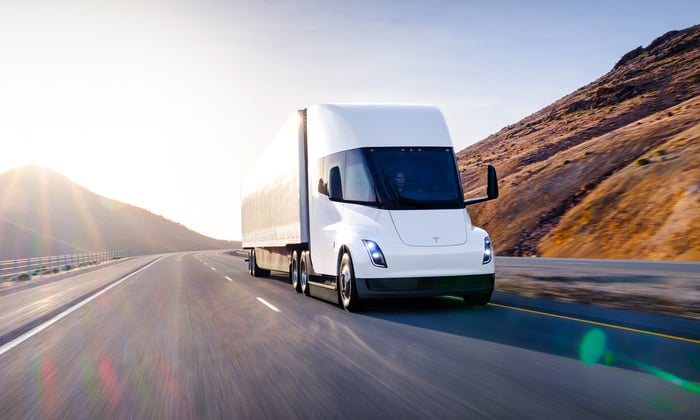
Image source: Tesla.
The key takeaway from Tesla's plans
There's little doubt what the key conclusion is here. Tesla is going all in on artificial intelligence (AI), and there's no turning back now, whether it's in the form of AI-powered robotaxis or AI-operated Optimus. If you think of Tesla as an electric vehicle (EV) company, this isn't an investment for you. Similarly, if you aren't comfortable with the idea that Cybercabs and Optimus are the reasons to invest in the company, then Tesla isn't a stock worth looking at. To buy Tesla stock, you have to believe in CEO Elon Musk's vision.
Musk couldn't have been clearer when asked about the company's EV strategy on the recent earnings call. Musk noted that "we would expect over time to make far more Cybercabs than all of our other vehicles combined."
Vice President of vehicle engineering Lars Moravy went on to argue, "You have to start thinking about us as moving to providing transportation as a service more than the total addressable market for the purchased vehicles alone." Musk then noted that "probably less than 5% of miles driven will be where somebody is actually driving the car themselves in the future, maybe as low as 1%."
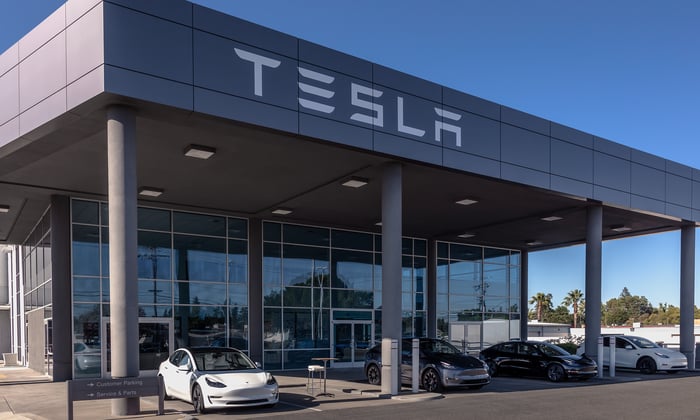
Image source: Tesla.
Tesla sees things differently
Embedded in all these statements and spending commitments is Tesla's fundamentally different vision of where the EV market, a market Tesla dominates, is heading, compared with that of automakers such as Ford.
As previously discussed, while a private internal combustion engine (ICE) car is cheaper to run, on a cost-per-mile basis, than hiring an ICE taxi, a robotaxi EV will, according to Tesla, be more affordable to run than a private EV.
As such, Musk envisions that robotaxis and autonomous driving in general will be the key to transportation.
Tesla in one year
It's a risky all-in bet, not least because Tesla doesn't yet have regulatory approval for widespread robotaxi services. Still, management plans to mass-produce Cybercabs in 2026.
An optimistic scenario sees a rolling series of regulatory approvals for robotaxis, a return to EV sales growth, growing energy storage sales, Cybercabs in mass production, and a mammoth multiyear expansion in ride-sharing revenue growth. Alternatively, Tesla's huge investment may turn out to be premature, as approval growth is sluggish while it's burning through cash.
This is not a stock for widows and orphans, but it might suit investors willing to go all in on Musk's vision of an AI-led future for transportation.
Don’t miss this second chance at a potentially lucrative opportunity
Ever feel like you missed the boat in buying the most successful stocks? Then you’ll want to hear this.
On rare occasions, our expert team of analysts issues a “Double Down” stock recommendation for companies that they think are about to pop. If you’re worried you’ve already missed your chance to invest, now is the best time to buy before it’s too late. And the numbers speak for themselves:
- Nvidia: if you invested $1,000 when we doubled down in 2009, you’d have $495,739!*
- Apple: if you invested $1,000 when we doubled down in 2008, you’d have $49,363!*
- Netflix: if you invested $1,000 when we doubled down in 2004, you’d have $450,256!*
Right now, we’re issuing “Double Down” alerts for three incredible companies, available when you join Stock Advisor, and there may not be another chance like this anytime soon.
*Stock Advisor returns as of February 3, 2026.
Lee Samaha has no position in any of the stocks mentioned. The Motley Fool has positions in and recommends Tesla. The Motley Fool has a disclosure policy.
Mentioned In This Article
Latest News
| 16 hours | |
| 17 hours | |
| Oct-09 | |
| Oct-09 | |
| Oct-09 | |
| Oct-09 | |
| Oct-09 |
Tesla's China Retail Sales Fall 9% Even as Shanghai Exports Surge 58%
TSLA
Benzinga Prediction Markets
|
| Oct-09 | |
| Oct-09 | |
| Oct-09 | |
| Oct-09 | |
| Oct-09 | |
| Oct-09 | |
| Oct-09 | |
| Oct-09 |
