Will Reblozyl Shine in Bristol Myers' Fourth-Quarter Results?
Bristol Myers’ BMY is banking on its growth portfolio, which comprises Opdivo, Orencia, Yervoy, Reblozyl, Opdualag, Abecma, Zeposia, Breyanzi, Camzyos, Sotyku, Krazati and others, to drive top-line growth in the upcoming quarterly results.
Among these, Reblozyl, the thalassemia drug that BMY co-developed with Merck, continues to be a major growth driver, with annualized sales now exceeding $2 billion.
Reblozyl is indicated for the treatment of anemia in adult patients with transfusion-dependent and non-transfusion-dependent beta thalassemia who require regular red blood cell (RBC) transfusions. It is also approved for the treatment of adult patients with very low- to intermediate-risk myelodysplastic syndromes (MDS) who have ring sideroblasts (RS) and require RBC transfusions, as well as for adult patients with very low- to intermediate-risk MDS who are ESA-naïve and may require regular RBC transfusions, regardless of RS status.
Sales in the United States are being driven by strong demand in first-line RS-positive and RS-negative myelodysplastic syndromes-associated anemia. International sales growth is being driven by strong launches in new markets.
The drug generated sales of $1.66 billion in the first nine months of 2025, up 35% year over year.
The Zacks Consensus Estimate and our model estimate for fourth-quarter Reblozyl sales are pegged at $636 million and $641 million, respectively.
While BMY’s IO portfolio and other drugs like Reblozyl, Camzyos and Breyanzi have enabled it to stabilize its revenue base, the legacy portfolio continues to face pressure from ongoing generic competition, particularly impacting Revlimid, Pomalyst, Sprycel and Abraxane. The erosion in sales from these mature brands has weighed on overall revenue performance.
The company is scheduled to report fourth-quarter and full-year 2025 results on Feb. 5, 2026, before market open.
Competition for BMY’s Reblozyl
Keros Therapeutics KROS, a clinical-stage biopharmaceutical company, is evaluating elritercept, in partnership with Takeda, in adults with transfusion-dependent anemia with very low, low, or intermediate risk MDS.
A phase III study, RENEW, is evaluating elritercept for the treatment of anemia and thrombocytopenia in patients with very low-, low-, or intermediate-risk MDS.
In July 2025, KROS announced that the first patient had been dosed in the RENEW study. This triggered a $10 million milestone payment to Keros under its global licensing agreement with Takeda.
Reblozyl also competes with established ESAs like Procrit (epoetin alfa), though it works through different mechanisms.
Johnson & Johnson’s JNJ Procrit is a prescription medicine used to treat anemia. JNJ’s Procrit works like the human protein called erythropoietin to help the body make more RBCs.
BMY’s Price Performance, Valuation & Estimates
Shares of Bristol Myers have gained 23.1% over the past six months compared with the industry’s growth of 18.8%.
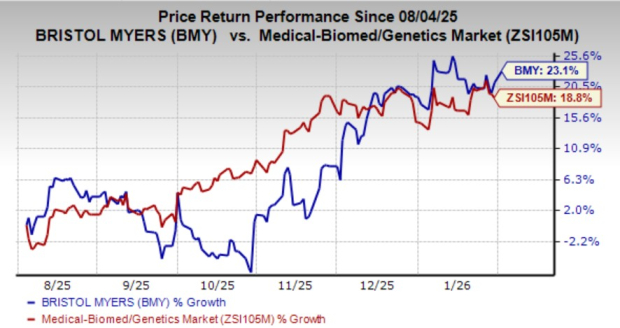
Image Source: Zacks Investment Research
From a valuation standpoint, BMY is trading at a discount to the large-cap pharma industry. Going by the price/earnings ratio, shares currently trade at 9.23x forward earnings, higher than its mean of 8.41x but lower than the large-cap pharma industry’s 18.42x.
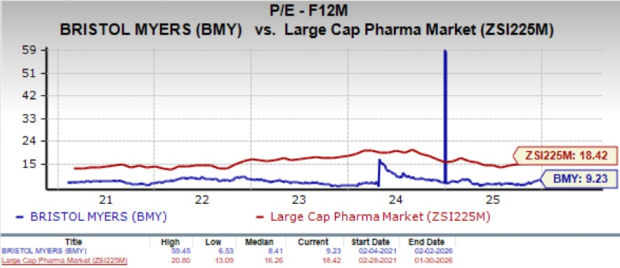
Image Source: Zacks Investment Research
The Zacks Consensus Estimate for 2025 EPS has moved south to $6.09 from $6.53 in the past 60 days, while that for 2026 has moved north.
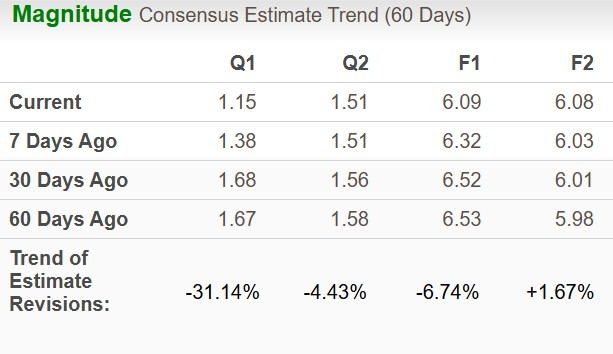
Image Source: Zacks Investment Research
BMY currently carries a Zacks Rank #3 (Hold). You can see the complete list of today’s Zacks #1 Rank (Strong Buy) stocks here.
Want the latest recommendations from Zacks Investment Research? Today, you can download 7 Best Stocks for the Next 30 Days. Click to get this free report
Bristol Myers Squibb Company (BMY): Free Stock Analysis Report
Johnson & Johnson (JNJ): Free Stock Analysis Report
Keros Therapeutics, Inc. (KROS): Free Stock Analysis Report
This article originally published on Zacks Investment Research (zacks.com).
Mentioned In This Article
Latest News
| 8 min | |
| Oct-08 | |
| Oct-08 | |
| Oct-08 | |
| Oct-08 | |
| Oct-08 | |
| Oct-08 | |
| Oct-08 | |
| Oct-07 | |
| Oct-07 | |
| Oct-07 | |
| Oct-07 | |
| Oct-06 | |
| Oct-06 | |
| Oct-05 |
