|
|
|

|
|||||
|
|
|

Investment management firm T. Rowe Price (NASDAQ:TROW) missed Wall Street’s revenue expectations in Q4 CY2025 as sales rose 5% year on year to $1.93 billion. Its non-GAAP profit of $2.44 per share was 1% below analysts’ consensus estimates.
Is now the time to buy T. Rowe Price? Find out by accessing our full research report, it’s free.
Founded in 1937 by Thomas Rowe Price Jr., who pioneered the growth stock investing approach, T. Rowe Price (NASDAQ:TROW) is an investment management firm that offers mutual funds, advisory services, and retirement planning solutions to individuals and institutions.
A company’s long-term sales performance can indicate its overall quality. Any business can have short-term success, but a top-tier one grows for years. Over the last five years, T. Rowe Price grew its revenue at a sluggish 3.5% compounded annual growth rate. This fell short of our benchmark for the financials sector and is a poor baseline for our analysis.
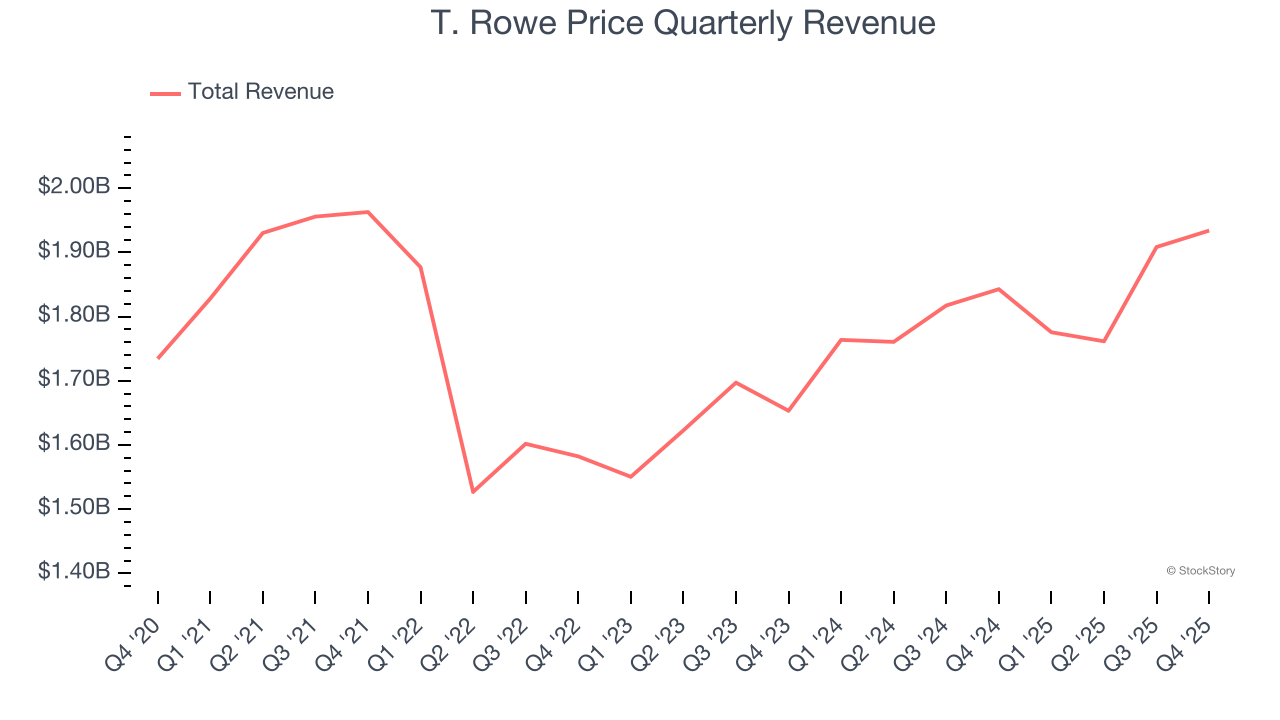
We at StockStory place the most emphasis on long-term growth, but within financials, a half-decade historical view may miss recent interest rate changes, market returns, and industry trends. T. Rowe Price’s annualized revenue growth of 6.4% over the last two years is above its five-year trend, but we were still disappointed by the results.
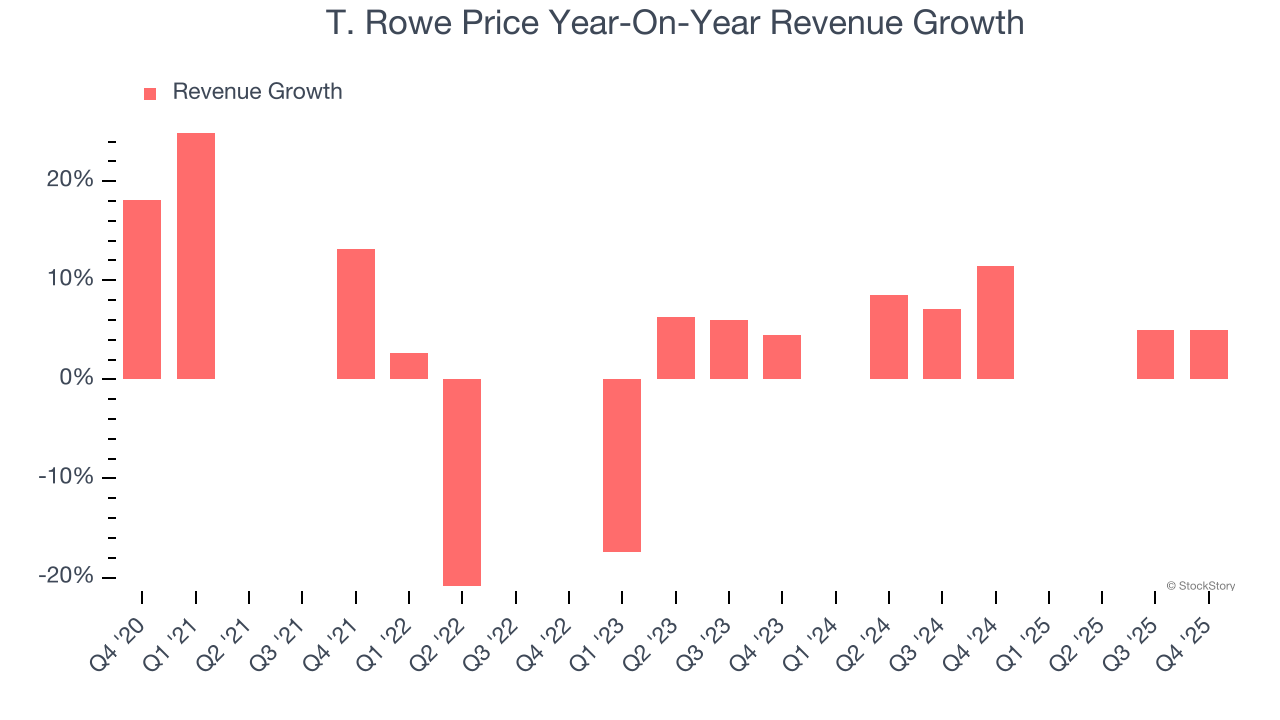
This quarter, T. Rowe Price’s revenue grew by 5% year on year to $1.93 billion, falling short of Wall Street’s estimates.
Microsoft, Alphabet, Coca-Cola, Monster Beverage—all began as under-the-radar growth stories riding a massive trend. We’ve identified the next one: a profitable AI semiconductor play Wall Street is still overlooking. Go here for access to our full report.
Assets Under Management (AUM) is the cornerstone of a financial firm's investment division, representing all client capital under its stewardship. Management fees on this AUM create reliable, recurring revenue that maintains stability even when investment performance struggles, though prolonged poor returns can eventually affect asset retention and growth.
T. Rowe Price’s AUM has grown at an annual rate of 6.3% over the last five years, slightly worse than the broader financials industry but faster than its total revenue. When analyzing T. Rowe Price’s AUM over the last two years, we can see that growth accelerated to 11% annually. Fundraising or short-term investment performance were net contributors for the company over this shorter period since assets grew faster than total revenue. That said, assets aren't the be-all and end-all due to their unpredictable and cyclical nature.
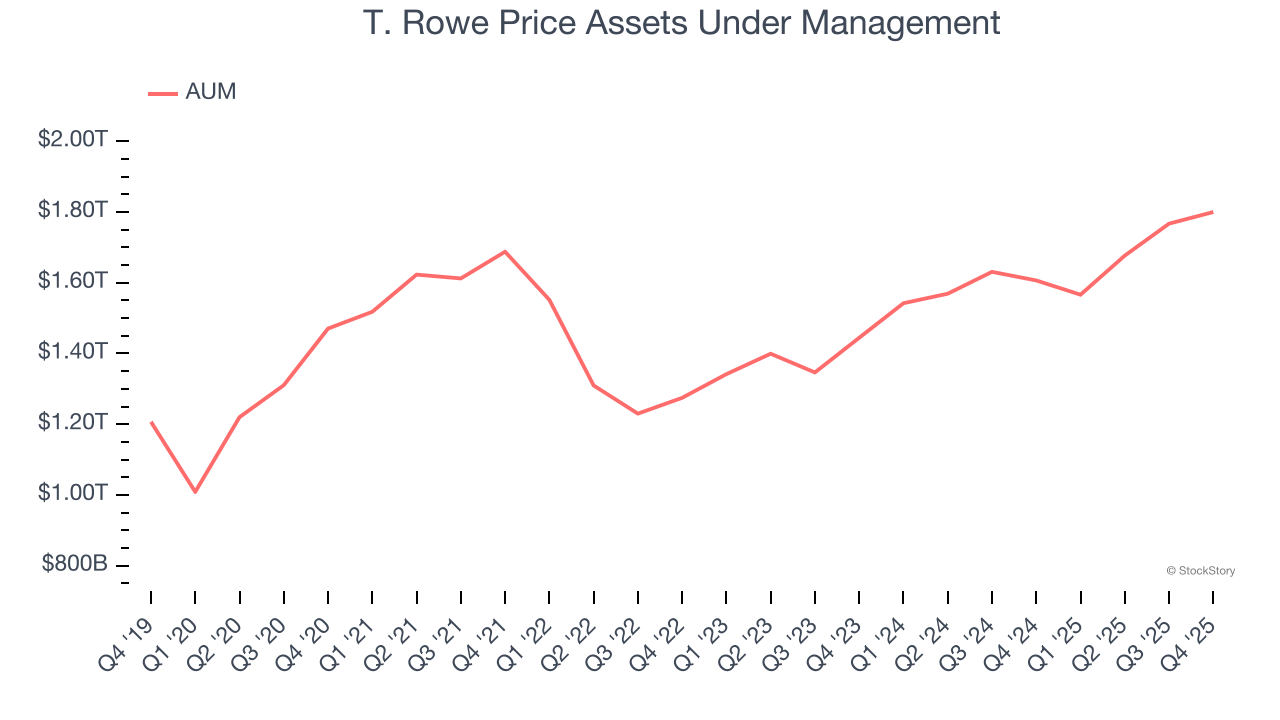
In Q4, T. Rowe Price’s AUM was $1.8 trillion, beating analysts’ expectations by 0.7%. This print was 12% higher than the same quarter last year.
Financial institutions earn fee-based income through various services including M&A advisory work, capital raising activities, and comprehensive client relationship management.
Over the past five years, T. Rowe Price’s fees grew by a poor 3% per year and lagged its 6.3% annual growth in AUM. A two-year view reveals a more encouraging story as growth picked up to 7.4% annualized.
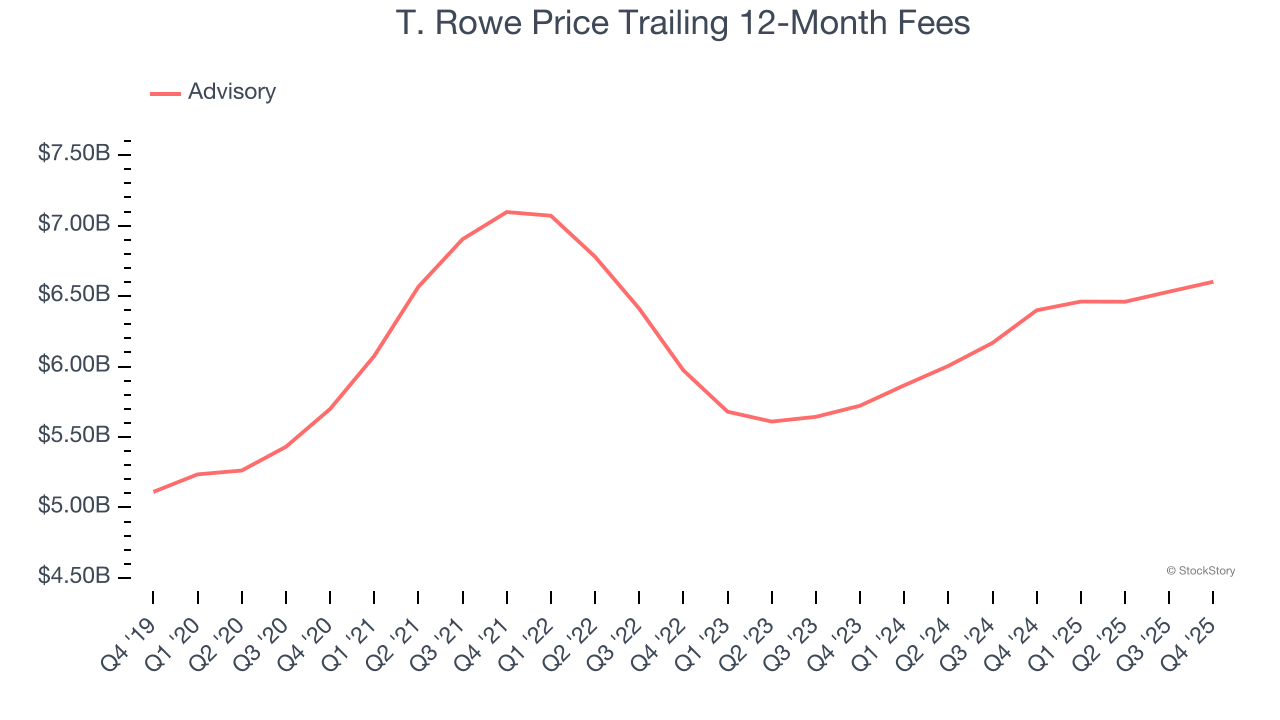
T. Rowe Price’s fees punched in at $1.74 billion in Q4, in line with Consensus estimates. Wall Street opinions aside, fees grew by 4.2% year on year.
It was good to see T. Rowe Price narrowly top analysts’ AUM expectations this quarter. On the other hand, its advisory and servicing fees was in line and its revenue fell slightly short of Wall Street’s estimates. Overall, this quarter could have been better. The stock traded down 1.4% to $101.27 immediately after reporting.
The latest quarter from T. Rowe Price’s wasn’t that good. One earnings report doesn’t define a company’s quality, though, so let’s explore whether the stock is a buy at the current price. The latest quarter does matter, but not nearly as much as longer-term fundamentals and valuation, when deciding if the stock is a buy. We cover that in our actionable full research report which you can read here (it’s free).
| 12 hours | |
| Jun-10 | |
| Jun-10 | |
| Jun-08 | |
| Jun-04 | |
| Jun-04 | |
| May-28 | |
| May-20 | |
| May-18 | |
| May-13 | |
| May-12 | |
| May-07 | |
| May-07 | |
| May-05 | |
| Apr-30 |

Join thousands of traders who make more informed decisions with our premium features. Real-time quotes, advanced visualizations, alerts, and much more.
Learn more about Finviz Elite