Reeling From Software Stock Losses? Alphabet Investors Have Some Advice For You
Key Points
Software stocks are plunging over a fear of disruption from AI.
Something similar happened to Alphabet stock when ChatGPT first came out.
Alphabet stock has tripled since then.
Cloud software stocks have been big winners on the market historically, but lately, one of the surest bets in investing over the last decade has gone belly up.
The iShares Expanded Tech-Software Sector ETF (NYSEMKT: IGV), which tracks top software stocks like Microsoft, Palantir, and Salesforce, is down 22% year-to-date, and the culprit is clear. Investors are panicked that new AI tools from companies like OpenAI and Anthropic could disrupt entrenched software-as-a-service (SaaS) models. That theory is leading to valuations in the historically expensive industry being dramatically compressed, even though there's no sign yet that AI is putting a significant dent in any major software businesses.
Where to invest $1,000 right now? Our analyst team just revealed what they believe are the 10 best stocks to buy right now. Continue »
This response from the market isn't unprecedented. The first software sell-off in response to AI fears came shortly after the launch of OpenAI's ChatGPT.

Image source: Getty Images.
Alphabet's "code red"
When ChatGPT was launched on Nov. 30, 2022, investors immediately understood that it was a disruptive innovation -- the era of AI was here.
Alphabet (NASDAQ: GOOG) (NASDAQ: GOOGL) and its investors also recognized the launch as the biggest challenge yet to Google Search.
Scrambling to come up with a response to ChatGPT, Alphabet announced a "code red," and by February 2023, it introduced Bard, its own chatbot similar to ChatGPT. However, in its initial presentation, Bard gave some incorrect answers, and Alphabet stock plunged as a result, falling 8% in a single session.
At the time, Alphabet looked weaker and more vulnerable than it had in a long time. A start-up that was little-known to most investors had kicked off the next technological revolution with the help of Microsoft, and the Google-parent had been left watching from the sidelines.
It might have seemed risky to double down on Alphabet stock at that point, but that would have been the right move, and you only need to look at the stock chart over the last three years below to see why.
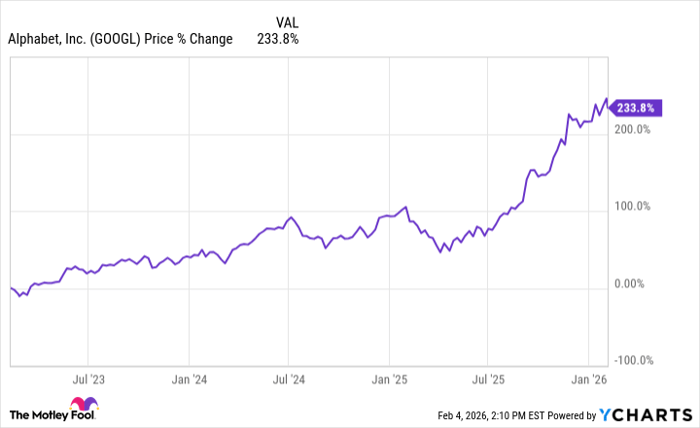
Alphabet regrouped after that misstep. It combined Google Brain and DeepMind, its two AI labs, and eventually launched Gemini, its latest LLM, which many observers consider to be better than ChatGPT's latest model.
Other factors played into the stock's recent surge, but that was certainly a major reason for the breakout. Additionally, Google Search has remained resilient and continued to deliver steady growth even as AI chat platforms have grown.
What it means for software investors today
There aren't any perfect analogs in investing, but it's worth taking away a couple of lessons here.
First, buying the dip, especially when a stock sells off for no fundamental reason, often pays off. Google's plunge was driven more by sentiment rather than a meaningful change in fundamentals.
Second, threats from new technologies are often exaggerated or unfounded. It takes time for industries to be disrupted and for people to change their habits.
That doesn't mean that every software stock will be a winner from here, but a sectorwide sell-off of more than 20% on pure AI fears seems excessive. Buying the dip on some of these stocks is likely to pay off down the road.
Should you buy stock in Alphabet right now?
Before you buy stock in Alphabet, consider this:
The Motley Fool Stock Advisor analyst team just identified what they believe are the 10 best stocks for investors to buy now… and Alphabet wasn’t one of them. The 10 stocks that made the cut could produce monster returns in the coming years.
Consider when Netflix made this list on December 17, 2004... if you invested $1,000 at the time of our recommendation, you’d have $431,111!* Or when Nvidia made this list on April 15, 2005... if you invested $1,000 at the time of our recommendation, you’d have $1,105,521!*
Now, it’s worth noting Stock Advisor’s total average return is 906% — a market-crushing outperformance compared to 195% for the S&P 500. Don't miss the latest top 10 list, available with Stock Advisor, and join an investing community built by individual investors for individual investors.
*Stock Advisor returns as of February 4, 2026.
Jeremy Bowman has no position in any of the stocks mentioned. The Motley Fool has positions in and recommends Alphabet, Microsoft, Palantir Technologies, and Salesforce. The Motley Fool has a disclosure policy.
Mentioned In This Article
Latest News
| 16 min |
Nvidia Is 'Too Big to Fail,' Semafor Editor Warns: 'The Government Would Step In'
GOOG
Benzinga Prediction Markets
|
| 56 min | |
| 57 min | |
| 1 hour | |
| 1 hour | |
| 1 hour | |
| 4 hours | |
| 5 hours | |
| 9 hours | |
| Oct-12 | |
| Oct-12 | |
| Oct-12 | |
| Oct-12 | |
| Oct-12 | |
| Oct-12 |
