Peloton (NASDAQ:PTON) Reports Sales Below Analyst Estimates In Q4 CY2025 Earnings, Stock Drops

Exercise equipment company Peloton (NASDAQ:PTON) fell short of the market’s revenue expectations in Q4 CY2025, with sales falling 2.6% year on year to $656.5 million. Next quarter’s revenue guidance of $615 million underwhelmed, coming in 3.5% below analysts’ estimates. Its GAAP loss of $0.09 per share was 53.8% below analysts’ consensus estimates.
Is now the time to buy Peloton? Find out by accessing our full research report, it’s free.
Peloton (PTON) Q4 CY2025 Highlights:
- Revenue: $656.5 million vs analyst estimates of $677.2 million (2.6% year-on-year decline, 3.1% miss)
- EPS (GAAP): -$0.09 vs analyst expectations of -$0.06 (53.8% miss)
- Adjusted EBITDA: $81.4 million vs analyst estimates of $72.61 million (12.4% margin, 12.1% beat)
- The company dropped its revenue guidance for the full year to $2.42 billion at the midpoint from $2.45 billion, a 1.2% decrease
- EBITDA guidance for the full year is $475 million at the midpoint, above analyst estimates of $462 million
- Operating Margin: -2.2%, up from -6.8% in the same quarter last year
- Free Cash Flow Margin: 10.8%, down from 15.7% in the same quarter last year
- Connected Fitness Subscribers: 2.88 million, in line with the same quarter last year
- Market Capitalization: $2.47 billion
“Our second quarter represented the most substantial period of innovation at Peloton since our founding. At the same time, our financial performance demonstrated our continued operational discipline, resulting in 39% year-over-year growth in Adjusted EBITDA and reducing Net Debt by 52% year-over-year, proving we can simultaneously innovate and increase our profitability,” said CEO Peter Stern.
Company Overview
Started as a Kickstarter campaign, Peloton (NASDAQ: PTON) is a fitness technology company known for its at-home exercise equipment and interactive online workout classes.
Revenue Growth
A company’s long-term sales performance is one signal of its overall quality. Any business can have short-term success, but a top-tier one grows for years. Peloton struggled to consistently generate demand over the last five years as its sales dropped at a 3.8% annual rate. This was below our standards and suggests it’s a low quality business.
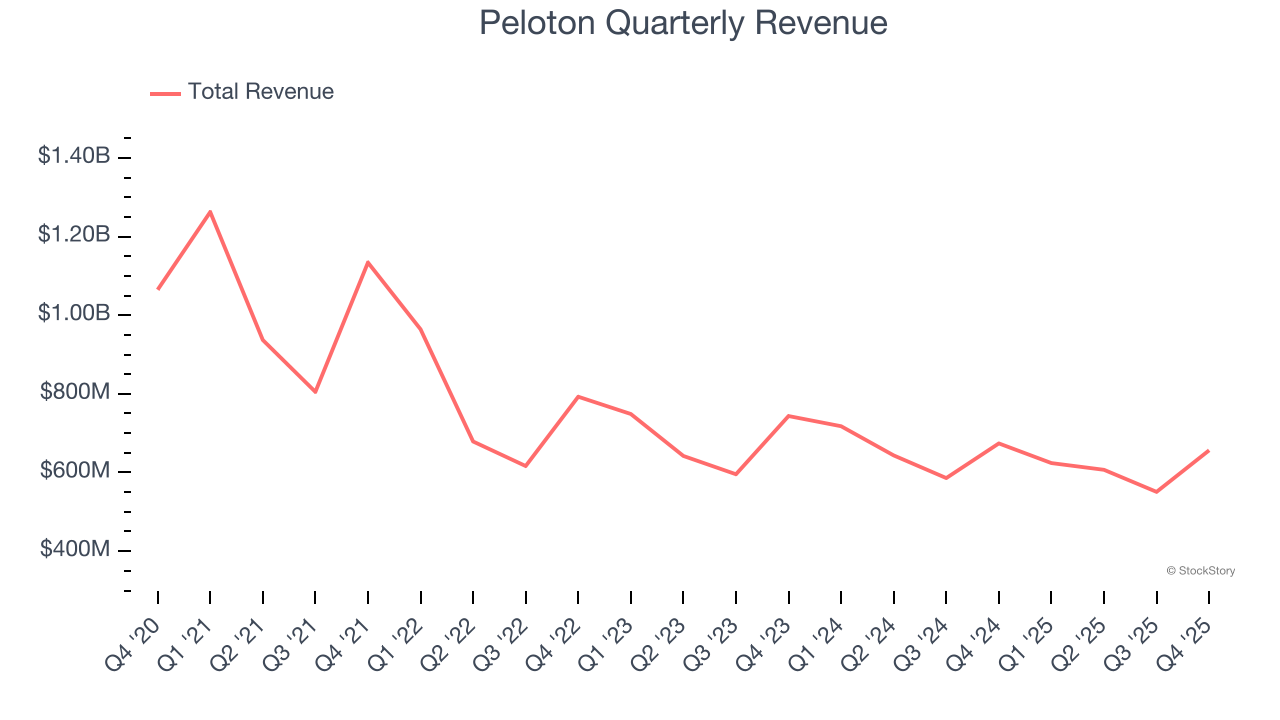
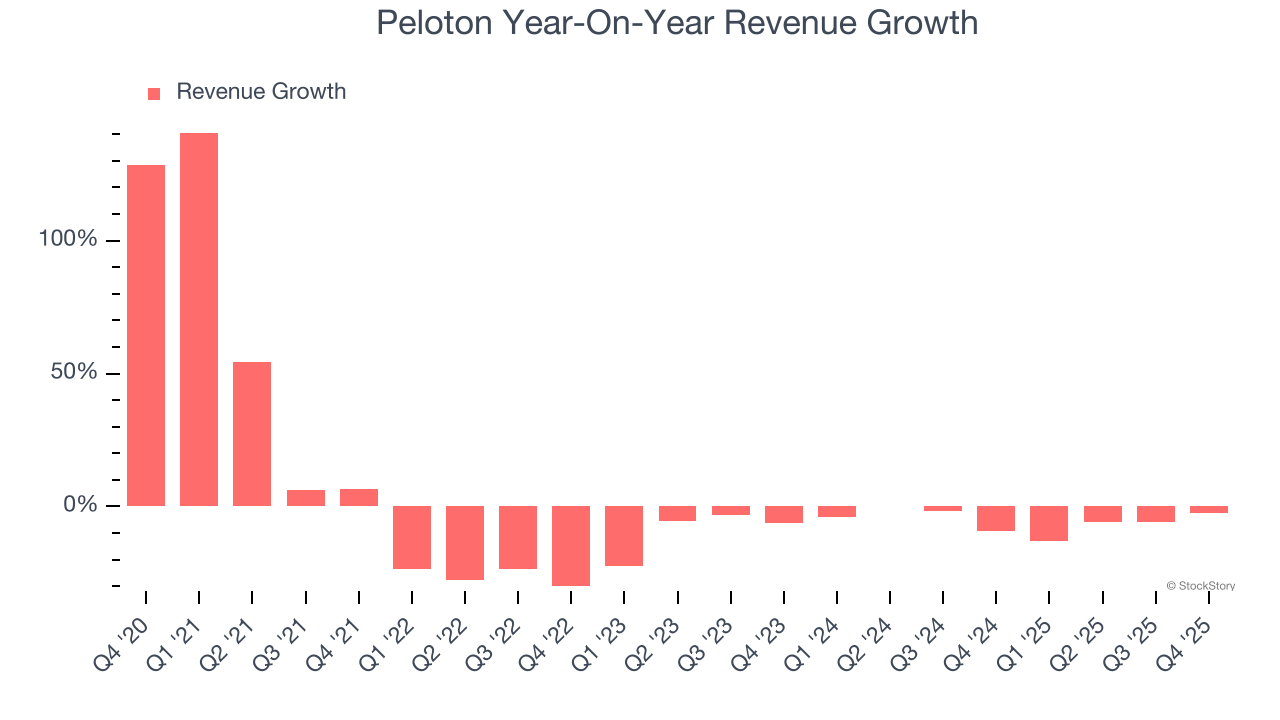
We at StockStory place the most emphasis on long-term growth, but within consumer discretionary, a stretched historical view may miss a company riding a successful new product or trend. Peloton’s recent performance shows its demand remained suppressed as its revenue has declined by 5.5% annually over the last two years.
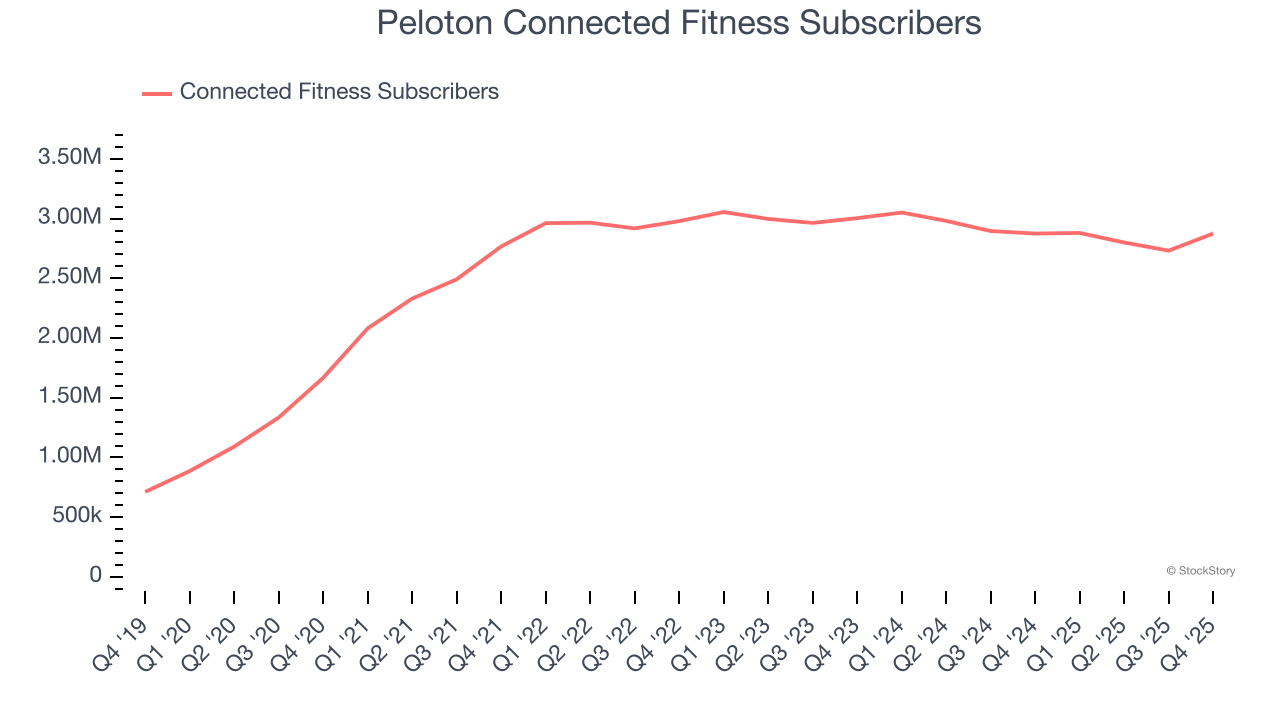
We can better understand the company’s revenue dynamics by analyzing its number of connected fitness subscribers, which reached 2.88 million in the latest quarter. Over the last two years, Peloton’s connected fitness subscribers averaged 3.1% year-on-year declines. Because this number is higher than its revenue growth during the same period, we can see the company’s monetization has fallen.
This quarter, Peloton missed Wall Street’s estimates and reported a rather uninspiring 2.6% year-on-year revenue decline, generating $656.5 million of revenue. Company management is currently guiding for a 1.4% year-on-year decline in sales next quarter.
Looking further ahead, sell-side analysts expect revenue to grow 2.7% over the next 12 months. Although this projection indicates its newer products and services will fuel better top-line performance, it is still below average for the sector.
Microsoft, Alphabet, Coca-Cola, Monster Beverage—all began as under-the-radar growth stories riding a massive trend. We’ve identified the next one: a profitable AI semiconductor play Wall Street is still overlooking. Go here for access to our full report.
Operating Margin
Operating margin is a key measure of profitability. Think of it as net income - the bottom line - excluding the impact of taxes and interest on debt, which are less connected to business fundamentals.
Peloton’s operating margin has been trending up over the last 12 months, but it still averaged negative 4.3% over the last two years. This is due to its large expense base and inefficient cost structure.

Peloton’s operating margin was negative 2.2% this quarter. The company's consistent lack of profits raise a flag.
Earnings Per Share
Revenue trends explain a company’s historical growth, but the long-term change in earnings per share (EPS) points to the profitability of that growth – for example, a company could inflate its sales through excessive spending on advertising and promotions.
Sadly for Peloton, its EPS declined by 18.2% annually over the last five years, more than its revenue. This tells us the company struggled because its fixed cost base made it difficult to adjust to shrinking demand.
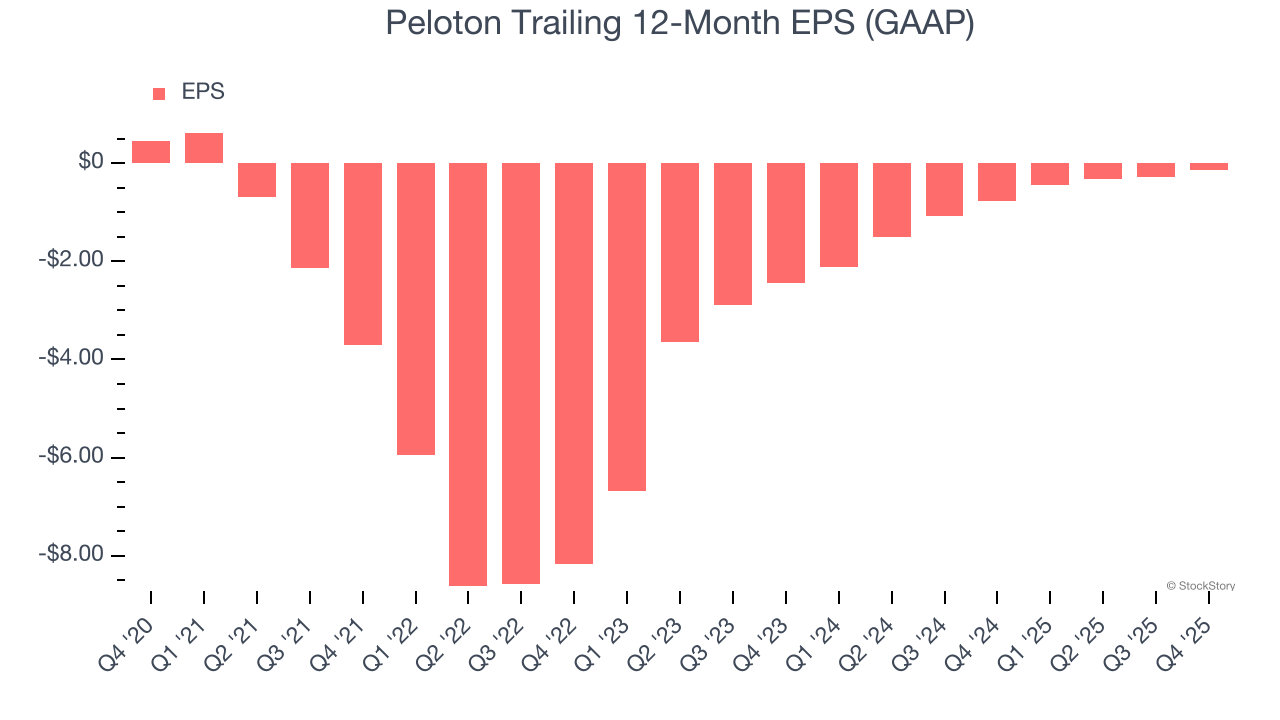
In Q4, Peloton reported EPS of negative $0.09, up from negative $0.24 in the same quarter last year. Despite growing year on year, this print missed analysts’ estimates. Over the next 12 months, Wall Street is optimistic. Analysts forecast Peloton’s full-year EPS of negative $0.14 will flip to positive $0.28.
Key Takeaways from Peloton’s Q4 Results
We were impressed by Peloton’s optimistic EBITDA guidance for next quarter, which blew past analysts’ expectations. We were also happy its EBITDA outperformed Wall Street’s estimates. On the other hand, its EPS missed and its full-year revenue guidance fell short of Wall Street’s estimates. Overall, this quarter could have been better. The stock traded down 5.3% to $5.60 immediately after reporting.
Peloton’s latest earnings report disappointed. One quarter doesn’t define a company’s quality, so let’s explore whether the stock is a buy at the current price. What happened in the latest quarter matters, but not as much as longer-term business quality and valuation, when deciding whether to invest in this stock. We cover that in our actionable full research report which you can read here (it’s free).
Mentioned In This Article
Latest News
| Sep-08 | |
| Sep-08 | |
| Sep-08 | |
| Aug-07 | |
| Aug-06 | |
| Aug-06 | |
| Aug-06 | |
| Aug-06 | |
| Aug-06 |
Peloton Interactive Forecasts Revenue Decline as Subscriber Losses Deepen
PTON -15.57%
The Wall Street Journal
|
| Aug-06 | |
| Aug-06 | |
| Aug-06 | |
| Aug-06 | |
| Aug-04 | |
| Jul-27 |
