Affirm Earnings Beat Highlights Growth and Credit Concerns
Affirm Holdings Inc. (NASDAQ: AFRM) delivered a solid earnings report after the market closed on Feb. 5. However, the stock fell about 4% in after-hours trading.
As investors have seen this earnings season, this is a time when good enough hasn’t been good enough, particularly when investors may question the valuation of a company’s stock.
Affirm posted stronger-than-expected results for its fiscal second quarter of 2026, underscoring continued momentum in its core business. Revenue climbed 48% year-over-year to $739 million, topping analyst estimates, while gross merchandise volume (GMV) surged 36% to $7.5 billion.
The company also narrowed its net loss to $167 million, or 40 cents per share, compared to a $322 million loss in the same quarter last year. Active consumers rose 21% to 19.5 million, with transactions per active user hitting a record 4.1.
Still, management flagged a higher provision for loan losses, a reminder that expanding volume comes with rising credit risk.
BNPL Business Is Growing
The core of Affirm’s business model focuses on its buy now, pay later (BNPL) offerings. This allows consumers to pay for items in installments rather than all at once. It’s also what makes Affirm different from other stocks in the banking and fintech sector.
At a time when affordability is on everyone’s mind, it’s not surprising that BNPL programs are most popular with consumers under 35, and particularly with Gen-Z. In fact, a recent study by the financial services firm, Empower, found that over half of Gen Z feel that BNPL programs help them better manage their finances.
Affirm reported a 36% increase in gross merchandise value (GMV) for BNPL. However, the reason for that gain should give consumers, and perhaps, investors, some pause. Affirm is introducing 0% financing for some programs.
While that might seem positive, as one concern about BNPL programs is high interest rates, there's another side of the arguement. BNPL programs are becoming more common for everyday purchases. Whereas once, buyers used them for a new couch or a trip, now, consumers are using these programs for everyday living expenses like groceries. One of the most common uses for BNPL is for medical expenses. And Affirm will soon be offering these programs for rent payment.
The “Gradually, Then Suddenly” Moment
In his novel, “The Sun Also Rises,” Ernest Hemingway had the main character describe his descent into bankruptcy as happening “gradually and then suddenly.” It’s become a way to understand that significant changes, for good or bad, usually follow a pattern. That is, a long, gradual buildup is followed by a sudden, dramatic tipping point.
What does that have to do with Affirm? The company announced it had to increase loan loss provisions to $214.2 million, and its loss on loan purchase commitments increased to $96.1 million.
That, in itself, is not unusual. However, the company’s presentation reveals that monthly installment loan delinquency rates are up. While significant, it's not a number to be alarmed at...yet.
But the trend is moving higher. And that’s the core issue. Programs like these can be useful. However, at their core, they reveal a lack of income more than a cash flow problem. It’s not an existential threat to Affirm’s business as long as the overall growth trends continue. But it may prompt investors to question the profitability metrics, particularly if the lower leg of this “K-shaped economy” continues to lengthen.
AFRM Stock May Have Too Much Upside to Ignore
There are concerning elements to Affirm’s business model and what it reveals about the state of the consumer. That said, the company’s business is clearly growing, and AFRM stock is showing clear signs of being oversold.
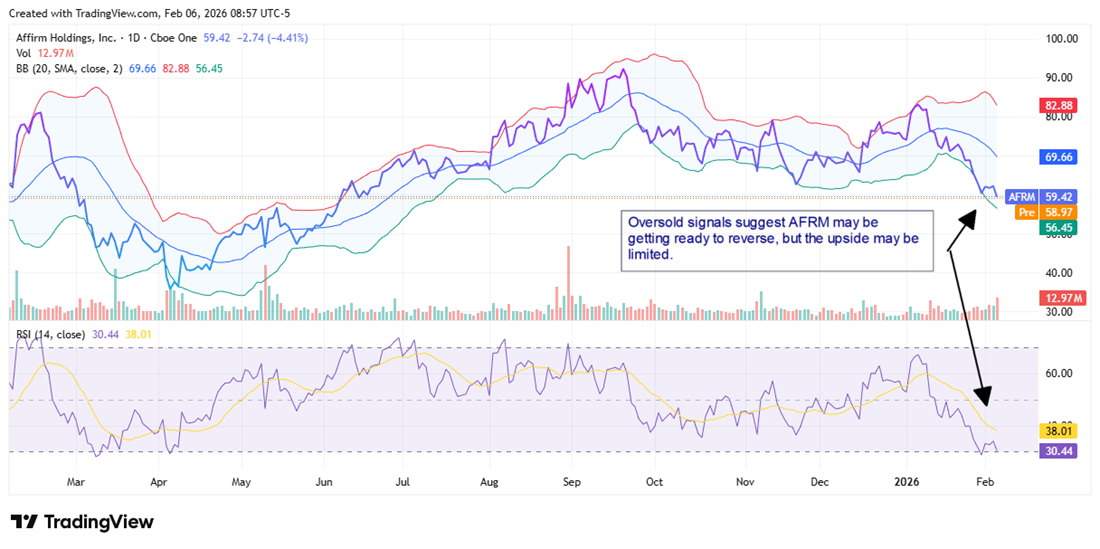
Analysts also support a higher stock price. The consensus price target for AFRM stock is $89.16, a 50% increase from its closing price on Feb. 5. It’s important to note that the price target, while significantly higher than one year ago, has been growing more slowly in the last three months. Some analysts have even lowered their price targets.
The company’s business is growing, but the model isn’t without risks. For now, AFRM may be a better trade than a long-term investment.
Where Should You Invest $1,000 Right Now?
Before you make your next trade, you'll want to hear this.
MarketBeat keeps track of Wall Street's top-rated and best performing research analysts and the stocks they recommend to their clients on a daily basis.
Our team has identified the five stocks that top analysts are quietly whispering to their clients to buy now before the broader market catches on... and none of the big name stocks were on the list.
They believe these five stocks are the five best companies for investors to buy now...
The article "Affirm Earnings Beat Highlights Growth and Credit Concerns" first appeared on MarketBeat.
Mentioned In This Article
Latest News
| Oct-08 | |
| Oct-08 | |
| Oct-07 | |
| Oct-06 | |
| Oct-06 | |
| Oct-05 | |
| Oct-01 | |
| Sep-30 | |
| Sep-29 | |
| Sep-28 | |
| Sep-27 | |
| Sep-25 | |
| Sep-23 | |
| Sep-21 | |
| Sep-20 |
