Is Quantum Computing Stock a Buy, Hold, or Sell Amid TFLN Market Growth?
Quantum Computing Inc. QUBT or QCi holds a meaningful and differentiated competitive advantage in the rapidly emerging photonics and quantum technology markets. At the core of this advantage is its U.S.-based thin-film lithium niobate (TFLN) photonic chip foundry in Tempe, AZ. This capability positions QCi among a very limited group of players able to support scalable, high-performance photonic device manufacturing domestically.
The TFLN Fab 1 is equipped with both front-end fabrication and back-end optical packaging capabilities under one roof. Fab 1 is currently focused on stabilizing production processes and increasing small-batch manufacturing to meet early customer demand.
The market dynamics further strengthen QUBT’s positioning. Per a 2024 report by QCi, the current TFLN market is valued at approximately $190 million and is projected to reach an estimated $1.93 billion by 2029, at a CAGR of 39.2%. TFLN is rapidly becoming one of the most promising materials for next-generation telecommunication devices and integrated photonics, paving the way for technologies such as quantum computing, quantum sensing, high-frequency modulators and LiDAR.
The planned development of Fab 2, a larger-scale facility designed to support higher-volume production, demonstrates a forward-looking strategy aimed at capturing accelerating market demand.
Other market players, such as D-Wave Quantum QBTS and IonQ IONQ, are also strategizing to capitalize on the growth opportunities in the TFLN market.
QUBT’s Share Price Performance
In the past year, QUBT’s shares have risen 4%, outperforming the Zacks Internet-Software industry and IONQ’s decline of 16.9% and 11.5%, respectively. However, QBTS has fared relatively better, posting a huge gain of about 225.2%.
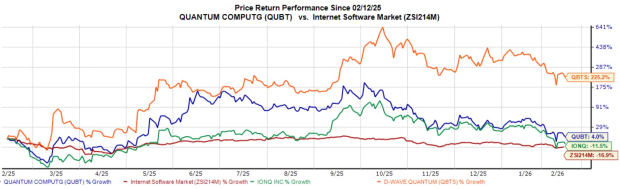
Image Source: Zacks Investment Research
Here’s Why QUBT Appears Appealing to Investors
Strengthened Balance Sheet: In 2025, Quantum Computing entered into multiple securities purchase agreements with institutional investors through oversubscribed private placements priced at-the-market under Nasdaq rules. In October, the company agreed to sell 37,183,937 shares for expected gross proceeds of $750 million.
In September, it agreed to sell 26,867,276 shares for $500 million in gross proceeds before expenses. Earlier offerings included 14,035,089 shares at $14.25 per share for $200 million and 8,163,266 shares at $12.25 per share for $100 million.
Total capital raised in 2025 exceeded $1.5 billion, significantly strengthening the balance sheet. The proceeds will support commercialization, scaling TFLN fabrication, advancing quantum machine development, expanding engineering and manufacturing teams, and enabling potential strategic acquisitions. This substantially de-risks near-term execution and provides the capital foundation necessary for Fab 2 planning and high-volume photonic chip production.
Real World Validation: In August 2025, QCi was awarded a contract by the National Institute of Standards and Technology (“NIST”), part of the U.S. Department of Commerce, to design and fabricate TFLN photonic integrated circuits (PICs). The company also secured a chip order from a Fortune 500 science and technology leader serving defense, intelligence, civil and commercial markets. These awards highlight QCi’s advanced prototyping capabilities and foundry services, facilitating the rapid delivery of mission-critical photonic components.
In January, QCi received its third and fourth purchase orders from a renowned European technical university and a Canadian PIC design house, marking a significant milestone in the QCi Foundry Pilot Launch Program. This was followed by the fifth purchase order for its TFLN photonic chip foundry from a Canadian research group focused on advancing quantum photonics.
Together, these partnerships underscore the growing real-world demand for QCi’s TFLN photonic chip foundry services.
QUBT’s Sales & EPS Growth
QCi is expected to report a 466.7% improvement in revenues for the fourth quarter. Earnings per share are expected to remain negative, but up 91.5% year over year.
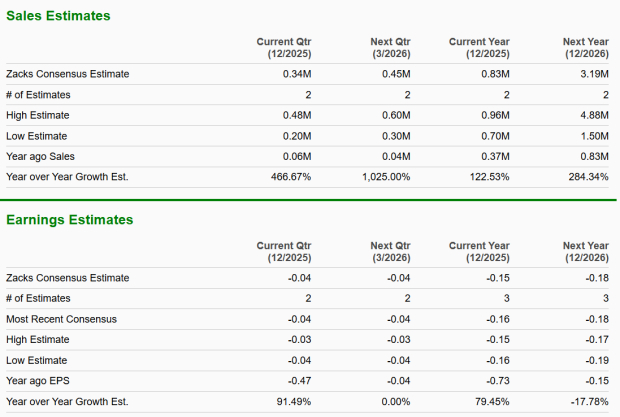
Image Source: Zacks Investment Research
Key Challenges for QUBT
QCi is prioritizing long-term platform leadership over near-term revenues and investing in manufacturing infrastructure to support future scale. Fab 1 lacks scale and Fab 2’s financial impact is back-end loaded. While successful execution supports real-world validation and credibility, the above-mentioned deployments generally lack scale. Low unit volumes, lengthy sales cycles and customization requirements limit repeatability and near-term revenue expansion.
QUBT’s Shares Look Overvalued
QCi stock is not so cheap, as suggested by the Value Score of F.
QUBT is currently trading at a 12-month forward price-to-sales (P/S) of 600.00X, which is higher than the industry average of 5.55X.
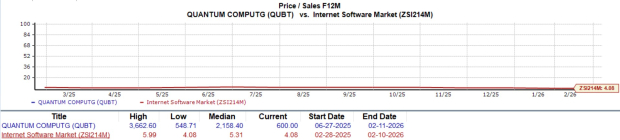
Image Source: Zacks Investment Research
Here’s How to Play QUBT Stock Now
QCi is entering a pivotal growth phase, supported by a differentiated domestic TFLN manufacturing foundry, accelerating customer traction, and a significantly strengthened balance sheet. With more than $1.5 billion raised to fund scaling, commercialization, and future TFLN foundry expansion, the company has reduced execution risk while positioning itself to capture the rapidly expanding TFLN market. Near-term performance, however, will depend on a successful production increase and market adoption.
QUBT, carrying a Zacks Rank #2 (Buy) at present, already trades at elevated levels. We advise those who have this stock in their portfolios to maintain their position, while others may wait for a more favorable entry point. You can see the complete list of today’s Zacks #1 Rank (Strong Buy) stocks here.
Want the latest recommendations from Zacks Investment Research? Today, you can download 7 Best Stocks for the Next 30 Days. Click to get this free report
Quantum Computing Inc. (QUBT): Free Stock Analysis Report
IonQ, Inc. (IONQ): Free Stock Analysis Report
D-Wave Quantum Inc. (QBTS): Free Stock Analysis Report
This article originally published on Zacks Investment Research (zacks.com).
Mentioned In This Article
Latest News
| Oct-09 | |
| Oct-08 | |
| Oct-08 | |
| Oct-07 | |
| Oct-06 | |
| Oct-06 | |
| Oct-05 | |
| Oct-05 | |
| Oct-02 | |
| Oct-01 | |
| Oct-01 | |
| Sep-30 | |
| Sep-29 | |
| Sep-28 | |
| Sep-28 |
