GS Stock Up 37.5% in a Year: Smart Entry Point or Wait for Pullback?
The Goldman Sachs Group, Inc. GS shares have jumped 37.5% in the past year, outperforming the industry’s growth of 19.1% and its peers JPMorgan JPM and Morgan Stanley’s MS rallies of 9.6% and 21.3%, respectively.
Price Performance

Image Source: Zacks Investment Research
With such strong momentum, investors are now wondering whether to hold on to the stock for now or cash out the profit. Let us delve deeper and analyze what is driving growth and whether there is more scope to grow.
Growth Catalysts for Goldman
IB Business: After several false starts, global mergers and acquisitions (M&As) finally witnessed a decisive upswing in the second half of 2025 amid easing regulation hopes and inflation pressures, setting the stage for a stronger 2026.
Per Dealogic, global M&As advanced 41% year over year to $4.81 trillion last year, led by a record 70 megadeals. In 2026, M&As are likely to shift from high-risk transformational deals to de-conglomeration and buy-and-build strategies. This back-to-basics focus will likely lift mid-market activity through smaller, synergy-rich add-ons and faster tech integration. With solid GDP growth and a potential rate cut, financing conditions are improving and strategic activity will continue rising.
Against this backdrop, GS stands out as a key beneficiary. Throughout 2025, Goldman’s IB division has capitalized on the resurgence in global deal-making, advising on more than $1.6 trillion in announced M&A volumes in 2025. The company’s IB revenues rose 21% in 2025, riding a wave of deal-making and IPO activity.
Management projects an even stronger M&A environment in 2026, provided macroeconomic conditions remain stable. The company has seen high levels of client engagement across its IB business, and expects the activity to accelerate in 2026. With the IB backlog at a four-year high and leadership position, Goldman is well-positioned to benefit in the upcoming period. Similarly, JPMorgan and Morgan Stanley are expected to record solid IB income growth this year as the industry-wide backdrop turns favorable.
Strategic Streamlining Progresses Well: The company’s streamlining efforts have been underway for some time as it retreats from the underperforming consumer banking ventures. Under CEO David Solomon, the company has embarked on a deliberate transformation to exit non-core consumer banking and double down on the divisions where Goldman maintains a clear competitive advantage.
In sync with its restructuring efforts, in January 2026, Goldman signed an agreement to transition the Apple Card program and associated accounts to JPMorgan. In November 2025, Goldman reached an agreement with ING Bank Slaski to divest its Polish asset management firm, TFI. The deal is targeted for completion in the first half of 2026. In the third quarter of 2025, Goldman completed the sale of its GM credit card business to Barclays.
In 2024, Goldman completed the sale of GreenSky. In 2023, it sold its Personal Financial Management unit to Creative Planning and also sold all of Marcus’s loan portfolio, part of its broader retreat from consumer banking.
These moves demonstrate a well-thought-out exit, allowing the company to reallocate capital and attention toward higher-margin, more scalable businesses like Global Banking and Markets and the asset and wealth management (AWM) divisions. The benefits of business restructuring began to show in the numbers. The Global Banking and Markets segment’s net revenues rose 18% year over year in 2025, while the AWM division’s net revenues rose 2% year over year, reflecting growing fee income and strength in private credit. In December 2025, GS agreed to acquire Innovator Capital Management, a leading provider of defined outcome exchange-traded funds (ETFs). The transaction significantly expands Goldman’s active ETF capabilities and is part of a broader pivot toward building “durable revenue streams” through diversified AWM offerings.
Betting Big on Private Equity to Aid Growth: The company is aggressively expanding its private equity and alternatives business through acquisitions, platform enhancements and the integration of new investment capabilities, which will likely support its growth over the long run.
In sync with this, in October 2025, Goldman agreed to acquire Industry Ventures, a leading venture capital platform that invests across all stages of the venture capital lifecycle. The planned acquisition of Industry Ventures underscores Goldman’s intent to strengthen its position in private markets and expand access to high-growth technology companies for clients globally.
In September 2025, GS partnered with T. Rowe Price in a $1-billion deal to co-develop retirement and wealth products. Later, the firms expanded the partnership to roll out alternative investment offerings for wealthy clients in 2025 and retirement savers in 2026. In January 2025, the company launched initiatives to grow private credit and other asset classes, including forming the Capital Solutions Group and expanding its alternatives team.
Goldman is expanding its private equity credit services internationally, focusing on Europe, the U.K. and Asia. Private banking and lending revenues reached record levels in 2025. Looking ahead, management expects high-single-digit annual growth in private banking and lending revenues over time, supported by international expansion, deeper integration with alternatives and continued focus on capital-light, client-driven lending solutions.
Private lending remains a key contributor to the firm’s target of improving AWM margins and returns over the medium term. The company's AWM unit intends to expand its private credit portfolio to $300 billion by 2029.
Scaling AI to Transform Business: GS is executing a firmwide artificial intelligence (AI) transformation that spans trading, investment banking, asset management and internal productivity, with a clear objective — to lift fee income and expand operating leverage over the coming years. At the center of this effort are the “One Goldman Sachs 3.0 (OneGS 3.0)” transformation and the “GS AI Assistant” program, both designed to embed generative and predictive AI into nearly every major workflow across the firm.
Management described OneGS 3.0 as a multi-year overhaul that embeds AI as a core operating capability rather than a standalone tool. The initiative focuses on simplifying processes, boosting productivity and enabling scalable growth, supported by high-quality data, shared platforms and modern infrastructure.
In parallel, the firm is reshaping its front-office strategy, recently reorganizing its TMT investment banking division to sharpen its focus on AI-related deal-making, including digital infrastructure, semiconductors, connectivity and core software, in response to evolving client demand.
Beyond operations and advisory, Goldman’s AI push is reshaping its revenue mix toward higher-fee, data-driven businesses and away from more balance-sheet-intensive activities. The planned acquisition of Industry Ventures reflects this shift, as Goldman looks to apply advanced analytics and AI to improve valuation, risk assessment and portfolio construction in private markets.
Overall, AI is emerging as a long-term growth engine for the firm, strengthening operating leverage, deepening client relevance and reinforcing Goldman’s competitive positioning.
Robust Liquidity Aids Capital Distribution: GS maintains a fortress balance sheet, with the Tier 1 capital ratios well above regulatory requirements. This financial strength allows it to return capital to shareholders aggressively through buybacks and a healthy dividend yield.
As of Dec. 31, 2025, Wells Fargo’s long-term debt was $174.7 billion. However, short-term borrowings were $251 billion. The company has a strong liquidity position, with a liquidity coverage ratio of 119% as of Dec. 31, 2025, which has exceeded its regulatory minimum of 100%. Its liquid assets (including cash and due from banks, as well as interest-earning deposits with banks) totaled $174.2 billion as of the same date. Given its strong liquidity, the company rewards its shareholders handsomely.
In January 2026, the company increased the quarterly dividend 12.5% to $4.50 per common share. In the past five years, the company has hiked dividends six times, with an annualized growth rate of 20.8%. Currently, it has a dividend yield of 1.7%.
JPMorgan raised its dividends six times over the past five years and offers a dividend yield of 1.8%. Morgan Stanley has raised its dividends five times over the past five years and has a dividend yield of 2.1%.
Additionally, Goldman has a share repurchase plan in place. In April 2025, its board of directors authorized an additional $40 billion share repurchase program, following the $30-billion authorization announced in July 2023. As of Dec. 31, 2025, the company had remaining authority to repurchase up to $29.7 billion of common stock.
Goldman’s Earnings Prospects & Valuation Analysis
Analysts are bullish on GS. Over the past 30 days, the Zacks Consensus Estimate for 2026 and 2027 earnings has been revised upward. The Zacks Consensus Estimate for Goldman’s 2026 and 2027 earnings implies year-over-year growth of 10.3% and 10.6%, respectively.
Estimate Revision Trend

Image Source: Zacks Investment Research
In terms of valuation, the GS stock looks inexpensive compared with the industry. The stock is trading at a forward price/book (P/B) of 2.17X below the industry average of 2.44X. Its peers, JPMorgan and Morgan Stanley, have forward P/B multiples of 2.41X and 2.64X, respectively.
Price-to-Book TTM
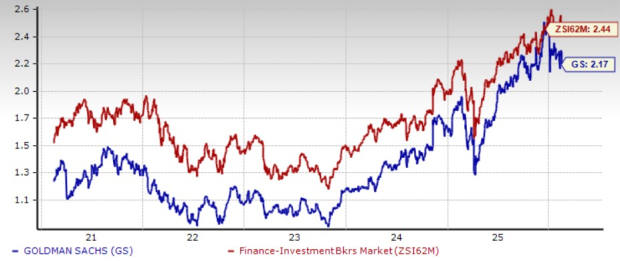
Image Source: Zacks Investment Research
Final Thoughts on GS Stock
Goldman’s strong rally is firmly supported by improving fundamentals, not excessive valuation. The company is entering the next phase of the cycle with a revived investment banking environment, a streamlined and higher-return business mix and powerful long-term growth drivers in private credit, alternatives, and asset and wealth management. Its aggressive adoption of AI is further enhancing operating efficiency and fee-generating capabilities, strengthening its competitive moat.
Importantly, GS continues to trade at a reasonable valuation relative to industry, while offering strong earnings visibility, robust capital returns through buybacks and dividends, and a fortress balance sheet that limits downside risks.
While short-term pullbacks are always possible, the company’s earnings momentum, strategic clarity and shareholder-friendly capital allocation suggest more upside ahead. Hence, prospective investors can consider buying the Goldman stock at the current level to generate healthy long-term returns.
At present, GS carries a Zacks Rank #2 (Buy). You can see the complete list of today’s Zacks #1 Rank (Strong Buy) stocks here.
Want the latest recommendations from Zacks Investment Research? Today, you can download 7 Best Stocks for the Next 30 Days. Click to get this free report
The Goldman Sachs Group, Inc. (GS): Free Stock Analysis Report
JPMorgan Chase & Co. (JPM): Free Stock Analysis Report
Morgan Stanley (MS): Free Stock Analysis Report
This article originally published on Zacks Investment Research (zacks.com).
Mentioned In This Article
Latest News
| 3 hours | |
| 4 hours | |
| 6 hours | |
| 8 hours | |
| 8 hours | |
| 9 hours | |
| 9 hours | |
| 10 hours | |
| 10 hours | |
| 11 hours | |
| 12 hours | |
| 19 hours | |
| Oct-08 | |
| Oct-08 | |
| Oct-08 |
