PGY Shares Plunge 47.7% in a Month: Is it Time to Sell the Stock?
After an impressive price performance in most of 2025, shares of Pagaya Technologies Ltd. PGY have plunged 47.7% in the past month, underperforming the S&P 500 Index and the industry to which it belongs.
If we compare the company’s price performance to its close peers, LendingTree TREE and Upstart Holdings UPST, it appears that the PGY stock has fared worse than both these firms. Shares of LendingTree have lost 40.2%, whereas Upstart has declined 35% in the past month.
1-Month Price Performance
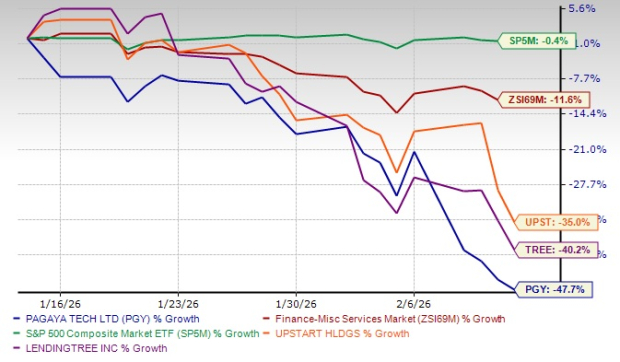
Image Source: Zacks Investment Research
The sharp decrease in PGY’s share price in the past month came mainly because investors reacted negatively to the company’s fourth-quarter 2025 earnings results. Although the company recorded its fourth straight quarter of positive GAAP net income in the three months ended Dec. 31, 2025 (as against negative earnings in the prior years), management issued a softer-than-expected guidance for early 2026.
PGY projects network volume of $2.5-$2.7 billion for first-quarter 2026. Also, total revenues and other income are expected to be $315-$335 million.
Along with this, management’s decision to tighten underwriting standards and reduce exposure to higher-risk credit segments weakened investor sentiments, sending the PGY stock lower. This is because, while this move will strengthen credit quality and long-term stability, it will likely limit loan volumes and near-term growth.
Now, given the recent pullback in PGY’s stock price, investors must consider whether it is worth holding on to the stock or better to exit. Before making any investment decision, it is important to examine PGY’s fundamentals and growth prospects to assess whether the stock still offers meaningful upside potential.
Factors That Have Been Supporting Pagaya
Diversified Business Model: PGY’s core strength has been its resilient and adaptable business model. The company expanded beyond its original focus on personal loans, moving into auto lending and point-of-sale financing. This diversification reduced exposure to cyclical risks in any single loan category, making the business more stable across economic cycles.
Parallel to this, Pagaya has built a robust network of more than 135 institutional funding partners to support the sale of its asset-backed securities (ABS). The company leverages forward flow agreements — structured financing arrangements in which institutional investors commit to purchasing future loan originations from Pagaya’s banking partners. These agreements offer a critical alternative funding source if ABS markets face disruptions during market stress.
PGY has a competitive edge in its proprietary data and product suite. One standout offering is its pre-screen solution, which enables banks and lenders to present pre-approved loan offers to existing customers without requiring a formal application.
By analyzing the lender’s customer base and identifying qualified borrowers proactively, the company helps financial institutions deepen customer relationships and expand credit access with minimal incremental marketing spend. This marks an evolution in its value proposition from driving market share gains for partners to enhancing their share of wallet with existing customers.
Lean Balance Sheet: Pagaya operates a capital-efficient model that largely avoids holding loans on its balance sheet, significantly reducing its exposure to credit risk and market volatility. This is made possible through the company’s robust network of institutional funding partners and a focus on issuing ABS.
The capital raised in advance is held in trust and deployed only when a lending partner originates a loan through Pagaya’s AI-driven network. At that point, the loan is immediately acquired by a pre-committed funding source, either through an ABS vehicle or a forward flow agreement. As a result, most loans never reside on Pagaya’s balance sheet or only do so briefly before being transferred.
This off-balance-sheet model has proven particularly effective during periods of elevated interest rates and market stress, such as from 2021 through 2023. By minimizing credit exposure and avoiding significant loan write-downs, Pagaya has maintained its financial flexibility in turbulent environments.
PGY appears to rely heavily on forward flow agreements. These contracts provide a reliable and predictable source of capital, helping the company maintain liquidity even amid tightening credit markets and rising inflation.
Analyzing Pagaya’s Valuation
In terms of valuation, the PGY stock looks inexpensive compared with the industry at large. The stock is trading at a forward 12-month price/sales (P/S) ratio of 0.62X, below the industry average of 2.82X over the last three years.
Price-to-Sales F12M

Image Source: Zacks Investment Research
While Pagaya is trading at a discount compared with Upstart, the stock appears to be trading at a premium compared with TREE. LendingTree has a P/S (F12M) ratio of 0.46X, while Upstart has a P/S ratio of 2.39X.
How to Approach the Pagaya Stock Now?
Given its resilient business model and capital-efficient funding strategy, PGY continues to stand out in the fintech space. Its AI-driven platform and reliance on forward flow agreements shield it from market volatility and credit risks.
However, the company has been witnessing a persistent increase in expenses over the past few years. Over the last three years (2022-2025), total costs and operating expenses saw a compound annual growth rate of 1.2%, mainly because of elevated production costs.
Moreover, analysts do not seem optimistic regarding PGY’s earnings growth potential. Over the past 30 days, the Zacks Consensus Estimate for Pagaya’s 2026 and 2027 earnings has been unchanged at $3.41 and $4.20 per share, respectively.
Earnings Estimate Revision

Image Source: Zacks Investment Research
Thus, despite the fact that the company’s fundamentals have not collapsed, there is uncertainty about future prospects because of the latest outlook that management has provided, which signals slower near-term expansion. The company’s decision to tighten underwriting standards may improve long-term credit quality but it immediately reduces lending volumes and growth momentum.
Hence, the PGY stock looks like a sell for risk-averse investors right now, mainly because the latest earnings update has reset growth expectations. For investors who prioritize stability, predictable growth or lower risk, the current environment may justify stepping aside until revenue momentum and guidance improve.
At present, Pagaya carries a Zacks Rank #5 (Strong Sell).
You can see the complete list of today’s Zacks #1 Rank (Strong Buy) stocks here.
Want the latest recommendations from Zacks Investment Research? Today, you can download 7 Best Stocks for the Next 30 Days. Click to get this free report
LendingTree, Inc. (TREE): Free Stock Analysis Report
Upstart Holdings, Inc. (UPST): Free Stock Analysis Report
Pagaya Technologies Ltd. (PGY): Free Stock Analysis Report
This article originally published on Zacks Investment Research (zacks.com).
Mentioned In This Article
Latest News
| Oct-14 | |
| Oct-12 | |
| Oct-11 | |
| Oct-07 | |
| Oct-06 | |
| Oct-06 | |
| Oct-05 | |
| Oct-05 | |
| Sep-29 | |
| Sep-23 | |
| Sep-23 | |
| Sep-22 | |
| Sep-17 | |
| Sep-16 | |
| Sep-16 |
