AbbVie Down Since Q4 Earnings Report: How to Play the Stock
AbbVie (ABBV) stock felt some downward pressure despite reporting better-than-expected fourth-quarter results on Feb. 4. AbbVie beat estimates for both earnings and sales and also issued an upbeat outlook for 2026, yet the stock fell on the day. This was due to a decline in sales of its oncology drugs, weakness in the aesthetics segment and overall market caution about growth sustainability. The company fundamentals remain strong in the long term. Let’s understand the company’s strengths and weaknesses to analyze better how to play AbbVie stock in this scenario.
ABBV’s Successful New Drugs — Skyrizi and Rinvoq
AbbVie lost patent protection for its blockbuster drug, Humira, in the United States in January 2023 and in the EU in 2018. Humira's sales are declining due to loss of exclusivity (LOE) and biosimilar erosion. However, AbbVie has successfully navigated the LOE of Humira, a drug that once generated more than 50% of its total revenues. It has accomplished this by launching two other successful new immunology medicines, Skyrizi and Rinvoq, which are performing extremely well, bolstered by approvals in new indications, and should support top-line growth in the next few years.
Skyrizi and Rinvoq generated combined sales of $26.0 billion in 2025, exceeding expectations and representing year-over-year growth of more than 40%. The drugs are seeing strong performance across all approved indications, especially in the popular inflammatory bowel disease space, which includes two conditions — ulcerative colitis (UC) and Crohn’s disease. In 2026, AbbVie expects combined Skyrizi and Rinvoq sales of more than $31 billion, which is $0.5 billion more than its 2027 long-term guidance of $31 billion.
Strong immunology market growth, market share gains and momentum from new indications, as well as the potential for five new indications for Rinvoq over the next few years, are expected to drive these drugs’ growth. Rinvoq could be approved for two indications — vitiligo and alopecia areata in 2026. In addition, phase III data with Rinvoq in hidradenitis suppurativa and systemic lupus erythematosus are expected in 2026. AbbVie believes that the next wave of potential approvals in Rinvoq could add roughly $2 billion to peak-year sales for the product.
AbbVie expects a low single-digit pricing headwind for both Skyrizi and Rinvoq in 2026 and over the next few years.
ABBV’s Oncology & Neuroscience Drugs Also Contributing
AbbVie’s neuroscience portfolio is also contributing to top-line growth. Sales of its neuroscience drugs increased almost 20% to $10.8 billion in 2025, driven by higher sales of Botox Therapeutic, depression drug Vraylar and newer migraine drugs Ubrelvy and Qulipta.
The initial international launch uptake of Vyalev, a transformative therapy for treating advanced Parkinson’s disease, approved in late 2024, has been encouraging. AbbVie expects Vyaley to achieve blockbuster status in 2026, with sales expected to ramp up substantiallyin the United States, where Vyalev recently received full coverage. AbbVie’s Parkinson’s disease franchise, comprising Vyalev and once-daily oral treatment tavapadon (under review in the United States; FDA decision expected in the third quarter of 2026), is being seen as the key to growth in neuroscience.
AbbVie has built a substantial oncology franchise with Imbruvica and Venclexta. Its oncology segment generated combined revenues of $6.6 billion in 2025, up 1.5% year over year as higher sales of Venclexta and contributions from new drugs, Elahere and Epkinly, partially offset the decline in Imbruvica sales. Some key oncology drugs approved in the past couple of years are Epkinly and Emrelis. Elahere was added to AbbVie’s oncology portfolio with the February 2024 acquisition of Immunogen. These three new drugs have strengthened AbbVie’s oncology franchise. Though oncology sales are slightly slowing down, AbbVie believes the oncology pipeline is robust with several study readouts and initiations expected this year.
Over the next couple of years. AbbVie expects new product approvals for tavapadon and pivekimab sunirine (blastic plasmacytoid dendritic cell neoplasm) and pivotal data readouts for key pipeline candidates, lutikizumab (hidradenitis suppurativa
), Temab-A (metastatic colorectal cancer) and etentamig (third-line-plus multiple myeloma). These pipeline programs have the potential to drive long-term growth for AbbVie, while Skyrizi and Rinvoq will boost near-term growth.
AbbVie on an Acquisition Spree
AbbVie has been on an acquisition spree in the past couple of years to bolster the early-stage pipeline that should drive long-term growth. Particularly, it is signing several M&A deals in the immunology space, its core area, while also signing some early-stage deals in oncology and neuroscience areas. In 2025, AbbVie invested more than $5 billion to acquire innovative pipeline candidates. These include an in-vivo CAR-T platform in immunology from Capstan Therapeutics, bretisilocin, a next-generation psychedelic in depression; ISB-2001, a novel trispecific antibody for multiple myeloma; 295, a long-acting amylin analog for obesity and a next-generation siRNA platform from Arx.
ABBV’s Struggling Aesthetics Segment & Humira Erosion
Sales of Humira are declining due to biosimilar erosion. The launch of Humira biosimilars in the United States in 2023 significantly eroded the drug’s sales in 2024 and 2025. Humira sales declined around 50% in 2025. Humira sales are expected to continue to decline in 2026 as more plans exclude branded Humira and move to exclusive biosimilar contracts.
AbbVie is also seeing declining sales of its Aesthetics unit due to continued macro challenges and weakened consumer sentiment. Global sales of the aesthetics portfolio declined 0.6% in 2024 and 5.9% in2025.
WhileJuvederm sales declined 15.6% in 2025, Botox Cosmetics sales declined 4.1%. AbbVie expects the aesthetics category growth to remain challenged in 2026. Global aesthetics sales are expected to be $5 billion in 2026, flat from 2025 levels as moderate growth in Botox Cosmetic is expected to be offset by continued decline in Juvederm sales due to continued headwinds in key dermal filler markets.
ABBV Stock Price, Valuation and Estimate Revision
ABBV stock has risen 17.9% in the past year compared with an appreciation of 19.5% for the industry.
ABBV Stock Underperforms Industry

From a valuation standpoint, AbbVie is reasonably priced. Going by the price/earnings ratio, the company’s shares currently trade at 15.75 forward earnings, lower than 18.83 for the industry. However, the stock is trading above its five-year mean of 13.66. AbbVie stock looks cheaper than other large drugmakers like J&J JNJ, Eli Lilly LLY and AstraZeneca AZN
ABBV Stock Valuation
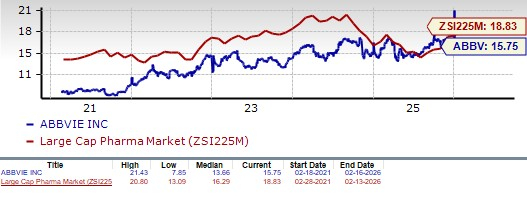
The Zacks Consensus Estimate for 2026 earnings has risen from $14.45 to $14.49 per share over the past 30 days, while that for 2027 has declined from $16.28 per share to $16.15 per share over the same timeframe.
ABBV Estimate Movement

Stay Invested in ABBV Stock
AbbVie combats its share of headwinds, like Humira LOE impact, increasing competitive pressure on Imbruvica and continued macro woes for Aesthetics. However, AbbVie has faced its biggest challenge — Humira’s patent cliff — quite well and looks well-positioned for continued strong growth in the years ahead. AbbVie delivered robust net sales growth in 2025, which is just the second full year following the Humira LOE in the United States. Sales of AbbVie’s ex-Humira drugs rose more than 14% (on a reported basis) in the fourth quarter, which was above its expectations, driven by Skyrizi, Rinvoq and neuroscience.
AbbVie expects another year of robust growth in 2026. It expects total revenues to rise approximately 9.5% in 2026. The top-line growth is expected to be driven by continued strong increase in Skyrizi and Rinvoq sales, a substantial sales ramp for Vyalev and continued double-digit revenue growth from migraine drugs, partially offset by headwinds from continued Humira erosion and the impact of lower IRA-related pricing on Imbruvica.
It expects a high single-digit revenue growth through 2029, as the company has no significant LOE events for the rest of this decade. A substantial portion of this growth is expected to be driven by the robust performance of Skyrizi and Rinvoq. With no significant LOEs in this decade, AbbVie enjoys the flexibility to invest more in R&D to continue to acquire external innovation.
Although the stock has been suppressed lately, it has consistently done well in the past couple of years. Adecent valuation, expectations for continued strong earnings growth, and a robust pipeline are good enough reasons to stay invested in this Zacks Rank #3 (Hold) stock. You can see the complete list of today’s Zacks #1 Rank (Strong Buy) stocks here.
Want the latest recommendations from Zacks Investment Research? Today, you can download 7 Best Stocks for the Next 30 Days. Click to get this free report
AstraZeneca PLC (AZN): Free Stock Analysis Report
Johnson & Johnson (JNJ): Free Stock Analysis Report
Eli Lilly and Company (LLY): Free Stock Analysis Report
This article originally published on Zacks Investment Research (zacks.com).
Mentioned In This Article
Latest News
| 28 min | |
| 2 hours |
Boston sues J&J subsidiary over alleged patent infringement for cardiology device
JNJ
Medical Device Network
|
| 5 hours | |
| 5 hours | |
| 6 hours | |
| Oct-08 | |
| Oct-08 | |
| Oct-08 | |
| Oct-08 | |
| Oct-08 | |
| Oct-08 | |
| Oct-08 | |
| Oct-08 | |
| Oct-08 | |
| Oct-07 |
