|
|
|

|
|||||
|
|
|

Agricultural and construction machinery company Deere (NYSE:DE) reported Q4 CY2025 results beating Wall Street’s revenue expectations, with sales up 13% year on year to $9.61 billion. Its GAAP profit of $2.42 per share was 15.4% above analysts’ consensus estimates.
Is now the time to buy Deere? Find out by accessing our full research report, it’s free.
Revolutionizing agriculture with the first self-polishing cast-steel plow in the 1800s, Deere (NYSE:DE) manufactures and distributes advanced agricultural, construction, forestry, and turf care equipment.
Examining a company’s long-term performance can provide clues about its quality. Any business can put up a good quarter or two, but many enduring ones grow for years. Regrettably, Deere’s sales grew at a tepid 4.8% compounded annual growth rate over the last five years. This was below our standard for the industrials sector and is a tough starting point for our analysis.
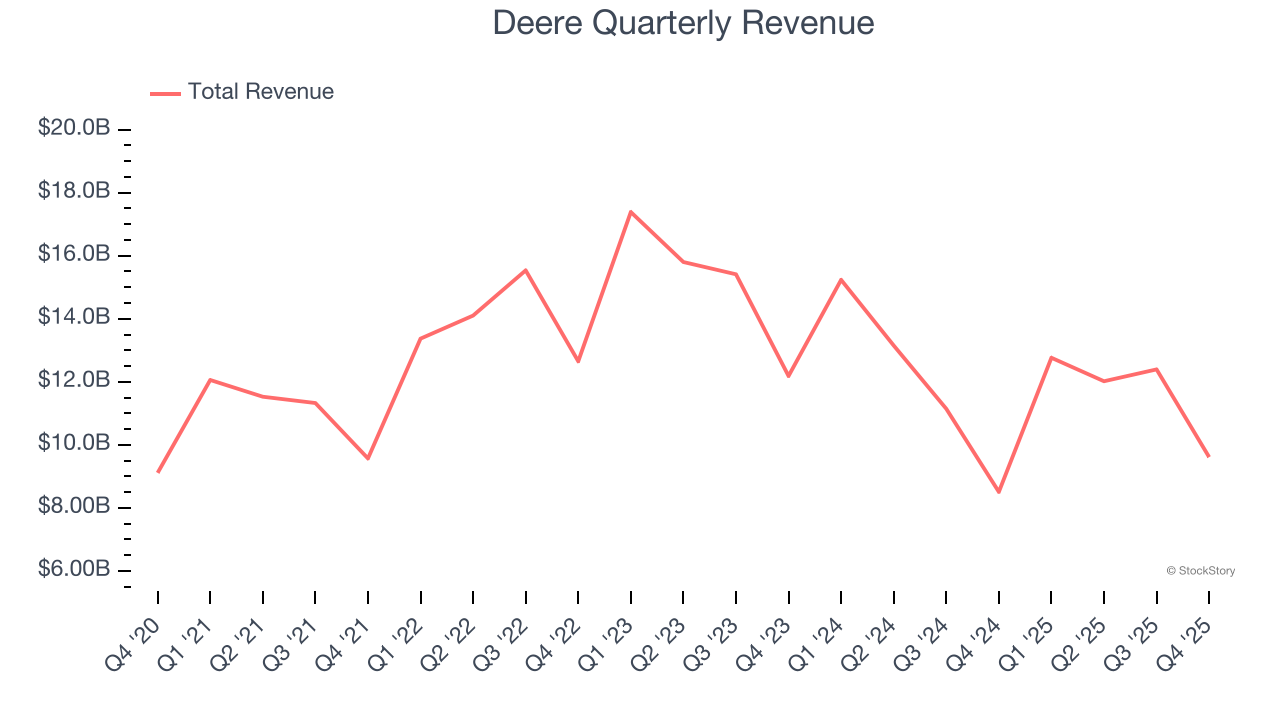
We at StockStory place the most emphasis on long-term growth, but within industrials, a half-decade historical view may miss cycles, industry trends, or a company capitalizing on catalysts such as a new contract win or a successful product line. Deere’s performance shows it grew in the past but relinquished its gains over the last two years, as its revenue fell by 12.3% annually. Deere isn’t alone in its struggles as the Agricultural Machinery industry experienced a cyclical downturn, with many similar businesses observing lower sales at this time.
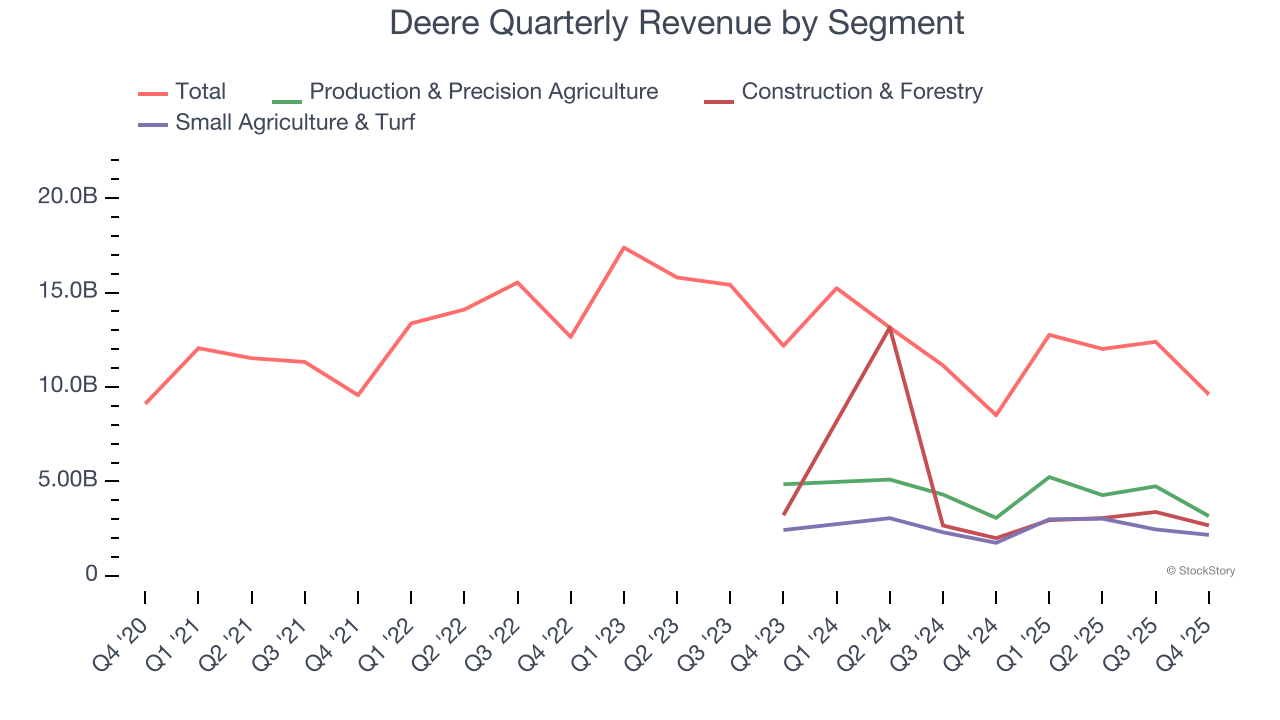
Deere also breaks out the revenue for its three most important segments: Production & Precision Agriculture , Construction & Forestry , and Small Agriculture & Turf, which are 32.9%, 27.8%, and 22.6% of revenue. Over the last two years, Deere’s Production & Precision Agriculture (tractors, harvesters, tillage) and Construction & Forestry (loaders, excavators, dump trucks) revenues averaged year-on-year declines of 9.9% and 13.5% while its Small Agriculture & Turf revenue (mowers and other small vehicles) was flat.
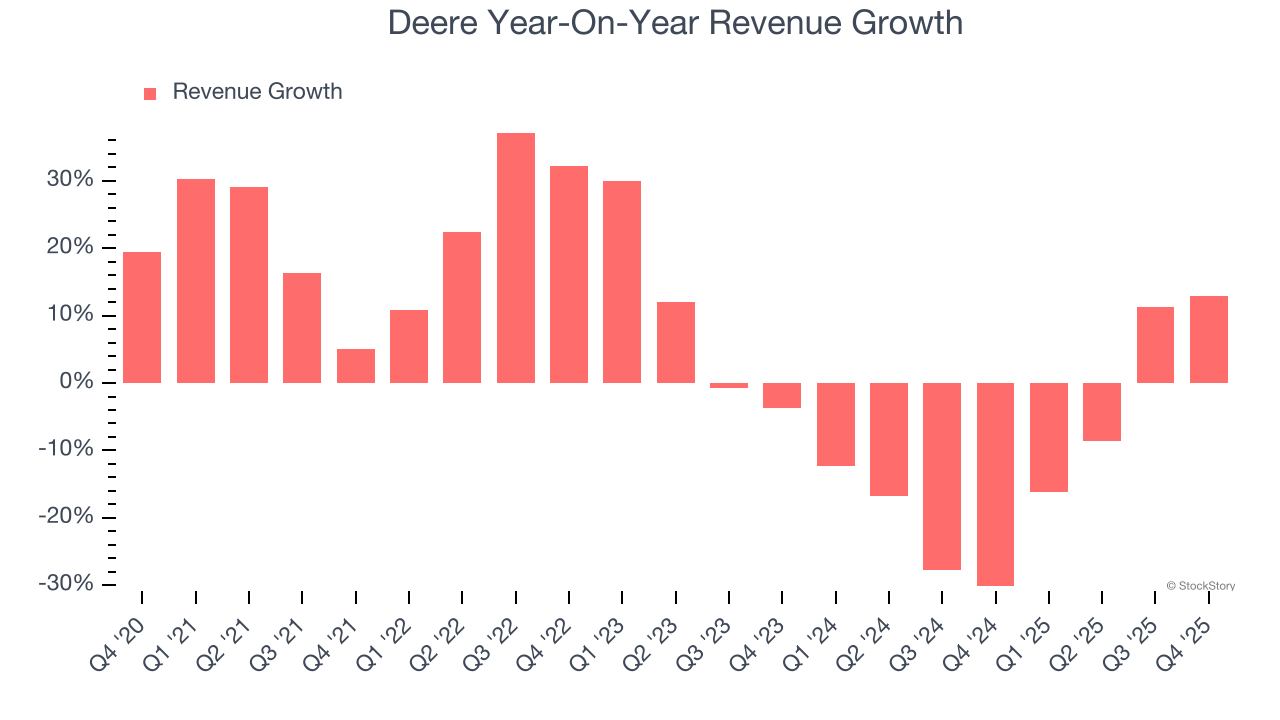
This quarter, Deere reported year-on-year revenue growth of 13%, and its $9.61 billion of revenue exceeded Wall Street’s estimates by 5.9%.
Looking ahead, sell-side analysts expect revenue to grow 1.3% over the next 12 months. While this projection implies its newer products and services will spur better top-line performance, it is still below average for the sector.
While Wall Street chases Nvidia at all-time highs, an under-the-radar semiconductor supplier is dominating a critical AI component these giants can’t build without. Click here to access our free report one of our favorites growth stories.
Operating margin is a key measure of profitability. Think of it as net income - the bottom line - excluding the impact of taxes and interest on debt, which are less connected to business fundamentals.
Deere has been a well-oiled machine over the last five years. It demonstrated elite profitability for an industrials business, boasting an average operating margin of 17.5%. This result was particularly impressive because of its low gross margin, which is mostly a factor of what it sells and takes huge shifts to move meaningfully. Companies have more control over their operating margins, and it’s a show of well-managed operations if they’re high when gross margins are low.
Analyzing the trend in its profitability, Deere’s operating margin decreased by 4.3 percentage points over the last five years. This raises questions about the company’s expense base because its revenue growth should have given it leverage on its fixed costs, resulting in better economies of scale and profitability.
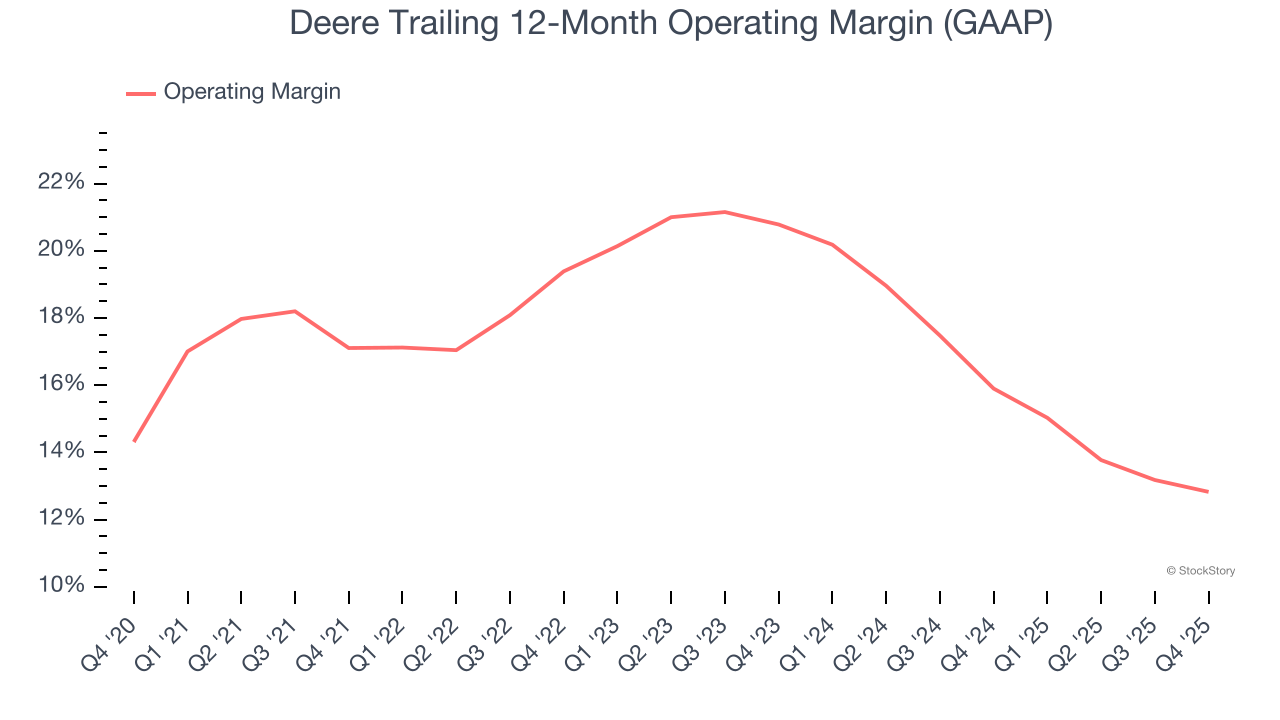
This quarter, Deere generated an operating margin profit margin of 8%, down 1.3 percentage points year on year. Conversely, its revenue and gross margin actually rose, so we can assume it was less efficient because its operating expenses like marketing, R&D, and administrative overhead grew faster than its revenue.
We track the long-term change in earnings per share (EPS) for the same reason as long-term revenue growth. Compared to revenue, however, EPS highlights whether a company’s growth is profitable.
Deere’s EPS grew at a solid 10.2% compounded annual growth rate over the last five years, higher than its 4.8% annualized revenue growth. However, this alone doesn’t tell us much about its business quality because its operating margin didn’t improve.
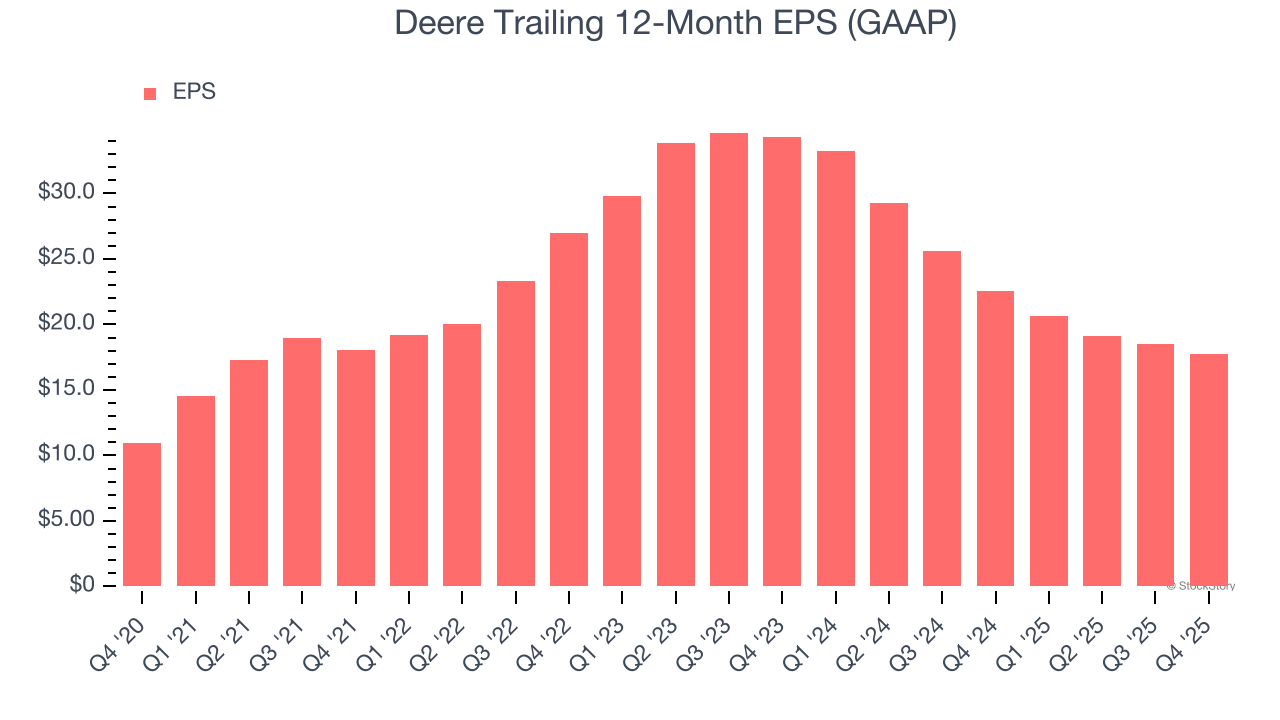
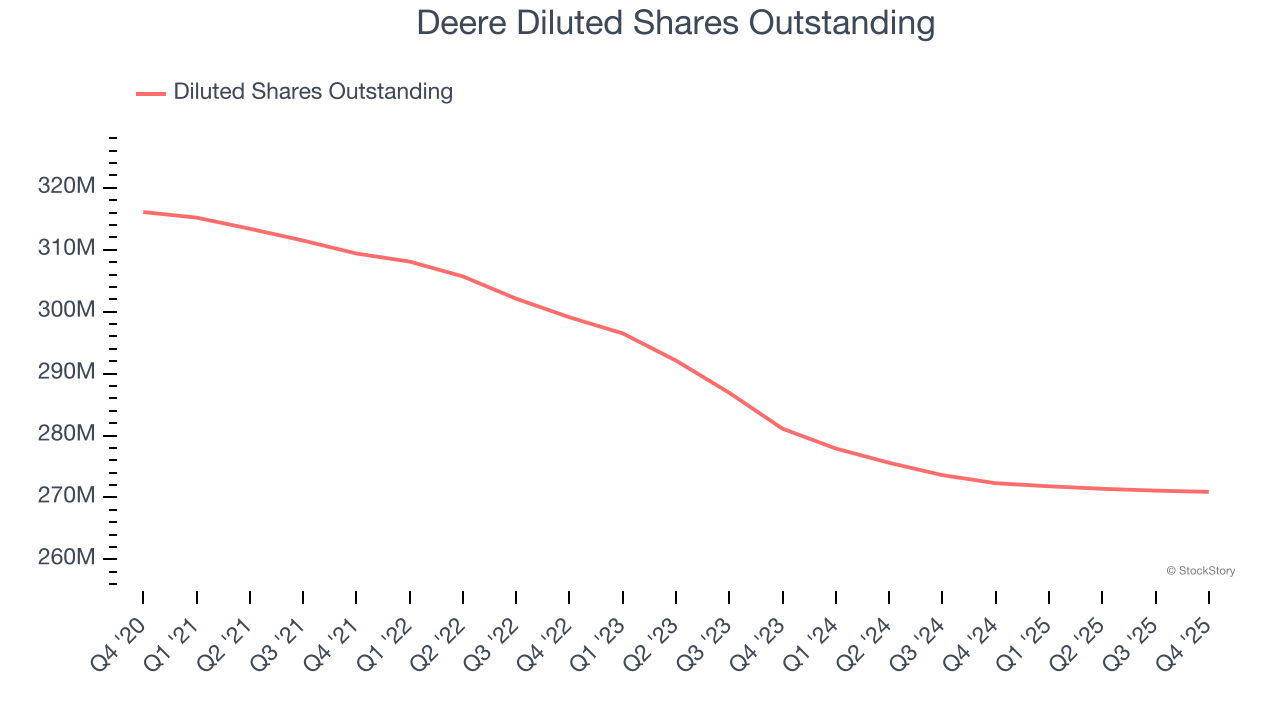
Diving into the nuances of Deere’s earnings can give us a better understanding of its performance. A five-year view shows that Deere has repurchased its stock, shrinking its share count by 14.3%. This tells us its EPS outperformed its revenue not because of increased operational efficiency but financial engineering, as buybacks boost per share earnings.
Like with revenue, we analyze EPS over a shorter period to see if we are missing a change in the business.
For Deere, its two-year annual EPS declines of 28.1% mark a reversal from its (seemingly) healthy five-year trend. We hope Deere can return to earnings growth in the future.
In Q4, Deere reported EPS of $2.42, down from $3.19 in the same quarter last year. Despite falling year on year, this print easily cleared analysts’ estimates. Over the next 12 months, Wall Street expects Deere’s full-year EPS of $17.74 to stay about the same.
We were impressed by how significantly Deere blew past analysts’ EBITDA expectations this quarter. We were also excited its revenue outperformed Wall Street’s estimates by a wide margin. Zooming out, we think this quarter featured some important positives. The stock traded up 4.4% to $619.50 immediately after reporting.
Deere may have had a good quarter, but does that mean you should invest right now? The latest quarter does matter, but not nearly as much as longer-term fundamentals and valuation, when deciding if the stock is a buy. We cover that in our actionable full research report which you can read here (it’s free).
| Apr-19 |
Deere Settled for $99 Million Over Repair Costs. Farmers Are Still Worried.
DE
The Wall Street Journal
|
| Apr-19 | |
| Apr-18 | |
| Apr-15 | |
| Apr-10 | |
| Apr-09 | |
| Apr-08 | |
| Apr-08 | |
| Apr-08 | |
| Apr-07 | |
| Apr-06 | |
| Apr-01 | |
| Mar-31 | |
| Mar-28 | |
| Mar-27 |

Join thousands of traders who make more informed decisions with our premium features. Real-time quotes, advanced visualizations, alerts, and much more.
Learn more about Finviz Elite