Verizon vs. T-Mobile: Which 5G Stock is the Better Buy Today?
Verizon Communications VZ and T-Mobile US, Inc. TMUS are major U.S. wireless carriers competing aggressively in the 5G market, battling for subscriber growth, network leadership and long-term cash flow strength. Operating as one of the premier wireless service providers in the United States, Verizon provides a vast array of communication and business solutions that include wireless, local exchange, long-distance, data/broadband and Internet, video, managed networking, wholesale and cloud-based services.
T-Mobile offers mobile voice, messaging and data services in the postpaid, prepaid and wholesale markets under the T-Mobile, Metro by T-Mobile and Sprint brands. The company is extensively deploying 5G and 4G LTE (Long-Term Evolution) networks across the country to bridge the digital divide.
Let us delve a little deeper into the companies’ competitive dynamics to understand which of the two is relatively better placed in the broadband and telecom services industry.
The Case for Verizon
Verizon is benefiting from the growing demand for its industry-leading 5G portfolio. With a customer-centric business model, the company delivers faster peak data speeds and capacity for customers, driven by disciplined engineering and steady infrastructure investments. The company’s 5G network hinges on three fundamental drivers to deliver the full potential of next-generation wireless technology. These are massive spectrum holdings, particularly in the millimeter-wave bands for faster data transfer, end-to-end deep fiber resources and the ability to deploy a large number of small cells.
Verizon is witnessing significant 5G adoption and fixed wireless broadband momentum with premium unlimited plans. It is offering various mix-and-match pricing in both wireless and home broadband plans, which has led to solid customer additions. Moreover, in the enterprise and wholesale business, Verizon is shifting its revenue mix toward newer growth services like cloud, security and professional services.
Verizon has further expanded Fios Forward to support digital inclusion and provide opportunities for underserved households to thrive in the digital world. With no data caps, Fios customers can experience faster upload and download speeds than any other comparable plans. The telecom giant plans to accelerate the availability of its 5G Ultra Wideband network across the country. The company’s growth strategy includes 5G mobility, nationwide broadband and mobile edge compute and business solutions.
However, the company operates in a highly competitive market and faces competition from other major players, such as AT&T, Inc. T and T-Mobile. AT&T is also aggressively expanding its fiber footprint. The company is acquiring Lumen’s fiber business. It is placing a strong focus on the densification of its existing fiber infrastructure. Such initiatives from AT&T can pose a challenge to Verizon’s fiber network expansion. In a bid to expand its customer base, Verizon is spending heavily on promotion and is offering lucrative discounts, which are weighing on margins.
The Case for T-Mobile
T-Mobile’s business model largely depends on its “Un-carrier Value Proposition”, which aims to enhance customer satisfaction by means of providing the latest products at cheaper rates and on uncomplicated terms and conditions. The company continues to boast a leadership position in the 5G market. Its 5G network covers 98% of Americans, or 330 million people in the country. The Ultra Capacity 5G delivers superfast speeds, powering 5G smartphones and enabling innovators to deliver transformational 5G experiences. T-Mobile achieved its full-year target of covering 300 million Americans with Ultra Capacity 5G network, two months before its targeted deadline in 2025. It intends to bring more competition to home broadband, especially in underserved rural markets.
T-Mobile’s acquisition strategy has significantly strengthened its position in the wireless industry over the past few years. The company completed its acquisition of Sprint in 2020. The combined company’s network has 14 times more capacity than on a standalone basis, which enables it to leapfrog the competition in network capability and customer experience. T-Mobile has completed the acquisition of US Cellular’s wireless operations. It has acquired all of US Cellular’s wireless operations along with 30% of its spectrum assets across several spectrum bands. The transaction enabled T-Mobile to expand both its fast-growing home broadband offerings and fixed wireless products through the additional capacity and coverage from the combined spectrum and wireless assets. It also enables the Un-carrier to lease space on various US Cellular towers to ensure continued, uninterrupted service for its customers.
T-Mobile continues to deploy 5G with the mid-band 2.5 GHz spectrum from Sprint. The 2.5 GHz 5G delivers superfast speeds and extensive coverage with signals that go through walls and trees, unlike 5G networks that are controlled by the mmWave spectrum. This gives the un-carrier a competitive edge over AT&T and Verizon. In many places, mid-band 5G average download speeds are around 300 Mbps with peak speeds approaching 1 Gbps. It plans to continue growing this 5G spectrum deployment at an aggressive pace. T-Mobile’s business strategy is built on covering 90% of rural America with average 5G speeds of 50 Mbps, up to two times faster than broadband.
However, the U.S. wireless market is highly competitive and saturated. T-Mobile has multiple wireless competitors, some of which have greater resources than it does. Intensifying competition with a relatively fixed pool of customers is putting pressure on pricing. To lure customers from competitors, T-Mobile has launched several low-priced service plans for consumers as well as small business entities. Management’s strategy of introducing several promotional activities such as free music streaming, video offers and price cuts on service plans and adoption of phone leasing plans, where equipment revenues are not booked upfront, creates a margin squeeze for the company.
How Do Zacks Estimates Compare for VZ & TMUS?
The Zacks Consensus Estimate for Verizon’s 2026 sales and EPS implies year-over-year growth of 3.6% and 4.2%, respectively. The EPS estimate for 2026 has been trending northward (up 1.7%) over the past 60 days.

Image Source: Zacks Investment Research
The Zacks Consensus Estimate for T-Mobile’s 2026 sales and EPS indicates year-over-year growth of 6.7% and 10%, respectively. The EPS estimates have been trending southward (down 5.5%) over the past 60 days.
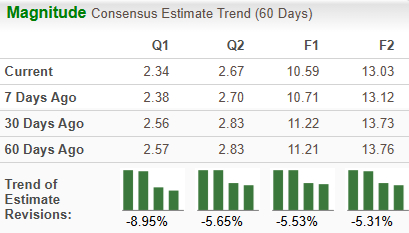
Image Source: Zacks Investment Research
Price Performance & Valuation of VZ & TMUS
Over the past year, Verizon has gained 13.7% against the industry’s decline of 6.6%. T-Mobile has plummeted 18.7% over the same period.

Image Source: Zacks Investment Research
Verizon looks more attractive than T-Mobile from a valuation standpoint. Going by the price/earnings ratio, Verizon’s shares currently trade at 10.01 forward earnings, lower than 19.92 for T-Mobile.

Image Source: Zacks Investment Research
End Note
While Verizon carries a Zacks Rank #3 (Hold), T-Mobile has a Zacks Rank #4 (Sell).
You can see the complete list of today’s Zacks #1 Rank (Strong Buy) stocks here.
Both Verizon and T-Mobile expect sales and earnings to increase in 2026. In terms of price performance, VZ has outperformed TMUS. An uptrend in estimate revisions shows bullish investor sentiment for Verizon. Moreover, Verizon appears to have attractive valuation metrics compared with T-Mobile. With a better Zacks Rank, an aggressive growth path (broadband upgrades + bundling + fiber densification), Verizon offers more upside potential and appears to be relatively better placed than T-Mobile and hence, is a better investment option at the moment.
Want the latest recommendations from Zacks Investment Research? Today, you can download 7 Best Stocks for the Next 30 Days. Click to get this free report
AT&T Inc. (T): Free Stock Analysis Report
Verizon Communications Inc. (VZ): Free Stock Analysis Report
T-Mobile US, Inc. (TMUS): Free Stock Analysis Report
This article originally published on Zacks Investment Research (zacks.com).
Mentioned In This Article
Latest News
| 51 min | |
| 2 hours | |
| 10 hours | |
| Oct-09 | |
| Oct-09 | |
| Oct-09 | |
| Oct-09 | |
| Oct-09 | |
| Oct-09 | |
| Oct-09 | |
| Oct-09 |
Wireless Carriers' Day of Woe After SpaceX Spectrum Deal
TMUS -13.27% T -10.82% VZ -10.14%
The Wall Street Journal
|
| Oct-09 | |
| Oct-09 | |
| Oct-09 | |
| Oct-09 |
