T-Mobile vs. AT&T: Which Telecom Stock Should You Bet On?
T-Mobile US, Inc. TMUS and AT&T Inc. T are two of the largest U.S. wireless and broadband providers, competing directly on 5G network expansion, subscriber growth and pricing in the highly competitive telecom market.
The U.S. telecom industry is presently driven by growing usage of high data-intensive applications such as video streaming, gaming, AR and VR applications, and growing usage of IoT devices in both consumer and industrial setups. The federal government’s strategy to foster digital inclusivity by expanding network infrastructure in rural and remote areas of the country is also driving growth. Per a report from Grand View Research, the U.S. telecom market is expected to witness a compound annual growth rate of 6.6% from 2024 to 2030.
With deep industry acumen, both AT&T and T-Mobile hold a strong foothold in the highly competitive U.S. telecom sector. Let us analyze the competitive strengths and weaknesses of the companies in depth to understand which is better positioned to maximize gains from the emerging market trends.
The Case for TMUS
T-Mobile is benefiting from industry-leading postpaid customer growth. During the quarter, TMUS added 2.4 million postpaid net customers and 261,000 postpaid net accounts. In 2025, it added 7.8 million postpaid net customers. Postpaid phone net customer additions were 962,000. The postpaid phone churn rate was 1.02%. 5G broadband net customer additions were 495,000. Postpaid average revenues per account rose to $150.17 from $146.28 in the year-ago quarter. Prepaid net customer addition was 57,000, with a churn rate of 2.76%.
The company has been steadily rolling out 5G Advanced nationwide. Its 5G Advanced blends faster speeds, greater reliability and built-in intelligence. The AI-native intelligence and automation allow the network to adapt in real time in response to changing demand pattern facilitating efficient network management. AI-powered radio access networks leverage vast customer data to predict traffic patterns, allocate resources, reduce congestion and improve reliability. This ensures better connectivity for end users and support for high-bandwidth intensive applications.
T-Mobile continues to acquire a large number of companies. While this improves revenue opportunities, it adds to integration risks. In 2026, the company expects to record a merger-related cost of $1.2 billion, primarily due to the acquisition of U.S. Cellular wireless operations. It is also set to record network optimization costs of $450 million. These are set to affect the company’s cash flow in 2026.
There is a growing promotional focus on free devices where carriers try to attract customers by offering high-end phones at very low upfront costs. This promotional chase doesn’t improve network quality or add any long-term customer value but raises churn and impedes margins. Despite several advancements in network infrastructure and solid user growth in recent quarters, T-Mobile is still lagging behind its major rivals, Verizon Communications, Inc. VZ and AT&T. Intensifying competition with a relatively fixed pool of customers is putting pressure on pricing.
From a valuation standpoint, T-Mobile appears to be trading at a premium relative to the industry. Macroeconomic challenges, market saturation or economic downturns can significantly impact overvalued stocks like TMUS.
The Case for AT&T
AT&T is benefiting from solid wireless momentum. In 2025, the company recorded 1.5 million postpaid phone net adds. During the quarter, it reported solid subscriber momentum in the fourth quarter with 641,000 post-paid net additions. Wireless service revenue is projected to grow 2-3% annually from 2026 to 2028. The company’s converged network offerings are paying off. When customers get dependent on multiple services from a single vendor, it becomes difficult for them to change service providers. This higher switching friction lowers churn rate and boosts customer retention.
The management is taking a consistent and disciplined approach to pricing. It focuses on improving ARPU by offering converged solutions rather than just price hikes. This is driving customer additions.
In 2025, AT&T’s fiber net additions were more than 1 million, with Internet Air customer additions of 875,000. It added 283,000 fiber customers during the fourth quarter. Fiber passings were 32 million at the end of 2025 and set to cross 40 million in 2026.
AT&T has recently completed the acquisition of Lumen Technologies’ mass-market fiber business for $5.75 billion. The buyout has expanded its fiber Internet presence across 32 U.S. states. It has added more than one million fiber subscribers to AT&T and over four million fiber-enabled locations. This will support AT&T’s long-term goal of reaching more than 60 million fiber locations by 2030. The acquisition also bolsters AT&T’s capability to offer integrated fiber broadband and 5G wireless services, supporting its convergence strategy and enabling greater customer retention. Such initiatives are expected to give it a competitive edge over its rivals such as Verizon, Charter and T-Mobile. Verizon has also acquired Frontier to expand its fiber footprint across the country.
The company operates in a highly competitive U.S. wireless market. Growing competition impedes its revenue growth. Amid this, the company is diversifying its portfolio to open up new revenue-generating streams. It recently introduced the AT&T IoT Network Intelligence, a leading-edge solution designed to enhance enterprise visibility across its connected devices ecosystem. AT&T IoT Network Intelligence brings leading-edge features to ensure comprehensive visibility into the distributed IoT network of the organization. It efficiently ensures visibility into several critical components such as signal strength, data throughput, and latency. Such innovative features can effectively bolster IoT visibility, intelligence and security, streamline operations across multiple sectors such as healthcare, transportation, logistics and more. Such strong focus on innovation bodes well for long term growth.
How Do Zacks Estimates Compare for TMUS & T?
The Zacks Consensus Estimate for T-Mobile’s 2026 sales implies 6.73% year over year growth, and EPS implies a year-over-year of 9.3%. The EPS estimates for 2025 and 2026 have been trending southward over the past 60 days.

Image Source: Zacks Investment Research
The Zacks Consensus Estimate for AT&T’s 2026 sales indicates growth of 1.9% year over year, while EPS is projected to grow 8.02%. The EPS estimates for 2025 and 2026 have been trending northward over the past 60 days.
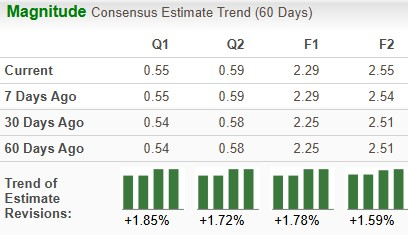
Image Source: Zacks Investment Research
Price Performance & Valuation of TMUS & T
Over the past year, T has gained 7.1% against the industry’s decline of 5.1%. TMUS has declined 18.7% over the same period.
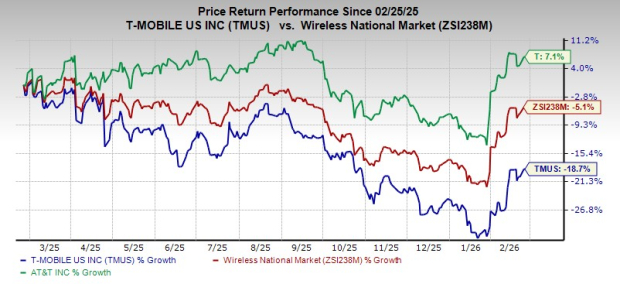
Image Source: Zacks Investment Research
Going by the price/earnings ratio, T-Mobile’s shares currently trade at 19.92 forward earnings, while AT&T’s shares currently trade at 12.26 forward earnings.
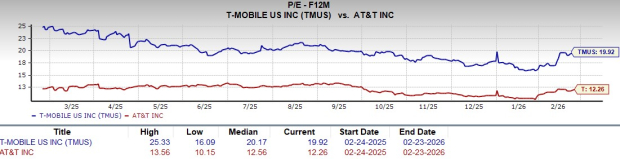
Image Source: Zacks Investment Research
TMUS or T: Which is a Better Pick?
AT&T carries a Zacks Rank #3 (Hold) at present, while T-Mobile carries a Zacks Rank #4 (Sell). You can see the complete list of today’s Zacks #1 Rank (Strong Buy) stocks here.
Both T-Mobile and AT&T are affected by intensifying competition in the U.S. telecom market. Despite T-Mobile’s effort to boost end-user experience by integrating AI, the company is affected by growing customer acquisition costs and a high churn rate. AT&T’s rapidly growing fiber infrastructure and convergence strategy are driving customer additions. Focus on portfolio diversification is expected to give it a competitive edge. Hence, with an attractive valuation, better price performance and a Zacks Rank #3, AT&T appears to be a better investment option at the moment.
Want the latest recommendations from Zacks Investment Research? Today, you can download 7 Best Stocks for the Next 30 Days. Click to get this free report
AT&T Inc. (T): Free Stock Analysis Report
Verizon Communications Inc. (VZ): Free Stock Analysis Report
T-Mobile US, Inc. (TMUS): Free Stock Analysis Report
This article originally published on Zacks Investment Research (zacks.com).
Mentioned In This Article
Latest News
| 1 hour | |
| 13 hours | |
| Oct-10 | |
| Oct-10 | |
| Oct-10 | |
| Oct-10 | |
| Oct-09 | |
| Oct-09 | |
| Oct-09 | |
| Oct-09 | |
| Oct-09 | |
| Oct-09 | |
| Oct-09 | |
| Oct-09 |
Wireless Carriers' Day of Woe After SpaceX Spectrum Deal
TMUS -13.27% T -10.82% VZ -10.14%
The Wall Street Journal
|
| Oct-09 |
