2 Technical Threats That Could Invite S&P 500 Profit Taking
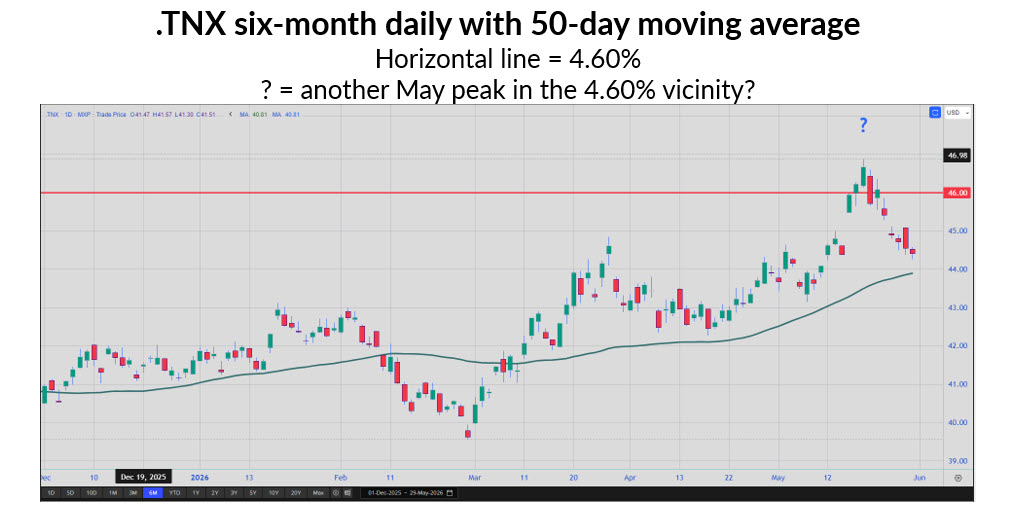
“The yield on the 10-year Treasury bond surged from 4.36% to nearly 4.6% during the week, with most of the damage being done on Friday, as the 10-year yield traded at its highest level since May 2025. For what it is worth, the 10-year peaked at 4.6% in May 2024 and May 2025 before pulling back by 100-basis points and 50-basis points, respectively. Might we see a third consecutive May peak in the 10-year yield at 4.6%?”
-Monday Morning Outlook, May 18, 2026
Market participants navigated multiple economic, geopolitical and company-specific headlines last week. They ranged from more attacks on Iran to reports of a deal being reached to extend the ceasefire. Economic data included April PCE prices that were below expectations, while company-specific news included earnings reports (mostly from retailers), and reports that the much-anticipated SpaceX IPO will scale back its valuation target from $2 trillion to $1.8 trillion.
When all was said and done, it was noticeable that the 10-year yield (.TNX) was lower for the week, retreating from 4.56% to 4.44%. As I noted in the middle of the month, the .TNX had retreated significantly from the 4.60% area beginning in May 2024 and May 2025. As such, I asked if May 2026 would mark a third consecutive year in which a major peak occurred at 4.60%?
The retreat in bond yields has been supportive of the market, with the advance/decline line improving on the S&P 500 Index (SPX—7,580.06), Dow Jones Industrial Average (DJI—51,032.46), and Nasdaq-100 Index (NDX—30,333.18). In fact, the new highs in the NDX were confirmed by new highs in its advance/decline line. While the other two benchmarks’ advance/declines did not reach new highs like the respective benchmarks, there has been a broadening in the number of stocks participating in the rally since yields peaked.
“The SPX closed beneath its 10-day moving average last Tuesday for the first time since the bottom in late March, and the slope of this moving average is not as steep as two weeks ago…the close below the 10-day moving average lasted one day, with dip buyers noticeably and immediately present. However, Friday’s high was in the vicinity of the prior week’s high just above 7,500. And the 7,530 level, which is 10% above last year’s close, is just overhead.”
-Monday Morning Outlook, May 26, 2026
There have been a couple potential “low-key” technical threats that hinted at slowing momentum, but amid the tailwind of lower rates, the SPX has made new highs.
The first technical threat to the SPX’s momentum higher was the close beneath its 10-day moving average two weeks ago. But buyers immediately stepped in, and I noticed that support was at its 15-day, or three-week, moving average.
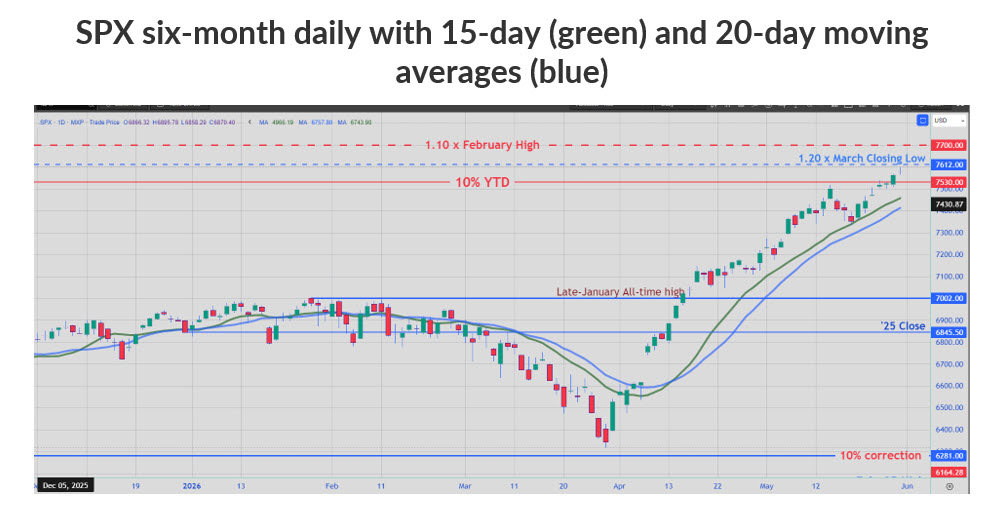
In the chart below, I display the SPX with its 15-day and 20-day moving averages, which are sitting at 7,460 and 7,415, respectively. If support at the SPX’s 15-day moving average is eventually broken, perhaps the 20-day, or four-week, moving average becomes supportive.
The second technical threat to the SPX’s momentum was the 7,530 level, which is 10% above the 2025 year-end close. The mid-May high was just below this level before a short-term pullback. The SPX made another run at this level, stalling in its vicinity early last week, but powering through it late in the week.
With the index at all-time highs, the path of least resistance is higher. As such, the best approach one can take is using an educated guess on where potential resistance may lie overhead.
I’m focusing on a couple levels overhead that could drive some profit-taking. The first is around 7,615, which is 20% above the March closing low. Investors anchoring to this closing low may be tempted to take some profits or reduce exposure in this area.
Another level that could invite profit-taking is at 7,700, which is exactly 10% above the late-January high that preceded a two-month correction of nearly 10%. Traders or investors that bought the mid-April breakout above the January high could reduce exposure if fixating on an approximate 10% gain at the round 7,700 century mark.
“Investors may be underestimating the chances of a ‘timely’ reopening of the Strait of Hormuz triggering a broad relief rally across financial markets, according to Citadel Securities… A full reopening of Hormuz by the end of July could lead to a decline of more than 12 basis points in 10-year Treasury yields…”
It goes without saying that as the market has moved higher, sentiment has followed, as market participants chase stocks higher or get into chasing mode (“fear of missing out”).One area that we see an optimistic extreme is among option buyers on SPX component stocks, with the 10-day buy (to open) put/call volume ratio at a multi-year low. Such extremes represent a sentiment-based risk. This risk is downgraded IF the technical backdrop is supportive of the sentiment, and such is the case at present.
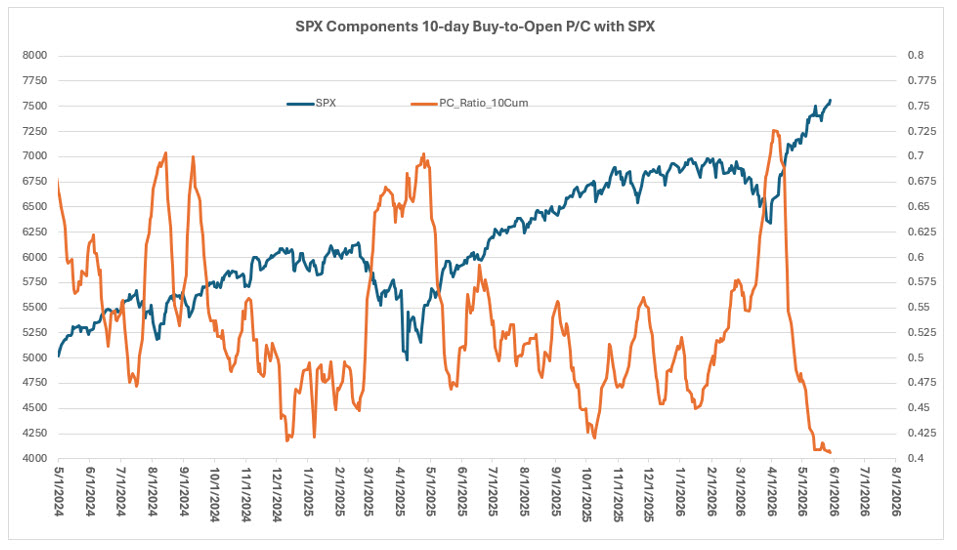
This extreme sentiment among SPX component option buyers is something to keep on your radar, but it is not yet actionable. The same can be said for exposure to stocks among active investment managers, as seen in the weekly NAAIM survey. The current reading is 98, which means fully invested. It reached a reading of 96 in early May, but this preceded only a shallow pullback before new highs to close the month.
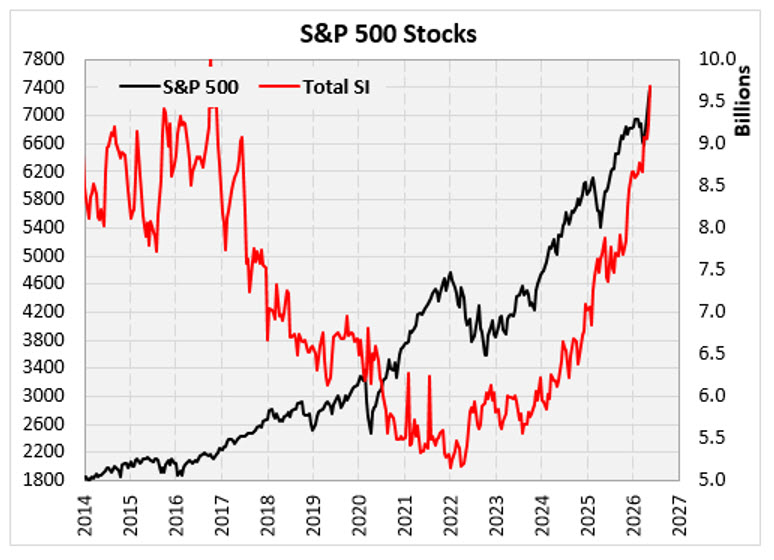
The above sentiment indicators are also tricky from the perspective that short interest on SPX stocks is around multi-year highs. This short interest represents future buying power and could be supportive on declines-- or help propel rallies on margin calls (short-covering rallies).
In fact, per the graph below, short interest increased a whopping 5% in the latest report, which covers two weeks. Based on this, if you are a bull, stay the course. This increase occurred as breadth improved in this period.
If the sentiment in the equity options market and among active investment managers is keeping you awake at night, a hedge of some sort may be worthwhile. The Cboe Market Volatility Index (VIX—15.78) is at its lowest level since mid-January. In other words, portfolio insurance is roughly one-half the cost of late-March. It is better to buy insurance during the calm versus the storm and we have not been insulated from 10% corrections, even with the market highly shorted.
Todd Salamone is Schaeffer's Senior V.P. of Research
Mentioned In This Article
Latest News
| Oct-16 | |
| Oct-15 | |
| Oct-14 | |
| Oct-13 | |
| Oct-12 | |
| Oct-09 | |
| Oct-08 | |
| Oct-07 | |
| Oct-06 | |
| Oct-05 | |
| Oct-02 | |
| Oct-01 | |
| Sep-30 | |
| Sep-29 | |
| Sep-28 |
