Real Parkinson's Disease Hope from Jupiter Neurosciences

By Mike Sheikh
Parkinson’s Disease has challenged drug developers for generations, but Jupiter Neurosciences (NASDAQ: JUNS) is betting that a streamlined clinical plan can break the stalemate. The market isn’t recognizing the story yet with its paltry market cap of $5.0M, and that disconnect has created a sizable opportunity for investors for a future rerating. Innovations in Parkinson’s Disease (PD) over the past 20 years have stagnated and been focused on dopamine replacement. The only innovations have been in either delivery or the smoothing out of fluctuations in the drug levels a patient gets during the day. There are about 1.1M people living with PD so if there was a new disease modifying drug capable of treating this patient population it would be conservatively valued by big pharma in the $2-6 billion range.
Big Pharma Focus – Symptoms
A handful of big pharma’s are working on Parkinson’s Disease. The leader is Roche (OTC: RHHBY) and they have a monoclonal antibody called Prasinezumab. It was designed to bind to alpha-synuclein. While there is no consensus on what truly causes Parkinson’s Disease, there is a consensus that misfolded proteins of alpha-synuclein accumulate into clusters called Lewy bodies which ultimately disrupt the neuronal cells that produce dopamine. Dopamine is a key neurotransmitter and hormone essential for motor control of our muscles. Neuroinflammation was also tagged as an alternative pathway of disease progression in PD.
Roche and its partner Prothena Corporation plc (NASDAQ: PRTA) failed to meet their primary endpoint in a Phase 2b study designed to show the slowing of motor function progression. Despite the failure there was enough close data in a subgroup for them to continue with development. Other big pharmas like Abbvie (NASDAQ: ABBV) and Biogen / Denali (NASDAQ: BIIB) (NASDAQ: DNLI) are continuing with their drug development on therapies designed to treat the symptoms. Big pharma has no disease modifying therapies in the pipeline and is focusing on symptom management.
Parkinson’s Disease – Pure Plays
A new group of small/microcap biotechs are pursuing PD by looking at the upstream biological causes of the disease. They are looking at targets like alpha-synuclein misfolding, impaired lysosomal clearance, chronic neuroinflammation, mitochondrial dysfunction, oxidative stress, and abnormal production of neurotoxic proteins. The opportunity in proving that a drug has disease modifying properties is substantial because it would result in a multibillion-dollar asset if they can show that the drug is capable of slowing the clinical progression of the disease. Success will ultimately boil down to the analysis of whether or not the medicine works. Investors need to parse through the MOA, the biomarkers, and ensure the trial endpoints of the study are randomized proof of disease modification.
Anavex Life Sciences Corp. (NASDAQ: AVXL)
- Market Cap: $316.1M
- Phase 2
- Alzheimer’s / Parkinson’s Target: Sigma-1 Receptor (SIGMAR1) & Muscarinic Receptors / Autophagy restoration.
- Pipeline Focus: Anavex develops small-molecule therapeutics designed to restore cellular homeostasis and enhance autophagy (cellular clearing) upstream of protein aggregation. Their lead asset, blarcamesine (ANAVEX®2-73), is an oral SIGMAR1 agonist that has completed Phase 2 proof-of-concept trials in Parkinson’s disease dementia and is advancing in clinical models targeting alpha-synuclein accumulation and motor function restoration.
AC Immune SA (NASDAQ: ACIU)
- Market Cap: $266.7M
- Phase 2
- Parkinson’s Target: alpha-Synuclein aggregation and NLRP3 Inflammasome.
- Pipeline Focus: AC Immune utilizes its proprietary SupraAntigen and Morphomer platforms to target protein misfolding. Their lead Parkinson’s drug, ACI-7104 (VacSYn program), is an active candidate in Phase 2 development designed to stimulate an immune response against toxic alpha-synuclein. They are also advancing ACI-19764, a brain-penetrant NLRP3 inflammasome inhibitor aimed at curbing neuro-inflammation.
Gain Therapeutics, Inc. (NASDAQ: GANX)
- Market Cap: $90.0Ml
- Phase 1b
- Parkinson’s Target: GBA1 / Glucocerebrosidase (GCase).
- Pipeline Focus: Gain uses its proprietary computational platform to discover allosteric small-molecule activators. Their lead drug, GT-02287, restores enzyme activity in misfolded GCase to improve lysosomal clearing of alpha-synuclein.
Annovis Bio, Inc. (NYSE: ANVS)
- Market Cap: $76.6M
- Phase 3
- Parkinson’s Target: Neurotoxic Protein Translation (alpha-synuclein, APP, Tau).
- Pipeline Focus: Annovis develops Buntanetap, an oral small molecule that inhibits the translation/overexpression of neurotoxic proteins upstream in the pathway. It is currently in late-stage Phase 3 trials for Parkinson’s disease motor and cognitive symptoms.
Jupiter Neurosciences, Inc. (NASDAQ: JUNS)
- Market Cap: $5.0M
- Phase 2
- Parkinson’s Target: Neuro-inflammation, Mitochondrial Dysfunction, and Oxidative Stress (SIRT1 / Nrf2 pathways).
- Pipeline Focus: Jupiter Neurosciences develops therapeutics targeting neuro-inflammation and mitochondrial decay underlying CNS disorders. Their lead asset, JOT-001, is a proprietary oral formulation of resveratrol designed to achieve high bioavailability and cross the blood-brain barrier without GI side effects, aiming to reduce neuro-inflammation and protect dopaminergic neurons in Parkinson’s disease and rare neurodegenerative conditions.
Standing Out From the Competition – Best in Class
Jupiter Neurosciences (NASDAQ: JUNS) is one of the market’s smallest and least recognized pure play biotechs involved in Parkinson’s Disease. The company’s lead candidate, JOTROL, is an oral, enhanced-bioavailability formulation of trans-resveratrol designed to address neuroinflammation, oxidative stress, and mitochondrial dysfunction. The market’s preoccupation on alpha-Synuclein in light of the failed trial of Prasinezumab should be skeptical of this as the primary pathway in the pathogenesis of Parkinson’s Disease. As mentioned earlier, calming the neuroinflammation may be an interconnected process of Parkinson’s as it is implicated in the loss of the dopamine-producing neurons. Unlike companies concentrating principally on one protein target, Jupiter is pursuing a broader cellular-resilience thesis centered on SIRT1- and Nrf2-linked pathways. JOTROL has the potential to be disease modifying and “Best in Class.”
Efficient Clinical Trial Readout within the Year
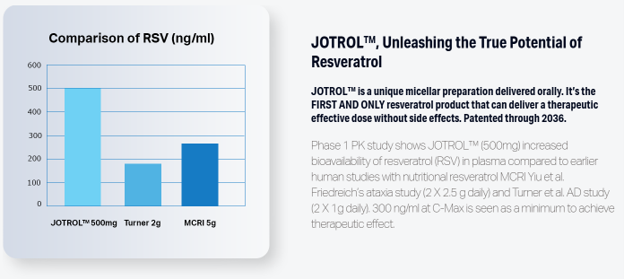
Jupiter has begun enrolling patients in the Phase 2a RESET trial of JOTROL in Parkinson’s disease. The company reported in its Phase 1 study (n=24) that there was approximately a nine-fold higher plasma bioavailability than conventional resveratrol, measurable cerebrospinal-fluid exposure, and no serious adverse events. While this data supports pharmacokinetic and tolerability claims, it does not yet establish clinical efficacy in Parkinson’s. This is the goal of the Phase 2a study which is projected to be completed in the first half of 2027, and the critical next value inflection point.
The company announced in May 2026 that patient enrollment was underway in its Phase 2a RESET trial in Parkinson’s disease. This is a randomized, placebo-controlled trial enrolling 30 patients and is designed to evaluate safety, tolerability, pharmacokinetics, cerebrospinal fluid penetration, and inflammatory biomarkers, alongside standard clinical assessments. It’s key to point out to investors that this trial is simply not another symptom management study but actually looking for disease modification. The trial design is built to generate mechanistic evidence that could support a disease-modification argument if the biomarker and clinical data move in the right direction.
Catalysts and Risks
The next major catalyst is straightforward in the sense that they need to execute on the Phase 2a RESET study. The study is fully funded and if they keep their timeline of Q1 2027 investors will start to rerate the company as they stop their obsessive focus on the financings, overhang, and the corporate restructuring. Any delays will be met with negative investor sentiment. If the trial produces biomarker evidence consistent with the disease-modification hypothesis the stocks market cap should start moving higher.
Many investors may think the clinical risk is extremely high because the duration is only 12 weeks with a patient population of 30. This forms the basis of their thesis of disease modification. While this is a risk, investors also should realize that Nugevia is a supplement launched by JUNS in June 2025 so the safety data will likely be positive. It’s very likely that they used patient surveys to fine tune their study design which mitigates the risk of a poor trial design. Also mitigating the risk are the animal trial results which showed changes in AD gene expression that were neuroprotective along with changes in inflammatory gene and cytokine levels.
JUNS is an asymmetric setup that may interest speculative investors who like highly derisked biotechs. The PD market place is barren of fresh treatment ideas. A disease-modifying drug is sorely needed. JUNS is one of the few microcap stories trying to attack that gap with a live clinical program and near-term data catalysts.
Final Takes
Jupiter Neurosciences (NASDAQ: JUNS) presents an unusually asymmetric Parkinson’s disease opportunity that could launch into the billions for speculative biotechnology investors if the medicine pans out. At approximately $5 million market cap, the company trades at a dramatic discount to Parkinson’s-focused pure plays with market capitalizations ranging from roughly $76 million to more than $300 million. The disparity is not rational and based on the future fear of further dilution rather than the potential of the science. By all accounts JUNS appears to have the “Best of Breed” technology versus a knockoff of another alpha-Synuclein blocker. While there are no guarantees to the stoppage of future dilution before the Phase 2a results it looks like JUNS has ripped off the proverbial band aid and no more dilution is on the horizon at these deeply discounted valuations.
JOTROL is a much better formulation of the nutraceutical resveratrol. It was designed to deliver a therapeutic dose without the gastro intestinal side effects. By increasing the bioavailability by nine-fold without any serious adverse effects it has positioned the drug as long term disease modifying oral treatment for PD. The next topline PD readout is expected in H2 of 2026 from ACIU followed by JUNS in Q1 2027 which places them at the head of the approval pack.
To keep the article focused, we left out that JUNS just doubled their pipeline and acquired rights to PharmAla Biotechs ALA-002 to treat post-traumatic stress disorder (PTSD) offering considerable upside and number of additional shots on goal. The value of JUNS borders on absurd and value investors and biotech investors should consider accumulating at the current levels or even higher. There are only 770K shares in the O/S making it a low float play with short squeeze potential adding the bullish investment thesis.
Never Miss our Weekly Highlights HERE
The post Real Parkinson’s Disease Hope from Jupiter Neurosciences appeared first on ExecEdge.
Mentioned In This Article
Latest News
| Oct-06 | |
| Aug-31 | |
| Aug-21 | |
| Aug-19 | |
| Aug-05 | |
| Jul-22 | |
| Jul-22 | |
| Jul-21 | |
| Jul-21 | |
| Jul-07 | |
| May-27 | |
| May-26 | |
| May-21 | |
| May-20 | |
| May-20 |
