The Clarity Act Gains Momentum: What you Need to Know
What is the Clarity Act?
The Digital Asset Market Clarity Act, better known as the Clarity Act, is a proposed federal bill that would establish a broad regulatory framework for digital assets and cryptocurrencies in the United States. For years, crypto and digital asset firms have been confused about which regulatory agency has jurisdiction over the industry. This murky regulatory environment leads to contradictions among regulators and litigation against digital asset firms trying to navigate these murky waters. The proposed bill seeks to set blear boundaries between the Securities and Exchange Commission and the Commodity Futures Trading Commission.
Beyond defining regulatory oversight, the bill groups assets into distinct categories such as digital securities, digital commodities, and permitted payment stablecoins. Additionally, The Clarity Act provides consumer protection by requiring exchanges like Coinbase (COIN) to register, disclose risks, and properly safeguard customer funds. Finally, the bill provides ethics guidelines for public officials, requiring them to divest from digital assets or place them in a blind trust.
What is the Status of the Clarity Act?
Introduced as a bipartisan bill by Senators Cynthia Lummis and Kirsten Gillibrand in June 2022, the foundational framework for the Clarity Act moved through Congress for over 4 years amid disagreement over the bill and pushback from legacy banking institutions. However, after a long road, the bill finally seems to be making progress. Last weekend, Senate Republicans released and updated 635-page text with significant concessions. A Senate Vote is scheduled for Tuesday afternoon. Because Republicans currently hold 53 Senate seats, the bill will need to win support from at least seven Democrats to overcome a potential filibuster and reach the 60-vote threshold.
According to reporting from Bloomberg, “There are 7-10 Democrats that ultimately want to pass a bill.” Meanwhile, according to Kalshi, the odds that the Clarity Act becomes law before July 1st, 2027 surged from ~30% earlier this month to 53%.
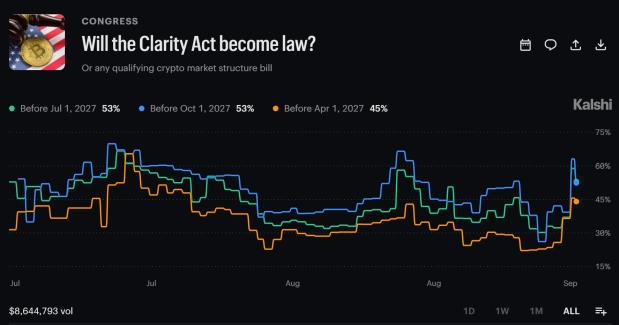
Image Source: Kalshi
The Clarity Act is a Potentially Massive Bullish Catalyst
For years, digital asset companies have dealt with regulation by enforcement, an uneven playing field, and de-banking. As a result, if the Clarity Act passes, it would be a major long-term catalyst for crypto proxies like the iShares Bitcoin ETF (IBIT), the iShares Ethereum Trust (ETHA), the Solana ETF (SOLZ), and stablecoin operator Circle Group (CRCL).
Bottom Line
By establishing clear regulatory boundaries between federal oversight agencies, enforcing stronger consumer safeguards, and implementing ethics guidelines, the Clarity Act offers a path out of years of regulatory uncertainty.
Want the latest recommendations from Zacks Investment Research? Today, you can download 7 Best Stocks for the Next 30 Days. Click to get this free report
Coinbase Global, Inc. (COIN): Free Stock Analysis Report
Circle Internet Group, Inc. (CRCL): Free Stock Analysis Report
This article originally published on Zacks Investment Research (zacks.com).
Mentioned In This Article
Latest News
| 2 hours | |
| 2 hours | |
| 8 hours | |
| 8 hours | |
| 10 hours | |
| 11 hours | |
| 11 hours | |
| 12 hours | |
| 12 hours | |
| 12 hours | |
| 13 hours | |
| 14 hours | |
| 18 hours | |
| Oct-07 | |
| Oct-07 |
