Tech Retakes Lead Heading into Q4: Stocks to Watch
There’s an old market adage that says you should watch what stocks do, not what they’re supposed to do. Last week offered a textbook case.
On Wednesday, the Federal Reserve raised interest rates for the first time since July 2023 and signaled it isn’t finished. The ten-year Treasury yield touched over 5%, its highest level since July 2007. By every piece of conventional wisdom, that combination should have been devastating for stocks.
Instead, the Nasdaq climbed about 2% between the last two sessions of the week, reclaiming its 50-day moving average as investors rotated back into memory and chipmakers. SanDisk surged nearly 11% on Friday to lead the S&P 500. AMD closed within striking distance of its 52-week high.
Heading into the fourth quarter, technology has quietly retaken market leadership — and the reason it’s happening in the teeth of a hawkish Fed tells you something important.
What the Fed Actually Did
Let’s start with the facts, because the details matter more than the headline.
The FOMC raised its target range 25 basis points to 3.75%–4.00% on a unanimous 12-0 vote. Chair Kevin Warsh was blunt at the press conference: “The plain fact is that inflation is too high and has been for too long.” When asked about political pressure for lower rates, he offered only, “We stay in our lane.”
The projections did the real damage. Of the 18 officials submitting forecasts, 16 see at least one additional hike this year — twelve expect exactly one more, four expect two, and only two see rates holding here. The median end-2026 dot sits near 4.1%. The committee also raised its core PCE forecast to 3.4% from 3.3% and pushed the expected return to 2% inflation out to 2029.
Warsh, notably, again declined to submit a dot of his own, just as he did in June. That 4.1% median is the committee’s view, not the Chair’s commitment — which leaves every remaining meeting genuinely data-dependent.
The market’s initial reaction was ugly. The Dow fell roughly 600 points on the announcement. But the better characterization of the week is that this was a duration shock rather than a decision shock: the hike itself was priced, and what investors had to reprice was how long rates stay restrictive.
Why Tech Led Anyway
Here’s the part that deserves attention. If rising long rates are supposed to compress high-multiple valuations, why did semiconductors lead the rebound?
The answer lies in where our work at Zacks concentrates. Earnings estimate revisions in the semiconductor space have been so strong that they overwhelm the discount-rate math. When analysts raise next year’s earnings estimate by 20% or more, a modestly higher discount rate is noise by comparison. Rate-sensitivity arguments assume the earnings stream is fixed. Right now, it isn’t.
Energy is also cooling as a competing trade after oil’s surge past $100, and the rate-sensitive corners of the market — housing, homebuilders, REITs — have nowhere to hide with the ten-year hovering near 5%. That leaves capital looking for growth that doesn’t require cheap money. Semiconductors fit the bill.
Stocks to Watch
Advanced Micro Devices AMD has emerged as the clear second horse in the AI infrastructure race. Shares closed Friday at $559.82, up 2.7% on the session and roughly 161% year-to-date from a January starting point near $215, putting the market capitalization at about $914 billion. That leaves the stock about 4% below its 52-week high — a remarkable recovery as we approach the final quarter of the year.
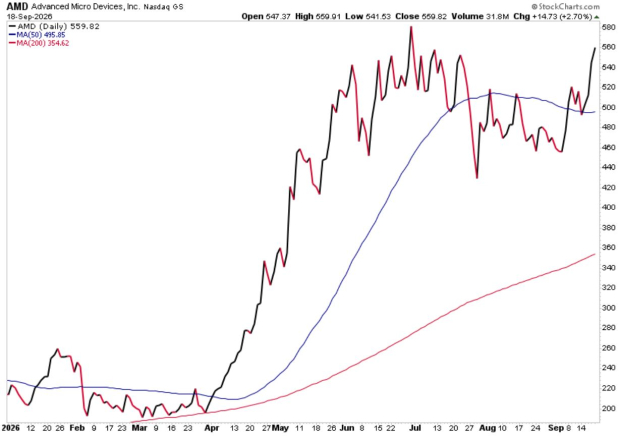
Image Source: StockCharts
The fundamentals justify the move. Second-quarter revenue rose 50% to $11.54 billion, with Data Center revenue doubling to $6.7 billion and non-GAAP EPS of $1.66 topping consensus. CEO Lisa Su has guided to revenue growth “substantially above 35%” with EPS exceeding $20 over about a 5-year timeframe, underpinned by the Helios rack-scale platform now shipping commercially and GPU commitments from OpenAI, Meta, Oracle, Microsoft and others. AMD is set to report quarterly results in early November.
SanDisk SNDK is the more explosive story. Shares jumped 10.99% Friday to end just under $1,800, leading the S&P 500, and are up more than 650% year-to-date. Two catalysts converged: a structural NAND flash shortage that has handed the company genuine pricing power, and confirmation that SanDisk joins the S&P 100 on Monday, which makes passive index funds mandatory buyers.
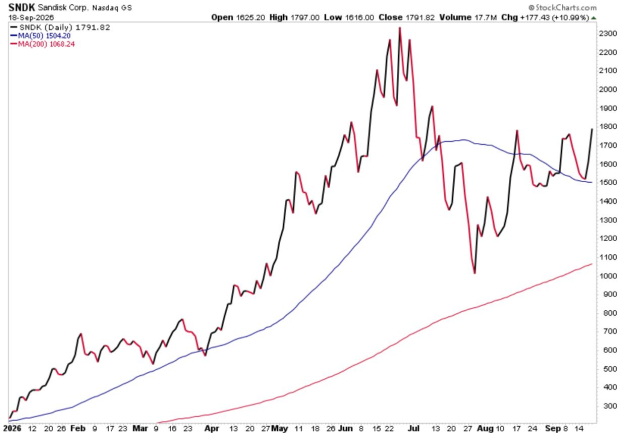
Image Source: StockCharts
Bottom Line
The Fed has told us rates are higher for longer, but the rotation back into tech stocks tells us that the earnings story continues to overwhelm slightly higher rates.
That doesn’t make these stocks safe as both carry volatility that accompanies momentum leadership. But with estimate revisions still pointed higher across semiconductors and memory, the path of least resistance heading into the fourth quarter appears to run through technology.
Want the latest recommendations from Zacks Investment Research? Today, you can download 7 Best Stocks for the Next 30 Days. Click to get this free report
Advanced Micro Devices, Inc. (AMD): Free Stock Analysis Report
Sandisk Corporation (SNDK): Free Stock Analysis Report
This article originally published on Zacks Investment Research (zacks.com).
Mentioned In This Article
Latest News
| 26 min | |
| 1 hour | |
| 2 hours | |
| 2 hours | |
| 2 hours | |
| 3 hours | |
| 3 hours | |
| 4 hours | |
| 4 hours | |
| 5 hours | |
| 5 hours | |
| 5 hours | |
| 5 hours | |
| 7 hours | |
| 7 hours |
Stock Market Today: Dow Rises On Bank Earnings; Micron, Sandisk, SK Hynix Sell Off (Live Coverage)
SNDK
Investor's Business Daily
|
