How Should Investors Navigate These Mixed Market Signals?
Happy to be back filling in for our Director of Research Todd Salamone, this week. It was another week of higher rates and for the most part, choppy, sideways markets. But we may have gotten a signal as to which way things ultimately break. Maybe!
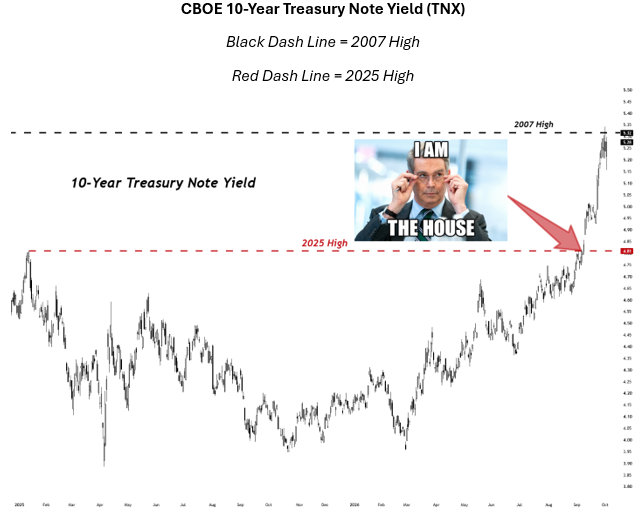
If you’re a rate watcher, you saw another advance in the 10-year and 30-year Treasury yields this past week. All of this comes on the heels of Treasury Secretary Scott Bessent’s “I am the house now” comment, in which he essentially challenged traders to bet against his efforts to strengthen the Japanese yen.
At the same time, the Treasury has expanded its buyback program for longer-dated government debt, which should theoretically help push yields lower. But markets have a funny way of humbling confidence, and when you tell traders, “I am the house now,” you shouldn’t be surprised when they decide to test said house.
The rise in rates is now spooking equity investors, who have grown much more comfortable with stocks advancing alongside falling or stable yields than with an inflationary advance in which equities and rates rise together. History, however, offers some perspective. Since 1953, the S&P 500 has been higher during 73% of rising-rate windows, with an average gain of +17.1%.
What we know is that the Cboe 10-Year Treasury Note Yield (TNX – 5.28%) touched 5.34% this week, its highest level since 2002. Friday’s weaker-than-expected jobs report initially knocked yields sharply lower, with the 10-year falling back beneath the 2007 high before recovering much of that decline and finishing around 5.28%. Equities, meanwhile, rallied. A pullback or consolidation in yields from here would certainly help ease some of the anxiety surrounding the magnitude of this move.
Those concerns aren’t entirely misplaced. Based on my studies, forward returns tend to slow after the 10-year yield reaches a five-year high, with average returns falling to roughly 5% versus the usual 9% over the next 12 months. At the same time, the odds of a 10% correction or greater jump from roughly one in three to nearly two in three. That’s really the whole effect: Returns slow, volatility rises, but the market has still tended to trudge higher.
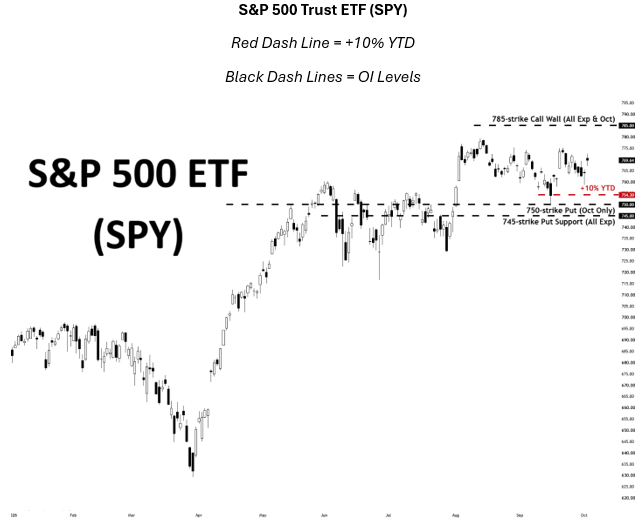
As for equities, the S&P 500 ETF Trust (SPY – 769.64) continues to chop around in consolidation for the eighth week since breaking above its May highs in early August. That can be frustrating for bulls, particularly as we once again see more of a rotational correction. It still induces plenty of pain underneath the surface, but it doesn’t necessarily offer traders a clean opportunity to hedge the broader market. So far, the 10% year-to-date level and put support continue to hold, with SPY’s 785-strike call wall serving as the next key upside level as we sit today.
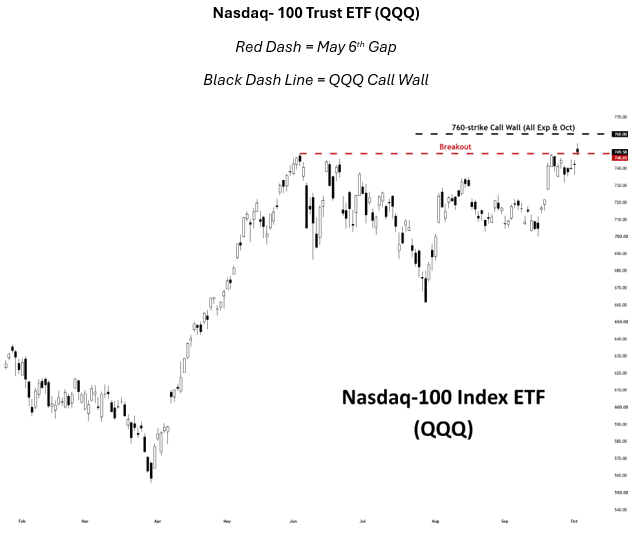
The silver lining, and perhaps the signal, is that technology resumed leadership this week. The Magnificent Seven broke out last week and this week broader technology pushed to new highs, while the Invesco QQQ Trust (QQQ – 749.58) also broke out to blue skies. More importantly, this is happening during one of the scarier seasonal windows on the calendar.
The post-September OPEX period is generally one of the worst periods for returns, with three-week returns averaging as 2.2% loss during midterm years. This window lasts until around the seventh trading day of October, which has historically marked the average timing of October lows. It’s a period in which we’ve seen plenty of flushes over the years, and is one of the primary reasons September has earned such a poor seasonal reputation.
But context and path matter, and that’s something people often leave out of the discussion. It just doesn’t make for as jarring of a headline, and fear sells. This year, the seventh trading day of October falls on Oct. 9, yet we’re already seeing signs of risk appetite returning, with technology and crypto moving higher.
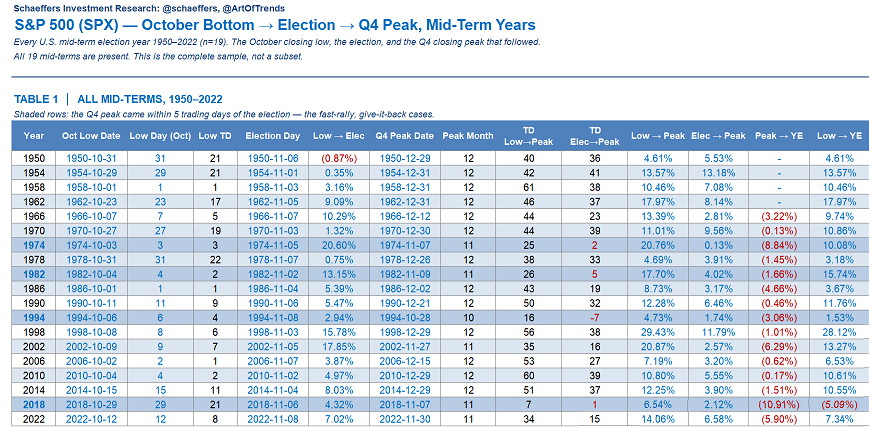
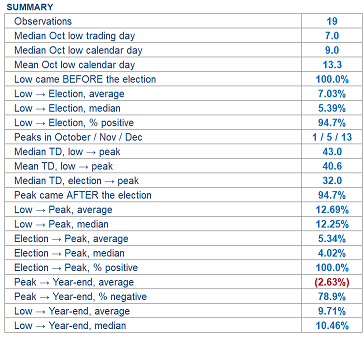
A few fun facts from the midterm-year data: The October low preceded Election Day in all 19 observations. Not once did the fourth-quarter bottom occur after the midterm election. From the October low through Election Day, the market was positive in 18 of 19 instances, with 1950 representing the lone miss at -0.87%. The average gain was 7.03%, with a median return of 5.39%.
Election Day through the fourth-quarter peak was even stronger, producing a positive return in all 19 observations. The average gain was 5.34%, with a median of 4.02%, and the peak typically occurred about 32 trading days after the election, putting it in late December. If you’d like to see more seasonal data about the period we are heading into, check out our latest Indicator of the Week.
When we turn to sentiment, the signals become more mixed. And it’s okay to admit that. Too often, financial pundits and traders anchor themselves to the narrative they want to express and then look for data to support it.
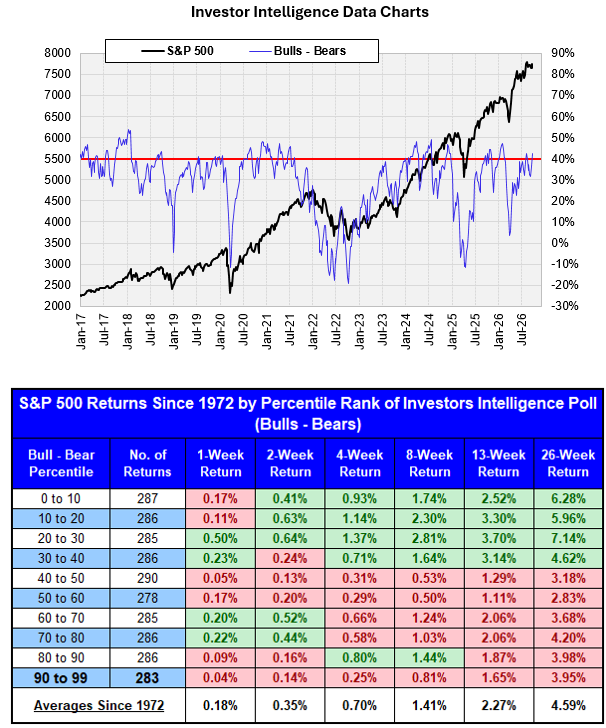
Take the Investors Intelligence survey. The bull-bear spread came in at 42.3, and we view anything above 40 as overly optimistic. Historically, when the indicator reaches the 90th percentile, forward returns from one week through 26 weeks have been poor. This dataset goes back to 1972, so there is significance behind it. One potential caveat is that the relationship may have changed somewhat in more recent history, and that shift may not yet be fully reflected in the longer-term data.
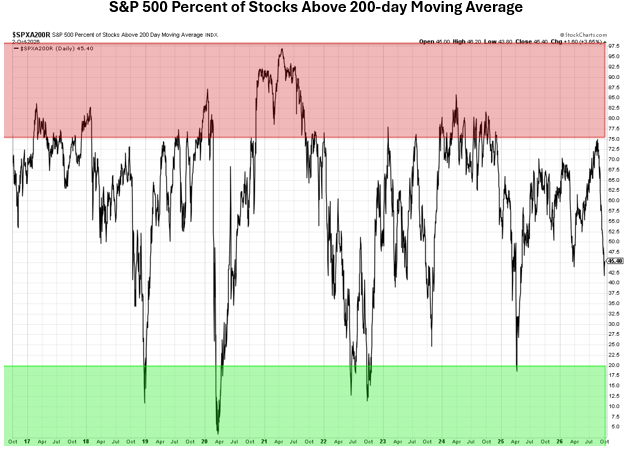
Breadth offers another mixed signal. The percentage of stocks below their 200-day moving average came in at 45.4%. This has been an area where rebounds have materialized before, marking local lows within broader uptrends. It can also be the level that sucks bulls into a bounce before a larger selloff begins. That’s trading, and it’s exactly what happened during the last Trump midterm year.
For example, the percentage of bears in the weekly American Association of Individual Investors (AAII) survey is 48%, higher than 95% of the readings in the survey’s history. Only 32% are bullish. Sentiment like this generally occurs in a bear market or market correction. Moreover, option buyers are ‘neutral’ at best, as opposed to being extremely bullish, with little drawdown so far since the all-time high last month.
“If these sentiment indicators were showing extreme optimism, I would be more worried about vulnerability to a corrective move. I want to emphasize that this doesn’t mean a corrective move lower isn’t in the cards, but I think the probability is lower relative to when sentiment indicators like the AAII survey and SPX component buy-to-open put/call volume ratio are displaying extremes in optimism amid a consensus mentality that ‘the sky is the limit.’”
--Monday Morning Outlook, Sept. 28, 2026
The larger point is that sentiment and breadth remain muddled, without a clear message in either direction. Todd discussed much of the same last week when looking at the weekly AAII survey, the SPX components 10-day buy-to-open put/call volume ratio, and VIX futures.
With all that said, this remains a market where you stay the course until the price trend breaks down, or something materially changes. In the meantime, we have tech stocks attempting to lead a breakout just as we approach what has historically been a much more favorable seasonal period by the end of this week.
Maybe it’s arriving a little early this year. Or maybe what we just saw was a fakeout breakout that ultimately gives way to a larger correction.
Sometimes it’s okay to say, “I don’t know,” and simply follow the price action until it fails. As traders and investors, we need to be comfortable with that. It’s part of the game. The best we can do is map out the most probable outcomes, recognize when the evidence changes, and manage our risk accordingly.
Matthew Timpane is Schaeffer's Senior Market Strategist.
Continue reading:
Mentioned In This Article
Latest News
| 3 hours | |
| 4 hours | |
| 5 hours | |
| Oct-26 | |
| Oct-26 | |
| Oct-26 | |
| Oct-26 | |
| Oct-25 | |
| Oct-23 | |
| Oct-23 | |
| Oct-23 | |
| Oct-23 | |
| Oct-23 | |
| Oct-23 | |
| Oct-22 |
