Winnebago Edges Past The Whisper, But Self-Help Guidance Rests On A Shrinking RV Market
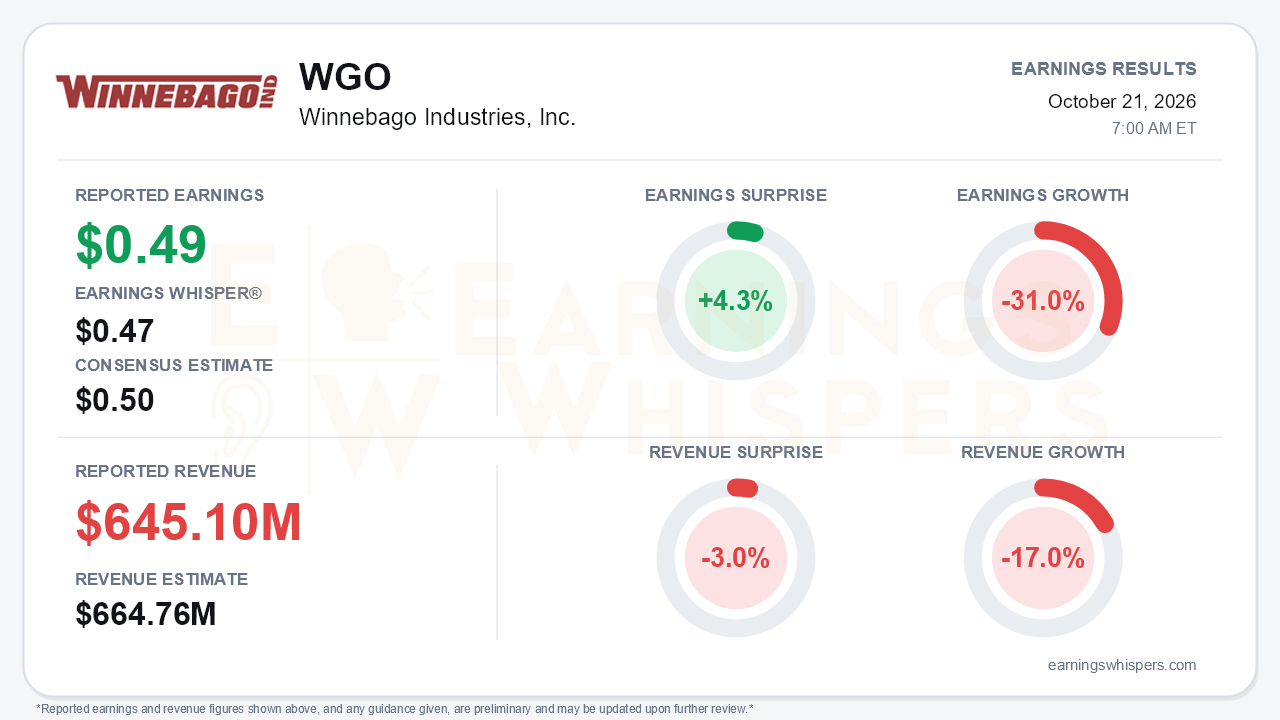
Winnebago Industries reported fiscal fourth-quarter adjusted earnings of $0.49 per share. That beat the $0.47 Earnings Whisper number by 4.3% but came in a penny below the $0.50 consensus. Revenue of $645.1 million missed the $664.76 million consensus by 3.0%. Earnings fell 31.0% year over year and revenue fell 17.0%, a sharp step down from the full-year revenue decline of 3.4%. The quarter landed roughly where the cut third-quarter outlook implied. The more consequential development is the fiscal 2027 framework. Management guided adjusted EPS to $1.65 to $2.25, a midpoint about 9% above fiscal 2026's $1.79. It paired that with an industry wholesale outlook that keeps getting worse. That is the central tension: the earnings growth on offer is almost entirely self-help, while demand continues to erode.
The quality of the quarter deserves scrutiny. Gross margin slipped only 30 basis points to 12.5%, and the adjusted result was protected mainly by a 20.1% cut in operating expenses. On a GAAP basis, EPS was $0.34 versus $0.49 a year ago. Beneath the consolidated figures, the segments diverged sharply:
- Towable RV was the weak spot. Revenue fell 28.1% and units dropped 23.6%, with fifth-wheel deliveries down 39.0%. Operating margin compressed to 4.2% from 7.0% a year earlier and 5.8% in the third quarter, as discounts and allowances rose and mix shifted toward cheaper models.
- Motorhome RV swung to a 2.4% operating margin from a slight loss, extending a turnaround that ran through every quarter of the year. Even here, revenue fell 10.4%, and Class A deliveries were cut by more than half.
- Marine held its 7.1% margin, and Barletta pontoon share climbed to 9.7%.
Cash generation was the clear highlight. Operating cash flow reached $142.5 million in the quarter, and full-year free cash flow rose to $144.6 million from $89.5 million. Net leverage fell to 2.2x from 3.0x in the third quarter. A meaningful part of that improvement came from working capital, however. Receivables declined by $38.5 million and payables rose by $43.7 million over the year, and those tailwinds will not repeat indefinitely.
The call laid out how far the demand picture has deteriorated. Early in fiscal 2026, management had raised guidance to $2.8 to $3.0 billion in revenue and $2.10 to $2.80 in adjusted EPS. The company ultimately delivered about $2.7 billion and $1.79. The calendar 2027 wholesale assumption of 265,000 to 295,000 units sits far below the 315,000 to 345,000 range used for calendar 2026 in the first half of the year. Management also cited:
- retail running down mid-teens;
- higher rates and fuel prices;
- aluminum inflation running well above general inflation;
- persistent towable promotions;
- dealers hesitant to take model-year 2027 inventory.
First-quarter sales are guided down mid-to-high single digits, with adjusted EBITDA margin flat to slightly lower, and first-half EPS is expected to decline. The fiscal 2027 revenue range of $2.65 to $2.80 billion implies roughly flat sales and came in below estimates. That makes the back-half earnings ramp a matter of execution rather than recovery.
The self-help case is credible but back-end loaded. Management introduced a $70 million to $80 million cumulative gross savings program spanning fiscal 2027 to 2029, nearly half of it structural. It is anchored by two plant consolidations: moving Winnebago towables to Grand Design's Middlebury campus and shifting B-van production to Forest City. These moves carry roughly $6 million in fiscal 2027 restructuring costs and execution risk. On the positive side, Grand Design Towables dealer turns improved to 2.0x from 1.6x, and travel trailer share is growing again. Management also outlined new aftermarket and strategic mobility pillars, including Lithionics portable power, but these are long-dated options rather than near-term earnings drivers. Investors should also note the GAAP EPS guide of $0.90 to $1.50, which excludes nothing and brackets fiscal 2026's $1.21.
The market had already priced in much of the gloom. Shares were at $23.17 heading into the report, down 18.7% since the opening after the June release. They were about 30% below both the $33.31 200-day moving average and the inter-earnings high set on August 13, and sat just 5.6% above a fresh 52-week low of $21.95 set the day before earnings. Investor sentiment improved modestly to slightly positive from essentially neutral, a change too small to signal real conviction. The Earnings Whispers trend signals remain uniformly negative, consistent with the steady selling since August.
The bottom line is that Winnebago delivered a cleaner balance sheet, a working motorhome turnaround, and a cost plan that can lift earnings even in a soft market. It did not deliver evidence that demand has bottomed. Bears have legitimate ammunition in the collapsing towable business, the reset wholesale outlook, and a guide that depends on second-half self-help. Bulls can point to a depressed share price and improving cash discipline. Until retail trends stop deteriorating, the earnings growth story rests on execution rather than recovery.
Read our earnings preview for Winnebago Industries, Inc.: https://www.earningswhispers.com/article/WGO/20439
This earnings review was originally published on Earnings Whispers.
This article is for informational purposes only and is not investment advice. Earnings Whispers and its staff may hold positions in the securities mentioned. It was generated automatically, with the help of AI, from Earnings Whispers and company data, and checked by Earnings Whispers before publication.
Mentioned In This Article
Latest News
| 5 hours | |
| 7 hours | |
| 7 hours | |
| 12 hours | |
| 13 hours | |
| 19 hours | |
| Oct-01 | |
| Sep-29 | |
| Sep-28 | |
| Sep-23 | |
| Sep-15 | |
| Sep-10 | |
| Sep-09 | |
| Sep-01 | |
| Aug-20 |
