PennyMac Mortgage's MSR Exit Faces Its First Real Test As Dividend Coverage Looms
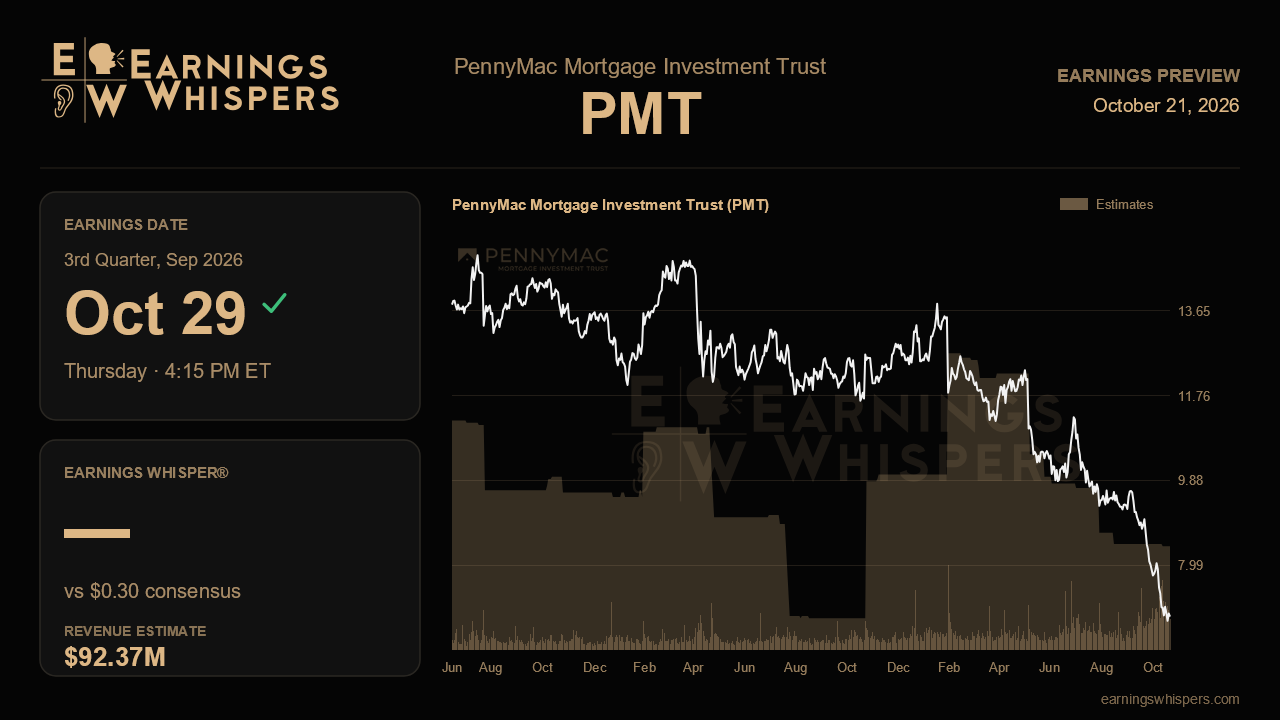
PennyMac Mortgage Investment Trust heads into its third-quarter report with a stock that has lost more than a quarter of its value since the last release, and with a simple question hanging over it: can the company's pivot from mortgage servicing rights into credit-sensitive private-label securities lift earnings back toward the $0.40 quarterly dividend, or has the market already concluded that it cannot? The quarter, due after the close on October 29, is the first to reflect both the planned sale of $13 billion in low-coupon agency MSRs and a full three months without conforming correspondent purchases. That makes it the cleanest early read on whether the strategy is working.
The Street is looking for earnings of $0.30 per share on revenue of about $92.4 million. That would be a solid sequential improvement from the $0.23 reported last quarter and the $73.0 million in revenue, but it still marks a steep contraction from a year ago, when the company earned $0.55 on $99.2 million. The expected 45.5% drop in EPS shows how far profitability has slipped from the strong second half of 2025. The company did not provide formal guidance. The nearest benchmark is management's own run-rate estimate of earnings potential, which ticked up to $0.33 per quarter from $0.31. Consensus sits a bit below that figure, a sign that analysts are leaving room for transition costs or softer volumes rather than banking on a clean execution story.
Last quarter's call offered a mixed picture. On the positive side, core earnings excluding market moves rose to $32 million from $28 million. Private-label loans acquired from PFSI production jumped 44% sequentially to $2.2 billion, and management said it remained on pace for roughly 30 securitizations this year with more than $600 million of retained investments targeting low-to-mid teens returns. The weaker spots were just as clear. Return on equity in credit-sensitive strategies fell to 11% from 17% the prior quarter and 27% at the end of 2025. Aggregation and securitization income slipped on lower volumes, and management acknowledged that rising rates were slowing originations. A strong report would show capital freed by the MSR sale quickly redeployed into subordinate bonds at returns near the stated targets, with securitization activity holding pace. The narrative would weaken if credit-sensitive returns slid again, if volumes faded further, or if the interest rate-sensitive segment lost the boost it got last quarter from slower prepayments.
The balance sheet deserves equal attention. Book value per share has fallen for three straight quarters to $14.83, and total debt-to-equity has climbed to roughly 12 times as non-recourse securitization debt is consolidated. Shrinking the MSR book should, in principle, ease some of the core leverage pressure. Another decline in book value, though, would undercut the argument that the rotation is improving the company's risk profile. With the dividend currently supported by taxable income rather than economic earnings, any commentary on payout sustainability will carry unusual weight.
Market sentiment has turned noticeably darker. Bearish readings have edged up from the prior quarter, and the shares are down 28.5% since the last report while the S&P 500 gained 5%. At $6.84, the stock is trading near the bottom of its post-earnings range of $6.70 to $9.81 and far below its 200-day moving average of $10.64. It also sits well beneath the prior quarter's trading band. At under half of reported book value, the price suggests investors are bracing for something worse than a modest earnings shortfall.
That sets a low bar but a pointed one. Hitting $0.30 matters less than showing that the run-rate is moving toward the dividend rather than away from it. If management can show the MSR proceeds working in higher-yielding credit assets while book value stabilizes, the pivot story stays intact. If not, the gap between earnings power and the payout becomes the only story that counts.
This earnings preview was originally published on Earnings Whispers.
This article is for informational purposes only and is not investment advice. Earnings Whispers and its staff may hold positions in the securities mentioned. It was generated automatically, with the help of AI, from Earnings Whispers and company data, and checked by Earnings Whispers before publication.
Mentioned In This Article
Latest News
| Oct-21 | |
| Oct-08 | |
| Sep-08 | |
| Sep-08 | |
| Sep-02 | |
| Aug-13 | |
| Jul-30 | |
| Jul-29 | |
| Jul-29 | |
| Jul-29 | |
| Jul-14 | |
| Jun-17 | |
| Jun-16 | |
| May-14 | |
| May-06 |
