Invesco Mortgage Capital Faces Book Value And Dividend Test After 27% Slide
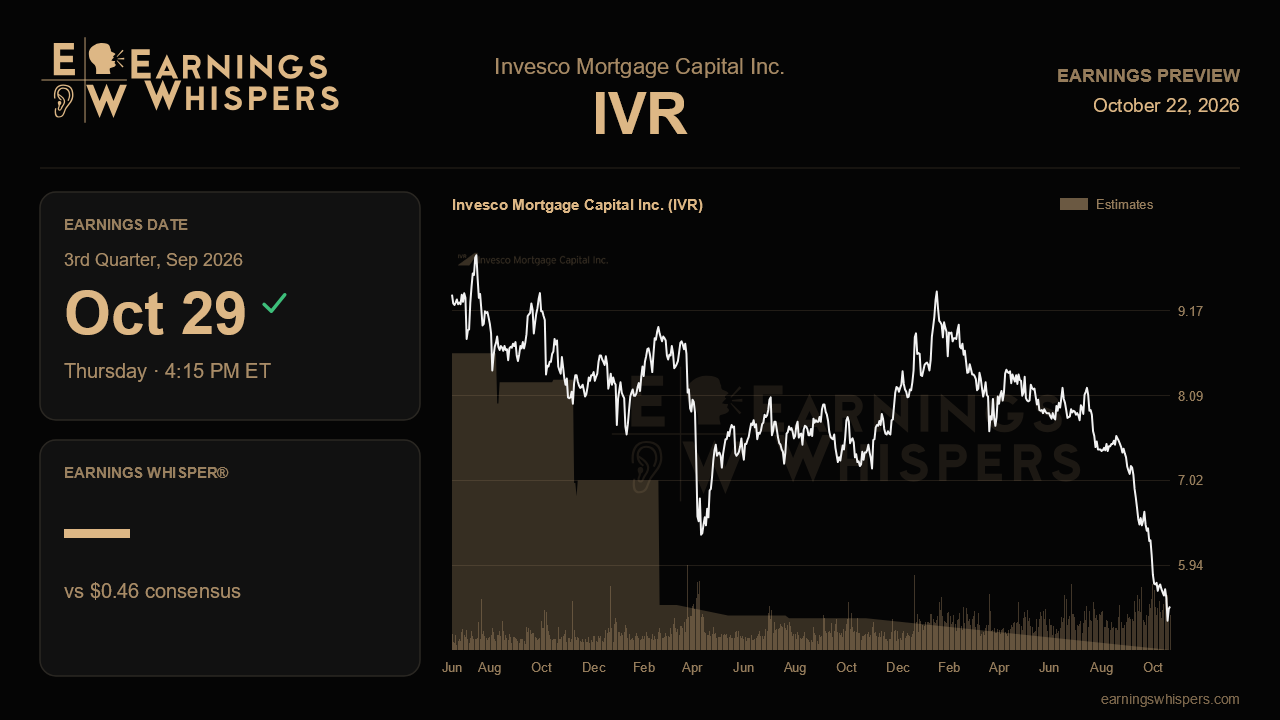
Invesco Mortgage Capital spent the second quarter doing what mortgage REITs do when they believe the opportunity is attractive: issuing stock and buying more bonds. The portfolio swelled to $8.2 billion, up more than 12% in a single quarter and roughly 44% from a year earlier. The market's verdict since then has been harsh. Shares have fallen nearly 27% since the last report while the S&P 500 gained about 4%, and the stock now sits at $5.42, well below its 200-day moving average of $7.78 and just a few percent above its post-earnings low of $5.22. The third-quarter report, due after the close on October 29, will show whether that expansion was well timed or whether the company scaled up just as the rate backdrop turned against it.
The Street is bracing for contraction. Consensus calls for earnings of $0.46 a share, down from $0.50 last quarter and about 21% below the $0.58 posted a year ago. That would be a third straight decline in earnings available for distribution, following $0.56 and $0.55 in the two quarters before the latest print. Management did not offer formal guidance, but it effectively set the bar itself by warning that earnings would face further pressure as older, lower-cost interest rate swaps roll off. A number near $0.46 would therefore look like the story unfolding as described. Something meaningfully lower would suggest the swap runoff is biting harder than expected, and that matters because the company pays 12 cents a month, or 36 cents a quarter. Coverage still looks adequate at consensus, but the cushion is thinning.
The more consequential figure may be book value. On the last call, management estimated book value was already down roughly 2.5% quarter to date, excluding the dividend, after mortgages underperformed. The macro picture it described was uncomfortable: a bear-flattening yield curve, markets beginning to price a possible rate hike under new Fed Chair Kevin Warsh, the elimination of forward guidance that raised front-end volatility, and renewed Middle East tensions. Current-coupon spreads, which had tightened to 143 basis points at the end of June, had already widened to around 150, and management raised the possibility of a move into the 160s. Wider spreads help future returns on new purchases, but they hurt the value of the bonds already on the books, and with a portfolio this large, the mark-to-market hit is amplified.
The defensive steps taken last quarter provide the framework for judging the results. The company held its hedge ratio at 97% and cut its duration gap from about half a year to a quarter year. If those moves limited the book value drawdown to something close to the early estimate, management's measured but constructive stance holds up. A materially larger decline would challenge the case for continued ATM issuance, since selling stock below book value dilutes existing holders rather than spreading costs over a larger base. The pace of issuance this quarter, after more than $250 million raised in the first half, will be an important tell about how management views its own shares at these prices. Liquidity of $548 million gives it room to absorb volatility, and the new book value sensitivity disclosure should make the risk easier to assess.
Sentiment has turned with the price. Readings have moved from modestly bullish ahead of the last report to modestly bearish now, consistent with a stock trading near its lows. That lowers the bar somewhat, but it does not remove the risk of a further leg down if the balance sheet news disappoints.
Ultimately, this report hinges less on whether earnings land at $0.46 and more on whether the rapid balance sheet growth has held up through a rougher rate regime. A contained book value decline and commentary that wider spreads now offer better reinvestment returns would support the scale-up thesis. A deep drawdown paired with continued earnings slippage would raise harder questions about dividend durability.
This earnings preview was originally published on Earnings Whispers.
This article is for informational purposes only and is not investment advice. Earnings Whispers and its staff may hold positions in the securities mentioned. It was generated automatically, with the help of AI, from Earnings Whispers and company data, and checked by Earnings Whispers before publication.
Mentioned In This Article
Latest News
| 13 hours | |
| Oct-21 | |
| Oct-16 | |
| Oct-14 | |
| Sep-15 | |
| Aug-31 | |
| Aug-14 | |
| Aug-03 | |
| Jul-31 | |
| Jul-30 | |
| Jul-30 | |
| Jul-20 | |
| Jul-15 | |
| Jun-18 | |
| Jun-12 |
