High-Yield REITs vs. 10-Year Treasuries: Which Is the Better Buy?
With the 10-year U.S. Treasury yield recently reaching 5.3%, income-oriented investors have a compelling alternative to dividend-paying stocks, particularly as rising interest rates pressure real estate investment trusts (REITs).
However, the recent selloff in REITs has pushed their dividend yields significantly higher and valuations lower, creating potential buying opportunities for investors willing to accept more risk in exchange for higher income and potential capital appreciation if REIT stocks rebound.
With several prominent REITs now yielding 6% to more than 15%, should investors buy the dip in these real estate stocks or look to lock in attractive Treasury yields?
The Appeal of 10-Year Treasury Yields
For high-net-worth investors seeking to preserve capital while generating dependable income, 10-year U.S. Treasuries have become increasingly attractive.
At a 5.3% yield to maturity, a $500,000 Treasury investment would generate approximately $26,500 in annualized returns, or $265,000 over 10 years before taxes, provided the bonds are held to maturity.
Furthermore, Treasury securities are backed by the U.S. government, providing substantial protection against default risk. Interest is also exempt from state and local income taxes, potentially making Treasuries particularly attractive to investors in higher tax brackets.
Still, Treasuries have drawbacks. Their fixed payments offer limited protection against inflation, while rising interest rates can reduce the market value of existing bonds, potentially resulting in capital losses if sold before maturity.
Conversely, declining yields can boost the value of bonds that were purchased at higher yields, creating opportunities for capital appreciation if sold before maturity.
Although the 10-year Treasury yield has since retreated to approximately 5.1%, its historically elevated level underscores the competition facing dividend-paying REITs.
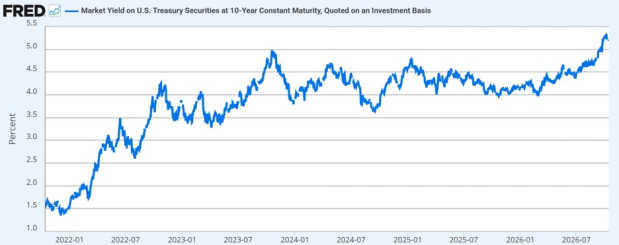
Image Source: Federal Reserve Economic Data
Why High-Yield REITs May Offer Better Long-Term Returns
The FTSE Nareit All Equity REITs Index (FNER) declined 5.7% in September as rising bond yields and tighter monetary policy weighed on the sector.
REITs typically face selling pressure when Treasury yields rise because their dividends become less competitive with government bonds. Higher borrowing costs can also pressure profitability, financing activity, and property valuations.
However, the recent correction has made several REITs very attractive from an income perspective, with dividend yields well above those offered by Treasuries.
Unlike fixed-rate government bonds, REITs offer the potential for dividend growth and share-price appreciation, creating opportunities for stronger long-term total returns.
Of course, these opportunities come with greater risks, as REIT dividends are not guaranteed and their shares remain vulnerable to economic weakness, refinancing challenges, and higher interest rates.
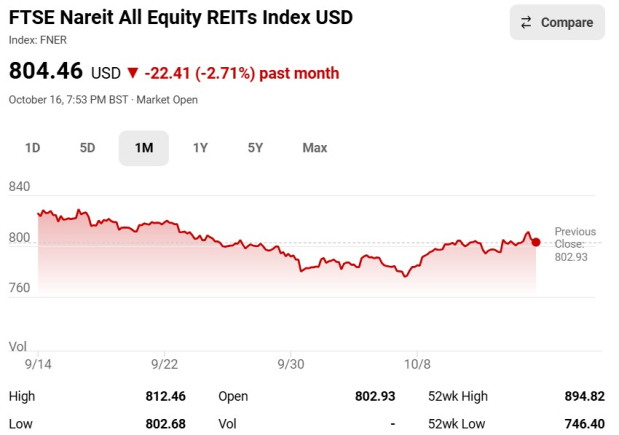
Image Source: Yahoo Finance
Top REITs to Consider
Ryman Hospitality Properties RHP) stands out as one of the highest-ranked REITs, currently sporting a Zacks Rank #1 (Strong Buy).
Specializing in upscale convention hotels and entertainment properties, Ryman offers exposure to group travel, corporate events, and hospitality demand.
Although its dividend yield of nearly 4% trails the 10-year Treasury, its favorable earnings outlook makes RHP appealing for investors prioritizing total returns over immediate income.
American Assets Trust AAT) presents a more compelling opportunity for income-focused investors, offering a 6.34% dividend yield and a Zacks Rank #2 (Buy).
With a diversified portfolio of office, retail, multifamily, and mixed-use properties in attractive U.S. markets, American Assets Trust offers a combination of above-Treasury income and potential recovery upside. Office exposure and refinancing costs remain important risks.
Meanwhile, Simon Property Group SPG), one of the world's largest retail REITs, provides exposure to premium shopping malls, outlets, and mixed-use destinations. Its dividend yield of 4.43% falls below the Treasury benchmark, but its established retail portfolio and dividend-growth potential could appeal to long-term investors, although SPG currently lands a Zacks Rank #3 (Hold).
Many Mortgage REITs Offer Double-Digit Dividend Yields
Investors willing to accept substantially higher risk may find mortgage REITs particularly appealing, although their elevated yields often reflect greater uncertainty about future distributions.
Trading under $20 a share, Annaly Capital Management NLY) offers a dividend yield exceeding 16%, investing primarily in mortgage-backed securities and mortgage-related assets. However, its leveraged investment strategy makes it sensitive to interest-rate volatility, financing costs, and changes in book value.
At $10 a share, Blackstone Mortgage Trust BXMT) offers a yield exceeding 17%, supported by its commercial real estate lending portfolio. Nevertheless, concerns about commercial property valuations, borrower defaults, and loan refinancing create additional risks.
At under $10 a share, Chicago Atlantic Real Estate Finance REFI) also stands out with a dividend yield of 20%. The specialty mortgage REIT provides financing primarily to state-licensed cannabis operators, a niche market that offers attractive lending opportunities but carries heightened regulatory, liquidity, and credit risks.
All three currently carry a Zacks Rank #3 (Hold), suggesting investors should balance their substantial income potential against the risks reflected in their unusually high yields.
Monthly Dividend REITs Provide Another Alternative
For investors seeking consistent monthly cash flow, Realty Income O), EPR Properties EPR), and Invesco Mortgage Capital IVR) offer another way to pursue income above the Treasury benchmark.
Known as “The Monthly Dividend Company”, Realty Income offers a yield approaching 6%, supported by a diversified portfolio of commercial properties leased primarily to large retail and service-oriented tenants.
EPR Properties provides an even higher yield at nearly 7%, focusing on experiential real estate, including entertainment and recreational properties. While attractive for monthly income, its portfolio remains sensitive to consumer spending and tenant financial health.
Invesco Mortgage Capital offers one of the highest yields in the group, with its recently declared monthly dividend of $0.12 per share implying an annualized yield over 25% at recent prices of $5 a share.
However, Invesco's substantial leverage and exposure to mortgage-backed securities make its dividend significantly more speculative than the distributions of traditional property-owning REITs.
All three currently land a Zacks Rank #3 (Hold), with Realty Income and EPR offering more conventional real estate income exposure, while Invesco targets investors with a considerably higher risk tolerance.
Bottom Line: Should Investors Buy REITs or Lock in Treasury Yields?
With 10-year Treasuries offering yields near 5%, risk-averse investors have a compelling opportunity to secure dependable income without assuming the credit, dividend, and share-price risks associated with REITs. This may be particularly appealing to high-net-worth investors seeking consistent income and long-term appreciation potential while putting substantial capital to work.
That said, the recent REIT selloff has also created rare opportunities for investors seeking higher income and potential capital appreciation, particularly if borrowing costs eventually stabilize or decline.
Ultimately, Treasuries appear better suited for preserving principal at maturity and locking in predictable returns, while select REITs may offer superior long-term total-return potential for investors comfortable with greater volatility.
For investors seeking a middle ground, combining Treasury securities with fundamentally sound, high-yield REITs could provide a balanced approach to income generation and long-term growth.
Want the latest recommendations from Zacks Investment Research? Today, you can download 7 Best Stocks for the Next 30 Days. Click to get this free report
Simon Property Group, Inc. (SPG): Free Stock Analysis Report
INVESCO MORTGAGE CAPITAL INC (IVR): Free Stock Analysis Report
Realty Income Corporation (O): Free Stock Analysis Report
American Assets Trust, Inc. (AAT): Free Stock Analysis Report
Ryman Hospitality Properties, Inc. (RHP): Free Stock Analysis Report
EPR Properties (EPR): Free Stock Analysis Report
Blackstone Mortgage Trust, Inc. (BXMT): Free Stock Analysis Report
Annaly Capital Management Inc (NLY): Free Stock Analysis Report
Chicago Atlantic Real Estate Finance, Inc. (REFI): Free Stock Analysis Report
This article originally published on Zacks Investment Research (zacks.com).
Mentioned In This Article
Latest News
| Oct-16 | |
| Oct-16 | |
| Oct-15 | |
| Oct-15 | |
| Oct-14 | |
| Oct-14 | |
| Oct-14 | |
| Oct-14 | |
| Oct-14 | |
| Oct-14 | |
| Oct-14 | |
| Oct-14 | |
| Oct-14 | |
| Oct-14 | |
| Oct-13 |
