Realty Income Matches The Whisper And Raises Guidance Again, But A Rate Spike Is Reshaping How It Grows
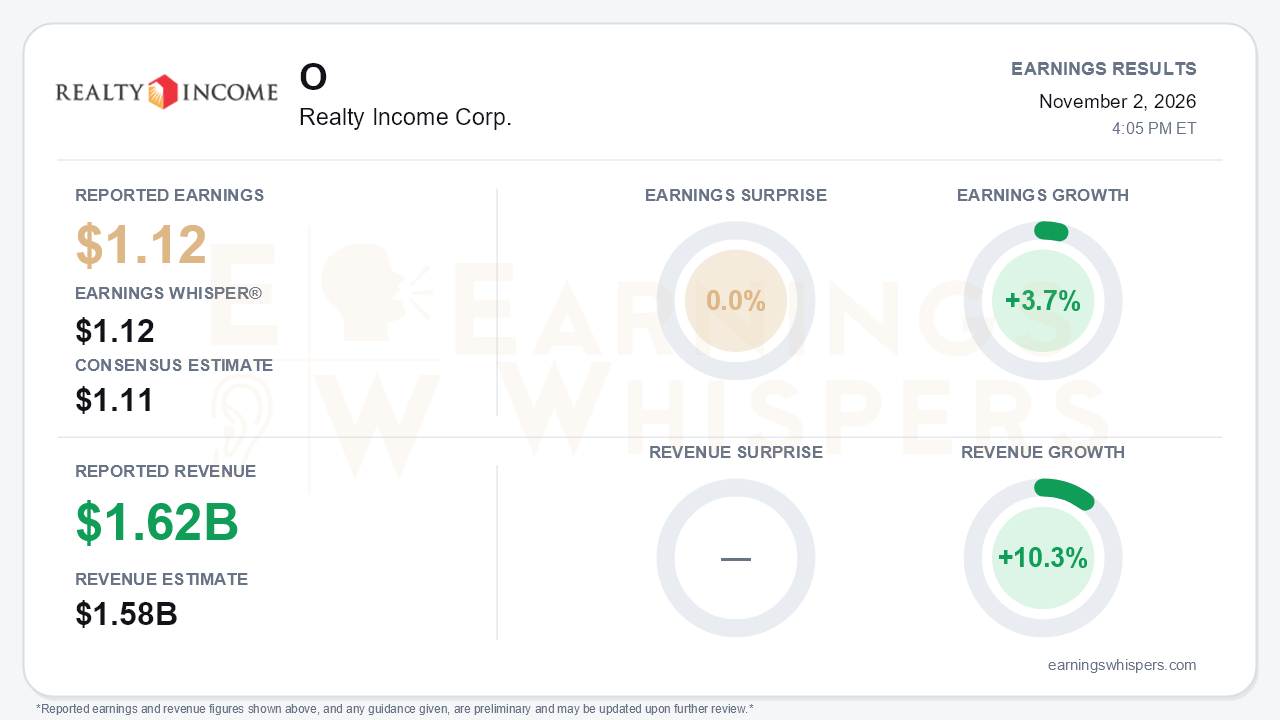
Realty Income delivered third-quarter AFFO of $1.12 per share, exactly matching the Earnings Whisper number and a penny above the $1.11 consensus. Revenue of $1.622 billion beat expectations by 2.6% and grew 10.3% year over year. AFFO per share rose 3.7%, a modestly faster pace than the year-ago move from $1.05 to $1.08. Management raised 2026 AFFO guidance for the third straight time, to $4.45–$4.46, and reaffirmed its $10.0 billion investment target. The operating execution was clean. The central tension is that the business is executing well while the cost-of-capital backdrop deteriorates around it. Higher long-term rates are visibly changing where, how, and with whose money Realty Income grows.
The beat deserves scrutiny. The top-line strength was not driven by the core lease book. Same-store rental revenue grew just 1.1%, consistent with the 1.1%–1.3% guide. Interest and dividend income on loans and preferred equity roughly doubled, to $105.0 million from $51.1 million, as the credit book expanded. Client reimbursements also rose to $104.9 million from $82.5 million, and those largely pass through rather than build margin. Interest expense climbed to $333.6 million from $294.5 million.
GAAP results need context too. Net income per share rose to $0.43 from $0.35, but that increase leaned on $113.9 million of gains on property sales, which offset $111.6 million of impairments. Full-year net income guidance was lowered to $1.55–$1.56 from $1.59–$1.60, even as AFFO guidance moved up. That is an easy cut to overlook in a quarter framed as an across-the-board raise.
The call showed real improvement in the underlying assumptions:
- The credit-loss outlook fell to roughly 30 basis points, from about 40 in the second quarter and 40–50 in February.
- Occupancy guidance was lifted to above 98.5%; reported occupancy was 98.8%.
- Non-reimbursable expense leakage guidance was trimmed to 1.3%–1.5%.
- The rent recapture rate was 103.5%.
- Investments totaled $2.2 billion on a pro-rata basis at a 6.8% cash yield.
- The leverage-neutral spread was about 170 basis points, above the 150–160 basis points targeted in February.
- Sourcing hit a record $59 billion in the quarter.
The mix of that growth is shifting. Europe accounted for 42% of third-quarter pro-rata volume, and credit investments exceeded 10%. Management explicitly framed credit as a rate hedge. Selectivity also fell to 4.4%, reflecting heavy industrial competition and caution on data centers.
Funding is where the story has changed most. Public equity funded only 19% of volume year to date, versus a three-year average of 47%. The gap was filled by other sources:
- The new KKR joint venture in Europe, with KKR investing €528 million for 49% of a 54-property portfolio.
- A $1 billion convertible at 3.75%, with a capped call at $83.55.
- €600 million of notes at about 3.7%.
- $875 million of year-to-date dispositions, already above full-year 2025.
The fourth quarter is fully prefunded with $1.1 billion of forward equity priced near $60.61, above the current share price.
Bears have legitimate ammunition, however. The 10-year Treasury spiked to 5.35% in early October, a move management did not anticipate, and it hurts U.S. acquisition economics. Management also signaled less appetite for new insurance-capital joint ventures at today's pricing. It acknowledged a refinancing headwind on about $2.9 billion of 2027 maturities that currently carry roughly 2.9%. The raised guidance also implies fourth-quarter AFFO of $1.10–$1.11, a one-to-two-cent step down from the third-quarter run rate.
The market has priced the rate risk more heavily than the operating progress. Shares were at $56.93 heading into the report, down 11.5% since the open following the August release. They sat 7.6% below the 200-day moving average of $61.63. The stock set a 52-week low of $53.15 on October 8, around the Treasury spike, and has since recovered about 7% off that level. It remains 12.3% below the $64.95 inter-earnings high. Investor sentiment is still negative but improved meaningfully, rising from -0.33 to -0.17. The Earnings Whispers trend readings are mixed: sequential growth and momentum are positive, while price and AVWAP remain negative.
The bottom line is that Realty Income produced a solid, unspectacular quarter that matched the whisper and preserved a credible, steadily rising AFFO trajectory. Credit, occupancy, and spread assumptions all improved. But the quality of growth is increasingly reliant on Europe, credit investments, and private capital partners, while core same-store growth stays near 1%. Rising 2027 refinancing costs and a softer implied fourth quarter keep the stock tethered to the bond market more than to its own execution.
Read our earnings preview for Realty Income Corp.: https://www.earningswhispers.com/article/O/21415
This earnings review was originally published on Earnings Whispers.
This article is for informational purposes only and is not investment advice. Earnings Whispers and its staff may hold positions in the securities mentioned. It is AI-assisted, based on proprietary Earnings Whispers data and company reports, and edited by Earnings Whispers staff.
Mentioned In This Article
Latest News
| 3 hours | |
| 6 hours | |
| Oct-29 | |
| Oct-26 | |
| Oct-17 | |
| Oct-16 | |
| Oct-16 | |
| Oct-16 | |
| Oct-14 | |
| Oct-14 | |
| Oct-14 | |
| Oct-14 | |
| Oct-14 | |
| Oct-14 | |
| Oct-14 |
