Arbor's Dividend Coverage And Problem-Loan Timeline Face A Test With Shares Near Lows
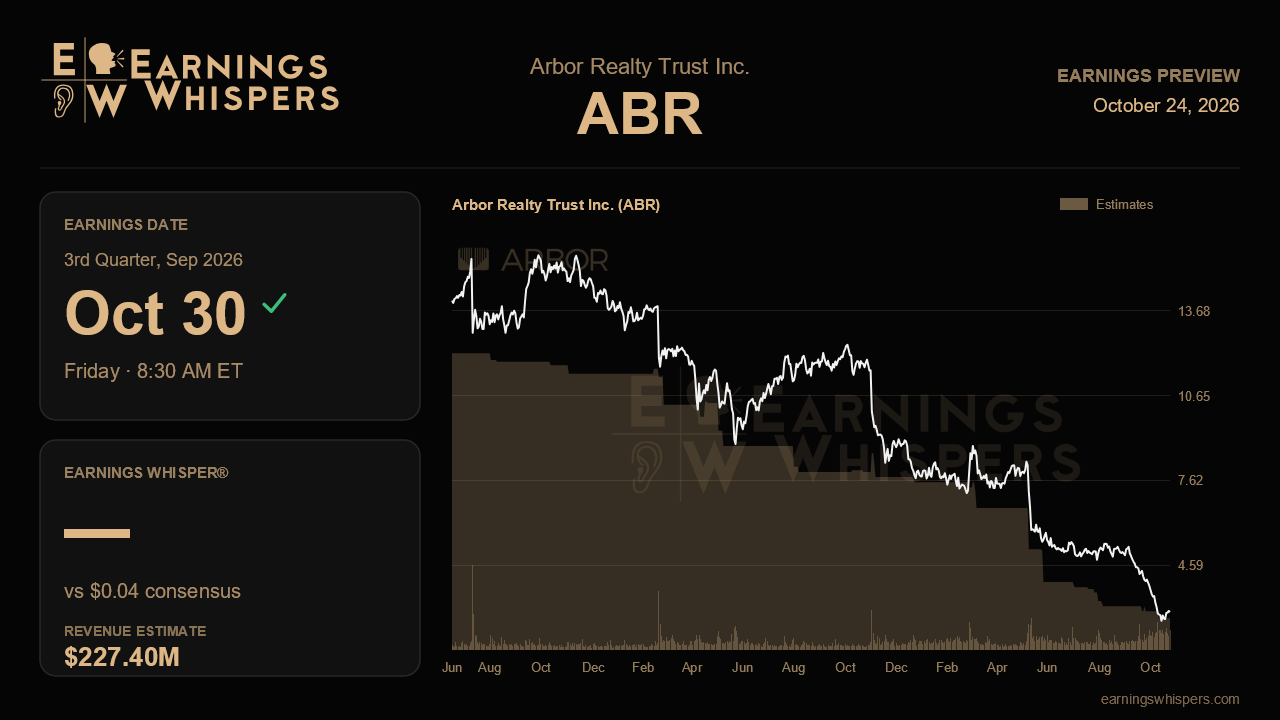
Arbor Realty Trust heads into its third-quarter report with a stock that trades at roughly a quarter of its stated book value, and that gap says more than any consensus figure. Shares have lost nearly 39% since the last report, falling to $2.92 against a pro forma book value management pegged at $11.59. That is a market pricing in either much deeper credit losses than the company has acknowledged or a dividend that cannot hold. The Oct. 30 release, due before the open, needs to show which fear is overdone.
The bar on paper is low. Analysts expect earnings of $0.04 a share, half of last quarter's $0.08 and down about 88% from the $0.34 reported a year ago. Revenue is forecast at $227.4 million, roughly 2% above last year and slightly below the prior quarter's $230.9 million. The top line is essentially flat, so the collapse in earnings comes from credit costs and a shrinking spread rather than lost business. The company has no formal guidance on record, so the most useful benchmark is distributable earnings. That figure has stepped down every quarter, from $0.35 a year ago to $0.15 in the second quarter. The dividend was already reset to $0.17, so another distributable print in the mid-teens or lower would widen the coverage gap and invite questions about a second cut.
The central issue is the timeline for problem loans, which has slipped on each of the last three calls as rates stayed high and volatile. Management now sees resolution four to six quarters out. It called the rise in non-performing assets to $1.07 billion an anomaly caused by rate-driven delays. It also raised expected realized losses to $20 million to $30 million a quarter and booked $36 million of reserves and impairments, up from $21 million. Evidence that would support the anomaly framing includes non-performing assets falling back toward $1 billion, realized losses landing inside the new range, and real progress toward roughly $300 million of REO resolutions by year end. Another increase in bad loans, losses above $30 million, or a further delay in the timeline would suggest management's estimates are still trailing the problem. Delinquencies in the Fannie Mae risk-sharing book, which reached 3.3%, are worth checking as an early warning.
The operating business offers some offsets, but they need to show up in the numbers. Agency volume was up 30% year over year in the first half. However, gain-on-sale margins fell from 1.86% to 1.33%, and management called the shift toward larger, lower-margin loans permanent. Higher volume has to make up for thinner margins. Single-family rental lending is the clearest growth story. Originations rose from $125 million in the first quarter to $315 million in the second, plus $215 million in July alone, after the housing bill's built-to-rent carve-out. Holding that pace would help show the rebound is durable. About $10 million in annual cost savings from July headcount cuts should also start to appear. Meanwhile, net interest spread narrowed to 0.57%, and management describes the bridge lending market as the most competitive it has seen.
Sentiment has soured. Investor sentiment has turned more bearish, roughly double the negative reading ahead of the last report. The stock has fallen from a post-earnings high of $5.48 and now sits just above its $2.53 low, far below its 200-day average of about $6.07. The July convertible offering retired 21 million shares at less than half of book value, and the CEO has said he is open to strategic alternatives. With the stock this far below book, buyback capacity and any update on those alternatives could matter almost as much as the quarterly numbers.
In the end, the report turns on whether the problem-loan timeline finally holds. If non-performing assets level off and losses stay inside guidance, the case for a 2027 earnings recovery stays credible, and the discount to book looks excessive. Another delay would suggest the market's skepticism is justified.
This earnings preview was originally published on Earnings Whispers.
This article is for informational purposes only and is not investment advice. Earnings Whispers and its staff may hold positions in the securities mentioned. It was generated automatically, with the help of AI, from Earnings Whispers and company data, and checked by Earnings Whispers before publication.
Mentioned In This Article
Latest News
| 5 hours | |
| Oct-23 | |
| Oct-22 | |
| Oct-22 | |
| Oct-05 | |
| Oct-01 | |
| Sep-29 | |
| Sep-04 | |
| Aug-14 | |
| Aug-11 | |
| Aug-07 | |
| Jul-31 | |
| Jul-31 | |
| Jul-24 | |
| Jun-30 |
