Vital Farms Faces Its First Real Test Of A Back-Half Margin Rebound
Vital Farms enters its third-quarter report with a simple but demanding proposition to prove: that the second quarter really was the bottom. Management spent its last call arguing that the worst of its oversupply problem had passed, reaffirming a heavily reduced full-year outlook and promising a steep second-half recovery. The math behind that promise leaves little room for slippage, and this report is the first chance to see whether the turnaround plan is translating into numbers rather than talking points.
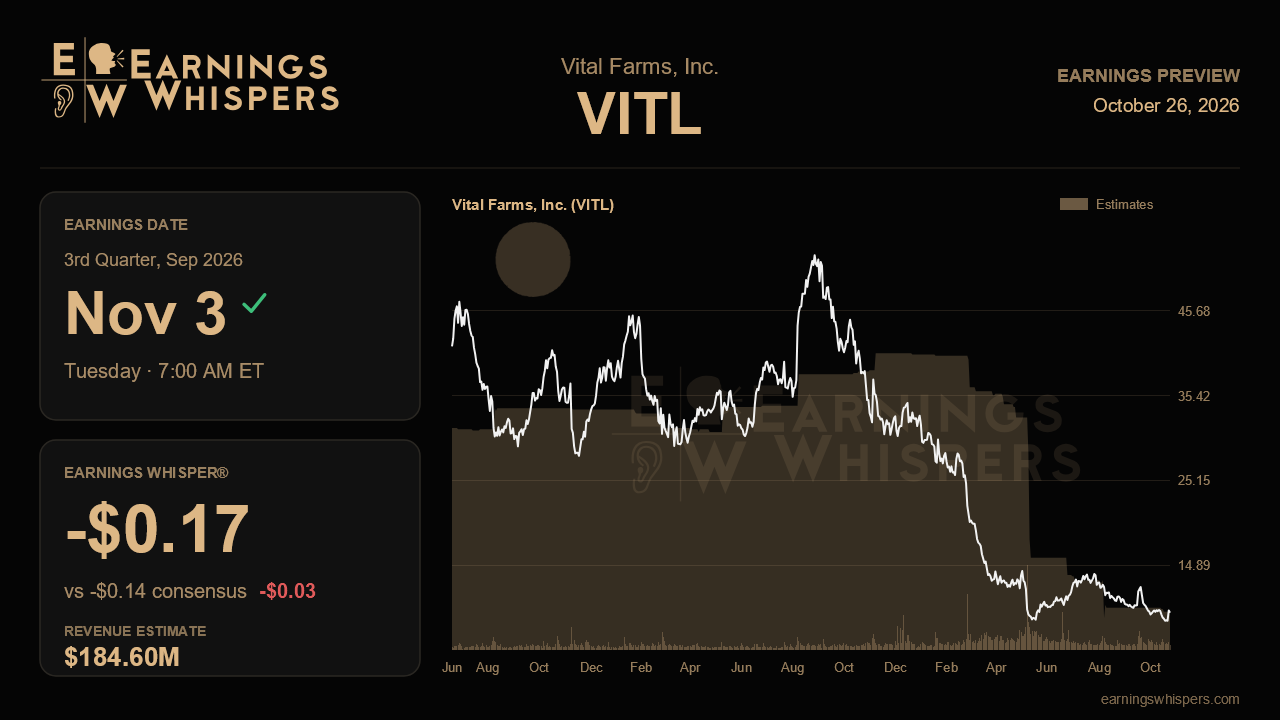
The Street expects a loss of $0.14 per share on revenue of about $184.6 million, down 7.2% from a year ago and a sharp reversal from the $0.36 profit earned in the same quarter of 2025. The whisper number sits a bit lower at a loss of $0.17, suggesting some investors are bracing for a messier quarter than published estimates imply. Still, consensus represents a meaningful sequential improvement from last quarter's $0.47 loss on $166.0 million in sales. Management continues to guide 2026 revenue to $775 million to $800 million, and the consensus of $781 million sits near the low end of that range, a sign analysts are giving the company credit for the plan but not much more.
The more revealing number is profitability. Adjusted EBITDA came in at a positive $5.0 million in the first quarter and a loss of $26.6 million in the second, leaving the company roughly $21.6 million in the hole at the halfway mark. Hitting the reaffirmed full-year range of zero to $10 million therefore requires somewhere between about $22 million and $32 million of adjusted EBITDA across the final two quarters. That is why gross margin is the line to watch. It collapsed to 6.6% in the second quarter, weighed down by $19.5 million of excess breaker egg sales and $7.8 million tied to a butter exit that grew uglier when leftover inventory had to be sold to a melter. Management has pointed to a roughly 30% gross margin exit rate in the fourth quarter, so a third-quarter figure that shows a clear climb toward that level would validate the story. A margin still stuck in the low teens would make the annual target look like a stretch.
The key mechanism is the shift away from costly breaker sales toward amended farmer contracts, which management said were already in place. Evidence that breaker losses shrank dramatically, and that full-year supply management costs are holding near the mid-$30 million range rather than creeping higher again, would go a long way. On the demand side, the company has promised its fastest distribution growth since going public, targeting roughly 170 to 175 total distribution points by year end, helped by a 24-count Whole Foods SKU that beat velocity expectations. Distribution gains need to start showing up as volume, particularly after second-quarter retail sales slipped on lower volumes and a delayed retailer transition. Cheaper shelf pricing, including a narrowed price gap at a major customer, should help volume but caps margin upside, which is why management already steered investors toward a low-30s structural gross margin rather than the old mid-30s target. Rising feed and fertilizer costs are another swing factor worth hearing about.
The market has shown little patience. Shares have fallen 22.8% since the last report while the S&P 500 slipped only 1.3%, and at $9.14 the stock trades far below its 200-day moving average of $14.61 and near the lower end of its post-earnings range of $8.04 to $12.88. Sentiment remains bearish and essentially unchanged from last quarter. The refinancing, which lifted available capacity to $185 million from $60 million after cash fell to $21.2 million, removed an immediate liquidity worry, but a stock this beaten down still needs operating proof.
Ultimately, the report hinges on whether gross margin rebounds sharply enough to keep the full-year EBITDA guidance credible. If it does, the reaffirmed outlook starts to look conservative rather than hopeful. If it does not, the turnaround narrative faces its toughest question yet.
This earnings preview was originally published on Earnings Whispers.
This article is for informational purposes only and is not investment advice. Earnings Whispers and its staff may hold positions in the securities mentioned. It is AI-assisted, based on proprietary Earnings Whispers data and company reports, and edited by Earnings Whispers staff.
Mentioned In This Article
Latest News
| Oct-26 | |
| Oct-24 | |
| Oct-23 | |
| Oct-20 | |
| Oct-14 | |
| Sep-24 | |
| Sep-17 | |
| Aug-06 | |
| Aug-06 | |
| Aug-06 | |
| Aug-01 | |
| Jul-23 | |
| Jun-05 | |
| May-21 | |
| May-11 |
