Vital Farms Rebounds From Its Q2 Trough, But A Third Guidance Cut And Withdrawn 2030 Targets Show The Reset Isn't Finished
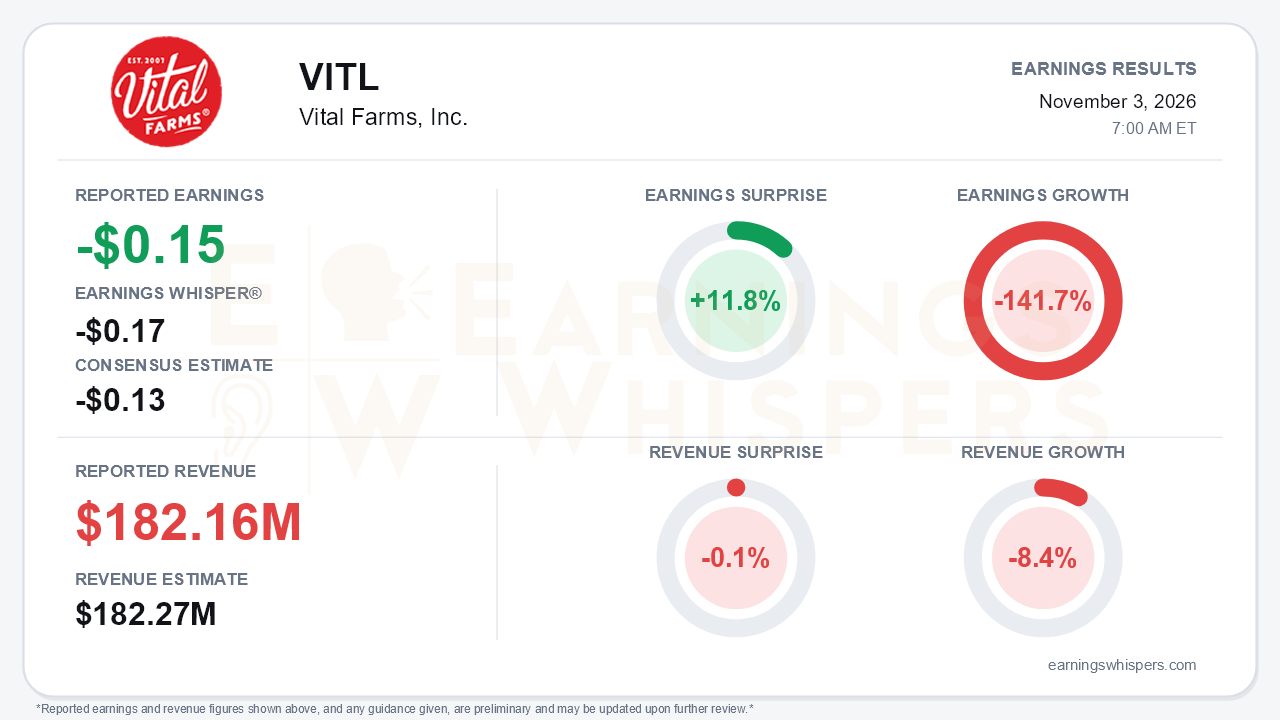
Vital Farms (NASDAQ: VITL) reported a third-quarter loss of $0.15 per share on revenue of $182.16 million. The result needs a careful read. The loss was wider than the $0.13 consensus estimate but narrower than the $0.17 Earnings Whisper number, a 11.8% positive surprise against the Whisper. Revenue matched consensus almost exactly, missing by just 0.1%. The year-over-year comparison is stark: earnings fell 141.7% as last year's $0.36 profit became a loss, and revenue fell 8.4%. Against a weak second quarter, though, this was clearly better. That is the central tension. Q3 likely confirmed that Q2 was the bottom, yet management cut full-year guidance for the third time and withdrew its fiscal 2030 targets. Investors were told the recovery will be slower and smaller than promised.
The sequential progress was real. Revenue rose 9.7% from Q2's roughly $166 million. Gross margin rose to 23.1% from 6.6% in Q2, though it remains far below 37.7% a year ago. Adjusted EBITDA turned to a $1.5 million profit from a $26.6 million loss, an improvement of $28.1 million. The main driver was oversupply management. Amended farmer contracts cut breaker and wholesale volume 59% from Q2, and the breaker hit to EBITDA fell to about $8 million from about $21 million. SG&A dropped 14% year over year to $38.1 million, which delivered the promised run-rate savings. The quality of the improvement still deserves scrutiny. Price/mix cost $14.3 million of year-over-year revenue and volume cost another $2.2 million. Shipping expense climbed to $11.7 million from $9.2 million. Interest expense jumped to $2.9 million from $0.2 million. A $2.8 million tax benefit softened a $9.2 million pretax loss.
The call changed the explanation for the slowdown in a way bears will seize on. In earlier quarters, management blamed branded competition. Now the problem is light buyers who came to Vital Farms during the avian-influenza price spike and are trading back down to private label as the category normalizes. That suggests part of the 2024-25 household gains was temporary. Distribution is not the problem. Shell egg TDPs reached 176 in the latest week, above the 170-175 Q4 target, and the company posted record 7.2% dollar share and 2.3% volume share. The issue is productivity. New placements reached shelves weeks late and are turning more slowly, and the Q4 velocity assumption was trimmed to about $200 per store per week per item from about $205 in Q3. The promised Q4 exit gross margin of about 30% has been abandoned.
The guidance cuts show how much has been reset. Fiscal 2026 revenue guidance is now about $730 million, down from $775-800 million and from the original $900-920 million. Adjusted EBITDA guidance is now a loss of about $15 million, down from a $0-10 million gain and from an original $105-115 million. The 2030 framework of $2 billion in revenue, a 15-17% EBITDA margin, and a 35%+ gross margin is gone. The Q4 outlook is deliberately cautious. It assumes no holiday lift, no firming in conventional egg prices, lean retailer inventories, and possibly more breaker volume. Management cited several 2027 tailwinds: feed cost savings, the butter exit, distribution maturing, and lower breaker costs. A free-range egg priced around $5 per dozen is in a limited pilot at Target, an attempt to compete for the price-sensitive shopper drifting to private label.
The balance sheet has also changed. The company had no debt at the end of fiscal 2025 and now carries $117.6 million, against $84 million in cash. Operations consumed $54.4 million of cash over 39 weeks, alongside $51.7 million of capex and $35 million of buybacks. Capex discipline helps. The fiscal 2026 range is held at $70-75 million versus $140-150 million in the February plan, and Vital Crossroads construction will pause once the building is enclosed. Maintenance spending should then settle in the low-to-mid teens of millions.
Investors had largely priced in disappointment ahead of the report. Shares closed at $9.18 before the release, down 22.5% since the open after the August report and 34.3% below the 200-day moving average of $13.98. The stock sat 28.7% below its August 7 high of $12.88 and 14.2% above its October 21 low of $8.04. Investor sentiment remained negative but improved modestly, rising to -0.15 from -0.23. That suggests positioning was less hostile, not optimistic. AVWAP remains negative while most other trend readings are neutral, consistent with a stock that has stopped falling sharply but has not regained buyers' confidence.
The bottom line is that Vital Farms delivered the sequential rebound it promised, but little else. Breaker relief and cost cuts are working, while consumer demand, velocity, and long-term credibility are not. With record share and expanding distribution yet revenue still declining, the next leg depends on whether the company can win back price-sensitive shoppers. Until guidance stops moving lower, skeptics have the stronger argument.
Read our earnings preview for Vital Farms, Inc.: https://www.earningswhispers.com/article/VITL/21527
This earnings review was originally published on Earnings Whispers.
This article is for informational purposes only and is not investment advice. Earnings Whispers and its staff may hold positions in the securities mentioned. It is AI-assisted, based on proprietary Earnings Whispers data and company reports, and edited by Earnings Whispers staff.
Mentioned In This Article
Latest News
| 13 hours | |
| Nov-03 | |
| Nov-03 | |
| Nov-03 | |
| Oct-26 | |
| Oct-24 | |
| Oct-23 | |
| Oct-20 | |
| Oct-14 | |
| Sep-24 | |
| Sep-17 | |
| Aug-06 | |
| Aug-06 | |
| Aug-06 | |
| Aug-01 |
