Denali Faces A Revenue Test As Shares Slide Toward Post-Earnings Lows
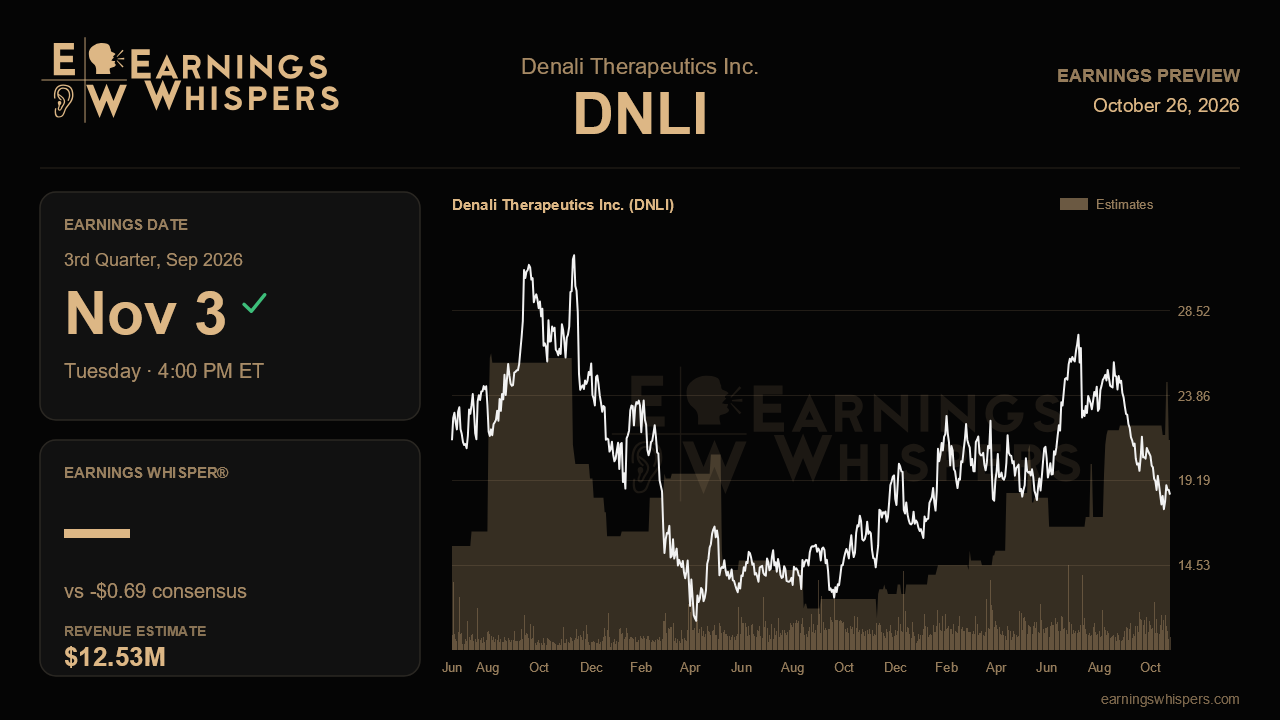
Denali Therapeutics heads into its third-quarter report with a stock that has lost more than a quarter of its value since the last update, yet Wall Street is quietly penciling in a sharp jump in revenue. That mismatch is the story. For a clinical-stage company whose revenue comes almost entirely from partnerships, a quarter in which sales are expected to more than triple raises an obvious question: is a collaboration payment actually landing, or are analysts leaning on a timing assumption that may not hold?
The consensus calls for a loss of $0.69 per share on revenue of about $12.5 million when results arrive after the close on November 3. The per-share loss would be essentially flat with the prior quarter's $0.68 deficit and about 7% narrower than the $0.74 loss posted a year ago. That is modest improvement, not a turning point, and it suggests the Street expects spending to hold roughly steady rather than fall meaningfully. Revenue is the bigger swing. Last quarter brought in just $3.6 million, so the forecast implies a substantial step up. Denali does not provide formal financial guidance, which leaves the revenue figure resting on analysts' reading of partnership economics rather than any company-stated target.
That partnership web is what makes the revenue line so unpredictable. Denali's LRRK2 Parkinson's program is partnered with Biogen, two RIPK1 inhibitor programs are partnered with Sanofi, and Takeda has opted into joint development of DNL593. Milestones and collaboration reimbursements from arrangements like these tend to arrive in lumps tied to clinical or regulatory events. A print near or above $12.5 million would indicate that at least one of these relationships is generating tangible economic value this quarter. A figure closer to last quarter's level would not necessarily signal a problem with the science, but it would show the Street got ahead of the calendar, and it would make the loss line look worse than modeled.
Beyond the headline numbers, the more durable signals will come from the pipeline commentary. The ETV:IDS program for MPS II, built on Denali's enzyme transport vehicle platform designed to carry therapies across the blood-brain barrier, is the clearest test of whether that technology can translate into a product. Any update on its development path, along with progress on the eIF2B activator program aimed at ALS and frontotemporal dementia, matters more to the long-term valuation than a few cents of EPS. Spending discipline is the other piece to watch. If operating expenses creep higher without corresponding pipeline milestones, the narrowing-loss narrative embedded in consensus weakens.
The market's verdict since the last report has been harsh. Shares fell 27.6% while the S&P 500 slipped only 1.4%, an underperformance of roughly 26 percentage points. At $18.41, the stock trades well below its 200-day moving average of $21.18 and sits only about 6% above its post-earnings low of $17.33. The current range of $17.33 to $25.74 has shifted lower than the prior quarter's $17.71 to $27.30 band, a sign of steadily eroding confidence. Interestingly, sentiment has softened in the other direction: readings remain bearish but have improved from 30.5% bearish to 22.8% bearish. Pessimism is still the default, just a bit less intense than it was three months ago.
That combination creates an asymmetric setup. Expectations around the stock price are depressed, but the revenue bar is unusually high relative to recent history. The central issue is whether Denali can show that its partnerships and blood-brain barrier platform are converting into real money and real milestones. A revenue print that validates the Street's jump, paired with credible pipeline progress and contained spending, could argue that the selloff went too far. A revenue shortfall without offsetting clinical news would likely reinforce the market's skepticism and leave the post-earnings low exposed.
This earnings preview was originally published on Earnings Whispers.
This article is for informational purposes only and is not investment advice. Earnings Whispers and its staff may hold positions in the securities mentioned. It is AI-assisted, based on proprietary Earnings Whispers data and company reports, and edited by Earnings Whispers staff.
Mentioned In This Article
Latest News
| Oct-26 | |
| Oct-22 | |
| Aug-06 | |
| Jul-27 | |
| Jul-21 | |
| Jul-20 | |
| Jul-16 | |
| Jul-15 | |
| Jul-13 | |
| Jul-09 | |
| Jun-18 | |
| Jun-18 | |
| Jun-16 | |
| May-22 | |
| May-21 |
