Champion Homes Brings A Swelling Backlog Into A Quarter Defined By Margin Pressure
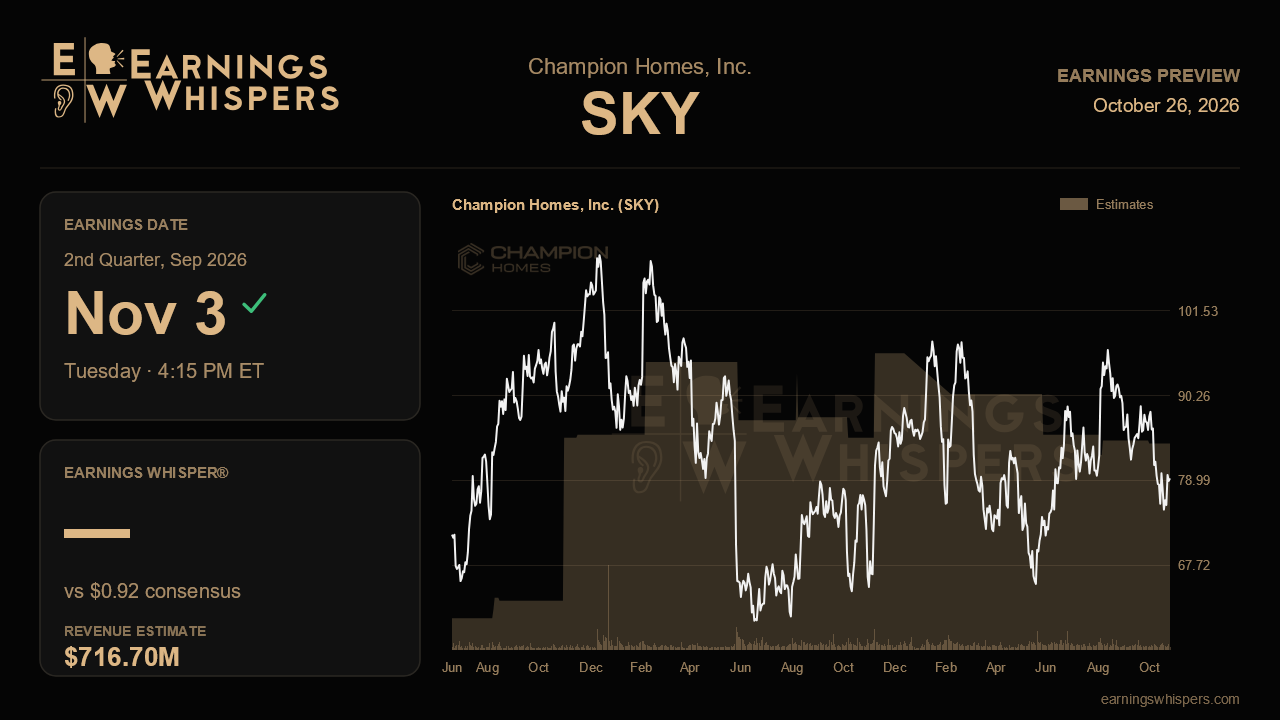
Champion Homes heads into its fiscal second-quarter report with an unusual split personality. Demand looks as healthy as it has in at least a year, with the manufacturing backlog up 40% from a year earlier, while profitability keeps slipping as material costs outrun price increases. The report after the close on November 3 should show which of those forces is winning, and whether management's newfound confidence can survive another quarter of cost inflation.
Wall Street expects earnings of $0.92 per share on revenue of $716.7 million. Revenue would be up 4.7% from a year ago, while earnings per share would fall 8.9% from $1.01. Higher sales paired with lower profits is the whole story in miniature. The revenue estimate lines up with management's call for mid-single-digit growth this quarter. That guidance was a clear step up from the roughly flat outlook it gave for the prior quarter and the flat outlook before that. The Street is not asking for anything heroic on the top line. It is essentially taking management at its word.
The top line therefore matters less as a beat-or-miss test than as proof that the backlog is converting into shipments. Backlog reached $421.8 million last quarter, with lead times stretching to about nine weeks from seven two quarters earlier, and plant utilization rose to 62%. If utilization climbs again and backlog holds near those levels even as factories ship more homes, the demand story strengthens. A backlog that shrinks sharply while revenue merely meets guidance would suggest orders were pulled forward rather than building. It also matters whether Champion keeps gaining share. Last quarter its U.S. unit sales rose modestly while industry HUD shipments fell about 5%. The Homes Direct acquisition, which closed August 1 and brings about $70 million of annual revenue from 11 western retail stores, adds roughly two months of sales that were not in guidance. That could give revenue a small cushion, though it will also make organic growth harder to read.
Margins are where this quarter can go wrong. Adjusted gross margin has fallen four quarters in a row, from 27.5% to 25.2%. Management's guide of 25% to 26% implies about 200 basis points of erosion from a year ago. The squeeze comes from steel, forest products and petroleum costs rising faster than prices. It is also coming from mix, because strength has been concentrated in cheaper independent and community channels and base-level multi-section homes. Average selling price rose only 0.6% last quarter. Management said pricing actions should start offsetting inflation this quarter. A margin at or above the midpoint, along with firmer selling prices, would back up that claim. Landing at the bottom of the range, or below it, would suggest the cost problem is stickier than advertised. A tax rate near 25%, up from about 20% after the Energy Star credit expired, adds another drag that limits how much revenue growth reaches earnings.
Sentiment has warmed modestly, moving from mildly bearish before the last report to mildly bullish now. The stock has edged up 0.4% since the last report while the S&P 500 slipped, but that small gain hides a round trip. Shares climbed as high as $96.59 before retreating to $79.25, below the 200-day moving average of $82.68 and in the lower part of the post-earnings range. The market liked the demand story and then had second thoughts, most likely about margins.
The longer-term catalysts, including chassis-optional HUD homes under the new federal housing law and Virginia's zoning reform, will take time to show up in results. For now, the narrative depends on whether the pricing actions are catching up with costs. If gross margin stabilizes while backlog stays elevated, the demand inflection starts to look like an earnings inflection. If margins slip again, rising volume may simply mean building more homes for less profit per home.
This earnings preview was originally published on Earnings Whispers.
This article is for informational purposes only and is not investment advice. Earnings Whispers and its staff may hold positions in the securities mentioned. It is AI-assisted, based on proprietary Earnings Whispers data and company reports, and edited by Earnings Whispers staff.
Mentioned In This Article
Latest News
| Oct-26 | |
| Oct-21 | |
| Oct-07 | |
| Oct-05 | |
| Sep-29 | |
| Sep-22 | |
| Sep-18 | |
| Sep-09 | |
| Aug-26 | |
| Aug-04 | |
| Aug-04 | |
| Aug-04 | |
| Aug-03 | |
| Jul-22 | |
| Jun-02 |
