Northeast Bank Edges Past Estimates As Record Loan Volume Collides With A Shrinking Margin And Rising Funding Costs
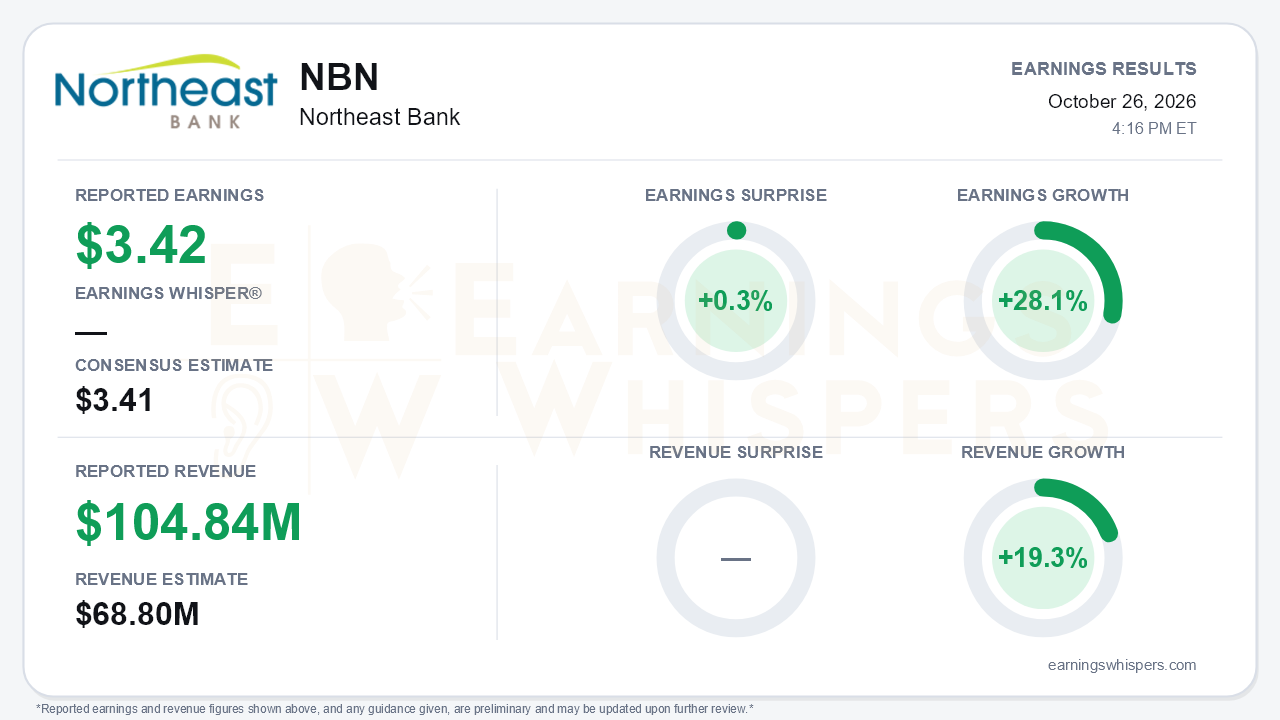
Northeast Bank (NASDAQ: NBN) earned $3.42 per diluted share in its fiscal first quarter, a penny above the $3.41 consensus and up 28.1% from a year ago. The year-over-year comparison looks strong. The sequential picture is less flattering: EPS fell from $4.05 in the June quarter, net income dropped to $29.0 million from $34.3 million, and return on equity slid to 18.65% from 23.51%. That is the central tension. Loan growth and capital have never looked better, but the bank is earning less on each dollar it puts to work, and management signaled that funding costs are about to move the wrong way.
The quality of the beat deserves scrutiny. Reported revenue of $104.84 million topped the $68.8 million consensus by 52.4% and grew 19.3% year over year. That revenue figure includes gross interest income, however, and the more telling line went the other direction. Net interest income fell to $58.9 million from $60.3 million in the June quarter and $63.1 million in the March quarter.
The EPS beat also leaned on items that may not repeat:
- $5.9 million of credit-mark releases on purchased loans, part of $9.6 million in transactional income, up from $2.4 million a year ago.
- A $2.6 million gain on recovery of insured credit losses.
- An effective tax rate of 26.2%, helped by restricted-stock vesting benefits. Management expects that rate to normalize to roughly 29%.
Strip away those tailwinds and the margin story is clearly softer. Net interest margin compressed to 4.57% from 4.80% in the June quarter and 5.15% in the March quarter.
The call explained why. Accretion income was lower, and the mix is shifting toward originated loans, which yielded 7.72% versus 8.24% on purchased loans. Originated loans yielded 8.63% a year ago. National Lending originations reached a record $258.6 million, the fourth consecutive record. About two-thirds of that volume is now direct loans rather than lender finance, which should extend duration but at thinner yields.
Purchases rebounded sharply to $237.6 million, priced at 93.5% of unpaid principal. That compares with $94 million in the June quarter and $25 million in the March quarter, and the bank won eight of ten pools it bid on. Because those purchases closed late in the quarter, they contributed little to these results and should be a meaningful source of income growth ahead. Management also said lending capacity on existing capital has risen to $1.58 billion and emphasized the operating leverage available as that capacity is deployed.
Bears have legitimate ammunition on funding. Last quarter, management guided cost of funds roughly flat. Now about $1.4 billion of CDs will reprice roughly 50 basis points higher over the next three months, adding about 15 basis points to funding costs next quarter. Deposit growth this quarter came largely from a $151.9 million increase in brokered time deposits, and net loans to deposits rose to 121.4%. Management framed rising rates as a net positive: more bank loan sales to buy, higher funding costs for non-bank competitors, and slower prepayments in the purchased book. That argument is credible, but it has to outrun margin pressure that is already visible.
Credit was mixed beneath healthy headline metrics. Nonperforming assets fell to $31.9 million, or 0.60% of assets, and nonperforming loans dropped to 0.48% of loans. Net charge-offs, however, rose to $5.3 million from $1.8 million, including roughly $3 million from the SBA book. Management raised reserve coverage on the SBA and purchased portfolios. The SBA run rate is now framed at about $35 million per quarter, well short of the long-promised $20 million per month. About $90 million of insured small-balance loans also remains unsold.
Balance-sheet compounding is the cleanest positive. Tangible book value rose to $73.22 per share from $70.58 last quarter, a 22% year-over-year gain, and Tier 1 leverage improved to 12.11%.
Investor sentiment remains clearly negative. It improved only marginally, from -0.56 to -0.54, which means expectations were not elevated heading into the report. Shares are down 1.3% from the open after the July report. They still sit about 6.5% above the 200-day moving average, so the market has been treating the stock with ambivalence rather than abandoning it. The internal trend readings are mixed, with momentum positive while AVWAP remains negative.
The bottom line is that Northeast Bank delivered a technical beat built partly on reserve releases, an insurance recovery gain and a low tax rate, while core net interest income and margin continued to decline. The growth engine is intact: record originations, a revived purchase pipeline and $1.58 billion of lending capacity give the bank real earnings leverage. The next few quarters, however, hinge on whether late-quarter purchase volume and capacity deployment can offset CD repricing and a lower-yielding loan mix. Until net interest income turns higher, the quarter reads as strong balance-sheet growth with weaker per-dollar profitability.
Read our earnings preview for Northeast Bank: https://www.earningswhispers.com/article/NBN/21001
This earnings review was originally published on Earnings Whispers.
This article is for informational purposes only and is not investment advice. Earnings Whispers and its staff may hold positions in the securities mentioned. It is AI-assisted, based on proprietary Earnings Whispers data and company reports, and edited by Earnings Whispers staff.
Mentioned In This Article
Latest News
| Oct-27 | |
| Oct-26 | |
| Oct-26 | |
| Oct-20 | |
| Oct-20 | |
| Jul-27 | |
| Jul-27 | |
| Jul-27 | |
| Jul-16 | |
| Apr-29 | |
| Apr-27 | |
| Apr-27 | |
| Apr-21 | |
| Jan-27 | |
| Jan-27 |
