AdvanSix Faces A Fertilizer Reset Test As Record Sulfur Costs Collide With Pricing Gains
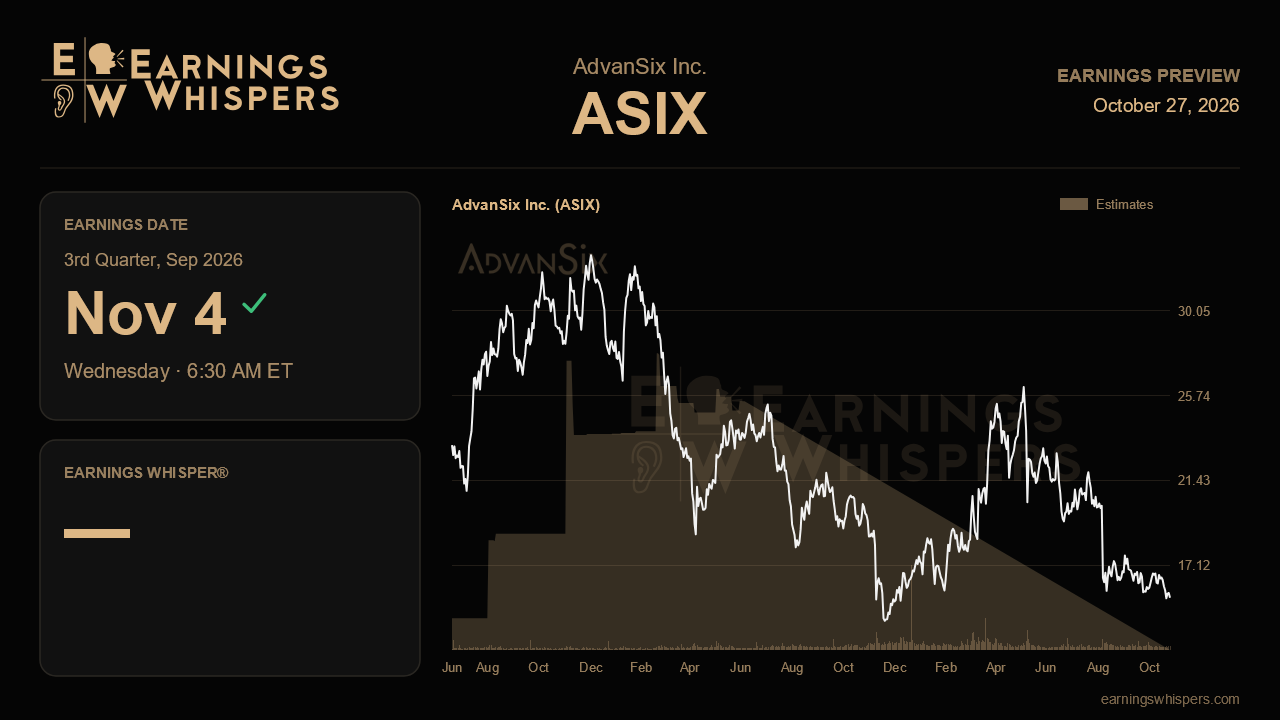
AdvanSix heads into its third-quarter report on November 4 with two stories pulling in opposite directions. Its commercial pricing engine finally regained traction last quarter, but its largest business is entering the weakest part of the fertilizer calendar just as sulfur, its key input, sits at record highs. The central question is whether pricing discipline in nylon and chemical intermediates can absorb what management has already flagged as a worse-than-usual seasonal hit in plant nutrients.
The year-ago comparison sets a low bar. AdvanSix earned just $0.03 a share in the third quarter of last year on revenue of $374.5 million. A reliable consensus figure isn't available for this quarter, so the more useful benchmarks are the year-ago result and the trajectory management laid out in August. Second-quarter revenue reached $421.3 million, but adjusted EBITDA fell to $32 million from $56 million a year earlier. Adjusted EPS of $0.19 was down more than a dollar, partly because Hopewell ran in the mid-70s percent utilization range during an ammonia turnaround that was moved up in the schedule. Management still expects sequential improvement in EBITDA and cash flow in the second half. That is the promise this report has to start keeping.
The swing from pricing is the strongest support for that view. Net price over raw materials moved from a $10 million sequential headwind in the first quarter to a $39 million tailwind in the second. AdvanSix fully offset a $72 million year-over-year increase in benzene and sulfur costs. Nylon and chemical intermediates performed at or above expectations, helped by mix optimization and firmer acetone dynamics tied to China. A third straight quarter of neutral or positive net pricing would show the recovery is durable rather than a one-time catch-up. A slide back into a price-over-raws deficit would undercut the second-half narrative almost immediately.
Plant nutrients, roughly 40% of revenue, is where the risk is concentrated. Tampa sulfur settled at $705 per long ton for the third quarter, up from $655 in the second and $310 only a year before. Management estimates every $100 move is worth about $35 million a year. That leaves roughly another $4 million of quarterly pressure on top of already elevated costs. Demand for ammonium sulfate weakened during the season as farmers turned to cheaper nitrogen. Importers and traders are also liquidating inventory with little regard for producer margins. Management warned that the second-half reset will likely exceed the historical $10 million to $15 million range. The key signals are summer fill-program pricing and volumes, and whether the shortfall stays near that range or widens meaningfully.
The offsets are real but need proof. A full-quarter return to normal Hopewell rates should lift fixed-cost absorption. Management also raised its full-year ammonia sales volume target to roughly 30% growth over a record 2025, after first-half volume of 49,000 short tons versus 33,000 a year earlier. Hitting that pace would show the company can steer molecules toward better returns while ammonium sulfate is under pressure. Updates on the planned USDA FIELDS grant application, which carries a 50% match, and on the DEF project are longer-term items. Even so, any slippage in the timeline toward a final investment decision in the first half of 2027 would be noticed.
The market has leaned skeptical. Shares are down 5.7% since the last report, about five points behind the S&P 500. At $15.47, the stock trades well below its 200-day average of $19.57 and near the bottom of a post-earnings range whose high of $17.86 never reached the prior quarter's low of $18.88. Sentiment remains bearish, though slightly less so than before the last report. Low expectations alone do not guarantee a rebound, but they do leave room for relief. In the end, the report turns on whether management can show the fertilizer reset is contained and that pricing gains are holding, keeping the case for a better 2027 intact, helped by the expected sulfur decline of about $200 per ton.
This earnings preview was originally published on Earnings Whispers.
This article is for informational purposes only and is not investment advice. Earnings Whispers and its staff may hold positions in the securities mentioned. It is AI-assisted, based on proprietary Earnings Whispers data and company reports, and edited by Earnings Whispers staff.
Mentioned In This Article
Latest News
| Oct-29 | |
| Oct-27 | |
| Oct-06 | |
| Aug-07 | |
| Aug-07 | |
| Jul-07 | |
| May-08 | |
| May-08 | |
| May-07 | |
| Apr-17 | |
| Apr-13 | |
| Feb-20 | |
| Feb-20 | |
| Feb-20 | |
| Feb-20 |
