Burford Capital's Defensive Pivot Faces A Cash And Leverage Test After YPF Setback
Burford Capital heads into its third-quarter report with a fundamentally different story than it told a year ago. The litigation financier spent much of last year selling a growth narrative built around doubling the business by 2030. After the appellate reversal in the YPF case wiped out much of an asset once carried near $1.7 billion, management pivoted hard toward liquidity, deleveraging and cost control. This report is the first full quarter under that defensive footing, and the market wants proof that the balance sheet can be repaired without the franchise shrinking.
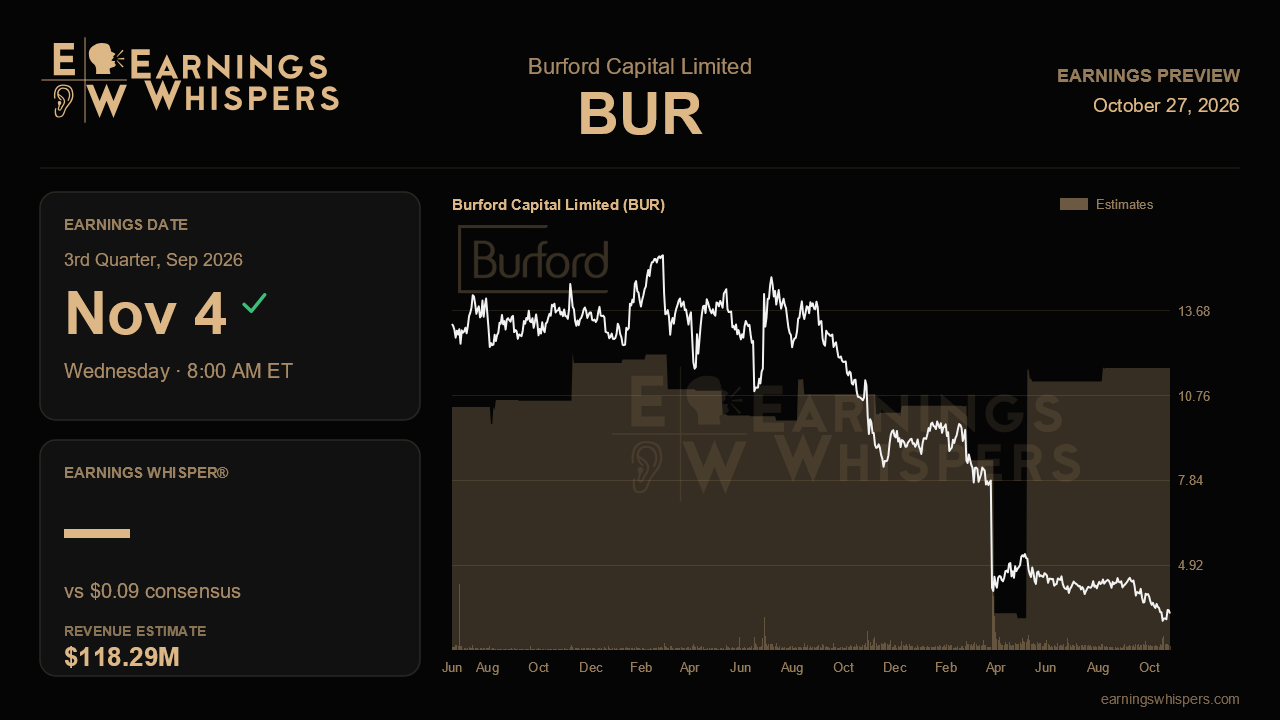
The Street is looking for earnings of about $0.09 a share on revenue of roughly $118.3 million. That would be a meaningful step up from the essentially break-even $0.01 posted last quarter and a swing from a loss of $0.09 a year ago, with revenue up nearly 70% from the year-ago $69.8 million. Sequentially, though, revenue growth is modest, rising only about 7% from $110.7 million. In other words, consensus is not asking for a dramatic acceleration in the top line so much as better conversion of revenue into profit. Management has not offered formal guidance, so the bar is set entirely by analysts, and the implied margin improvement makes the cost cuts announced last quarter, roughly $10 million in annualized compensation savings from senior and middle management, more than a footnote.
The most encouraging thread from the last call was cash. Realizations climbed to $94 million from $62 million a year earlier, and cash receipts of $157 million were the largest in five quarters. Liquidity held at $733 million, well above the $621 million at year-end. Management also pointed to a cluster of favorable outcomes, including a jury verdict, an arbitration win, a German Supreme Court ruling and a UK decision. If those wins begin flowing through as realized proceeds, it would validate the argument that the portfolio, still around $4.1 billion, can fund deleveraging internally. A drop in cash receipts or a renewed slide in liquidity would challenge that thesis directly, especially given management's own warnings about lengthening case durations and slow court calendars.
Leverage is the other pressure point. Debt to equity stood at 3.5 times after the YPF write-down, far above the 1.25 times management historically considered comfortable and above the 2.0 times incurrence covenant. Management also complained that its bonds were trading at yields it viewed as too high. Any concrete progress, whether through debt reduction, equity rebuilding from profits or improved bond pricing, would carry outsized weight. On the growth side, new definitive commitments had already slipped below the 2025 run rate after rising more than 50% in the third quarter of last year and 39% in the fourth. Further deceleration is arguably expected given management's stated retreat from very large, lower-return deals. What matters is whether the shift toward the most profitable deal types, which more than doubled in the new business mix, keeps building. Updates on the YPF arbitration path will also draw scrutiny, even if resolution is distant.
The market has been unforgiving. Shares have fallen 23.5% since the last report while the S&P 500 was essentially flat, and at $3.25 the stock sits about 41% below its 200-day moving average. It trades in the lower part of its post-earnings range of $2.86 to $4.52, a band that lies entirely beneath the prior quarter's $3.91 to $5.29 range. Sentiment is mildly bearish and little changed from last quarter, suggesting skepticism has settled in rather than intensified.
Ultimately, this report hinges on whether Burford can show that its improving cash generation is durable enough to shrink leverage while keeping profitable new business flowing. Strong receipts, stable liquidity and visible deleveraging would suggest the defensive pivot is working. A soft cash quarter or a further stretch in the balance sheet would leave the deeply discounted stock without its most important support.
This earnings preview was originally published on Earnings Whispers.
This article is for informational purposes only and is not investment advice. Earnings Whispers and its staff may hold positions in the securities mentioned. It is AI-assisted, based on proprietary Earnings Whispers data and company reports, and edited by Earnings Whispers staff.
Mentioned In This Article
Latest News
| 4 hours | |
| Oct-26 | |
| Sep-29 | |
| Sep-28 | |
| Sep-28 | |
| Sep-17 | |
| Sep-14 | |
| Sep-14 | |
| Aug-06 | |
| Aug-05 | |
| Jul-28 | |
| Jul-24 | |
| Jul-07 | |
| May-29 | |
| May-21 |
