Cooper-Standard Must Prove Its Promised Second-Half Margin Recovery After A 31% Slide
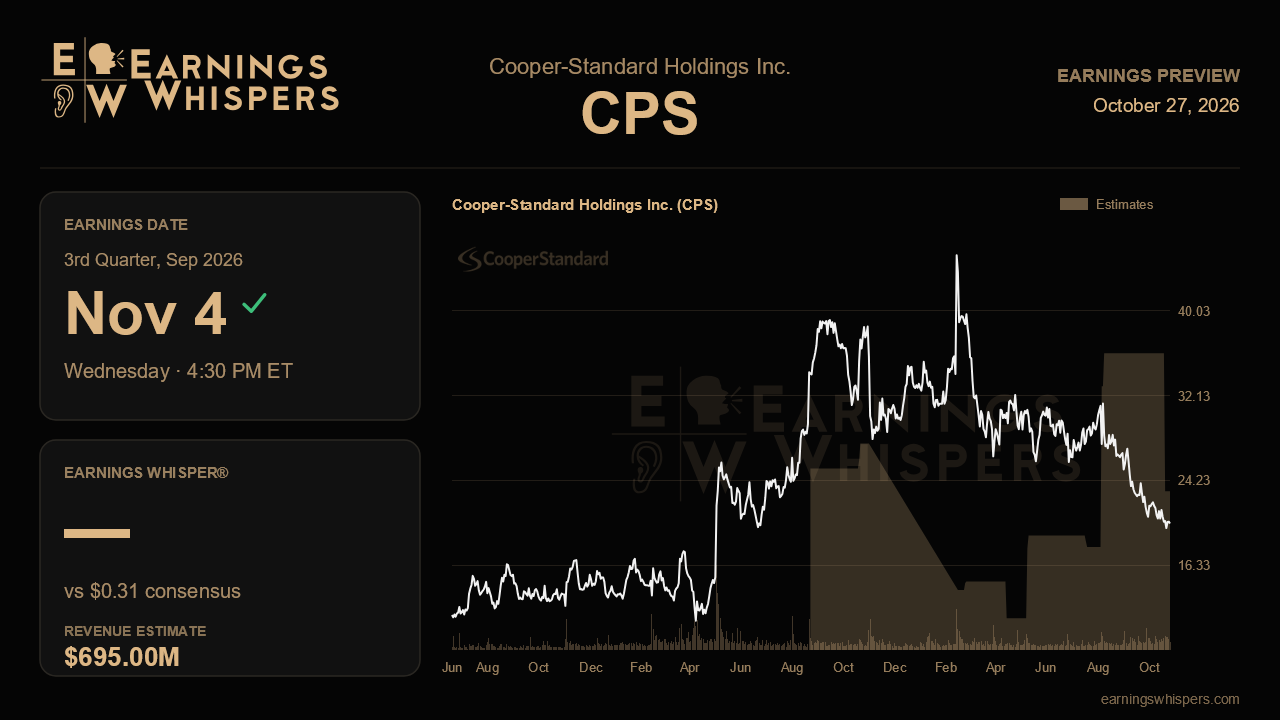
Cooper-Standard heads into its third-quarter report with a simple promise to keep and a skeptical market waiting to see whether it does. Last quarter, management blamed a margin air pocket on timing: oil prices roughly $30 a barrel above plan, tariffs and wage inflation all hit the cost line before contractual recoveries could catch up. The company held its full-year adjusted EBITDA midpoint near $280 million and asked investors to trust a stronger back half. The stock has since fallen 31%, while the S&P 500 was roughly flat. That suggests the market has not extended much credit.
The Street is looking for a sharp earnings rebound on a flat top line. Consensus calls for EPS of $0.31 on revenue of about $695 million. That would be a swing from a $0.13 loss last quarter and a $0.24 loss a year ago, and the expected growth rate of more than 229% reflects how low that base is. Revenue is expected to be essentially unchanged from last year and down from the $721.3 million posted in the second quarter. So any profit improvement has to come from margins, not volume. In other words, this quarter is almost a pure test of the recovery mechanism management described.
That mechanism has a few moving parts, and each can be checked in the release. The first is pricing. Index-based commodity contracts triggered price increases that management said were already in effect for the third quarter. These are effectively the first real-world test of whether Cooper-Standard can pass through an oil shock in something close to real time, with a plan built around $65 oil against realized prices above $90. The second is tariffs. Duties added $8 million of cost in the second quarter and $11 million in the first half, and only part of that had been recovered. The third is cost savings. The back half depends on roughly $50 million or more of incremental savings, building on lean and purchasing gains that have run about $15 million to $17 million per quarter. If adjusted EBITDA margin climbs meaningfully from the roughly 7% run rate of the first half toward the double-digit target, the timing story holds. If it stalls, the narrative shifts from timing to structural pressure, and the narrowed full-year range starts to look fragile.
There are also upside levers worth tracking. Management flagged a possible F-Series production increase of roughly 60,000 units above plan, worth around $450 of content per vehicle. It also pointed to FlexiCore body seals entering production on two programs later in the fiscal year, and about $40 million of annual mid-production conquest business won in fluids as competitors stumbled. Evidence that these wins are converting into revenue, along with continued strong net new business awards, would support the multiyear thesis even if near-term margins remain choppy. Free cash flow also deserves attention. The second quarter delivered $16.3 million, helped by the March refinancing, but higher capex and restructuring guidance could weigh on that improvement.
Sentiment has warmed modestly, moving to mildly bullish from slightly bearish heading into the last report. Price action tells a harsher story. At $20.22, shares sit far below the 200-day moving average of $28.94 and just above the post-earnings low of $19.22. The current trading range is also well below the prior quarter's band of roughly $25 to $36. A depressed stock with improving sentiment can respond sharply to proof of execution, but it can also break support quickly if the guide wobbles.
Ultimately, the report hinges on one question: did the recoveries and savings actually land in the third quarter? A clear margin step-up with the roughly $280 million EBITDA midpoint intact would validate management's account of a temporary squeeze. Another quarter of costs outrunning pricing would suggest the problem runs deeper than timing.
This earnings preview was originally published on Earnings Whispers.
This article is for informational purposes only and is not investment advice. Earnings Whispers and its staff may hold positions in the securities mentioned. It is AI-assisted, based on proprietary Earnings Whispers data and company reports, and edited by Earnings Whispers staff.
Mentioned In This Article
Latest News
| 3 hours | |
| Oct-21 | |
| Sep-24 | |
| Sep-10 | |
| Sep-02 | |
| Aug-05 | |
| Aug-05 | |
| Aug-04 | |
| Jul-21 | |
| Jul-09 | |
| Jun-16 | |
| May-28 | |
| May-13 | |
| May-06 | |
| May-06 |
