Cooper-Standard Misses Badly As Commodity Inflation Forces EBITDA Guidance Cut, Overshadowing Record Bookings
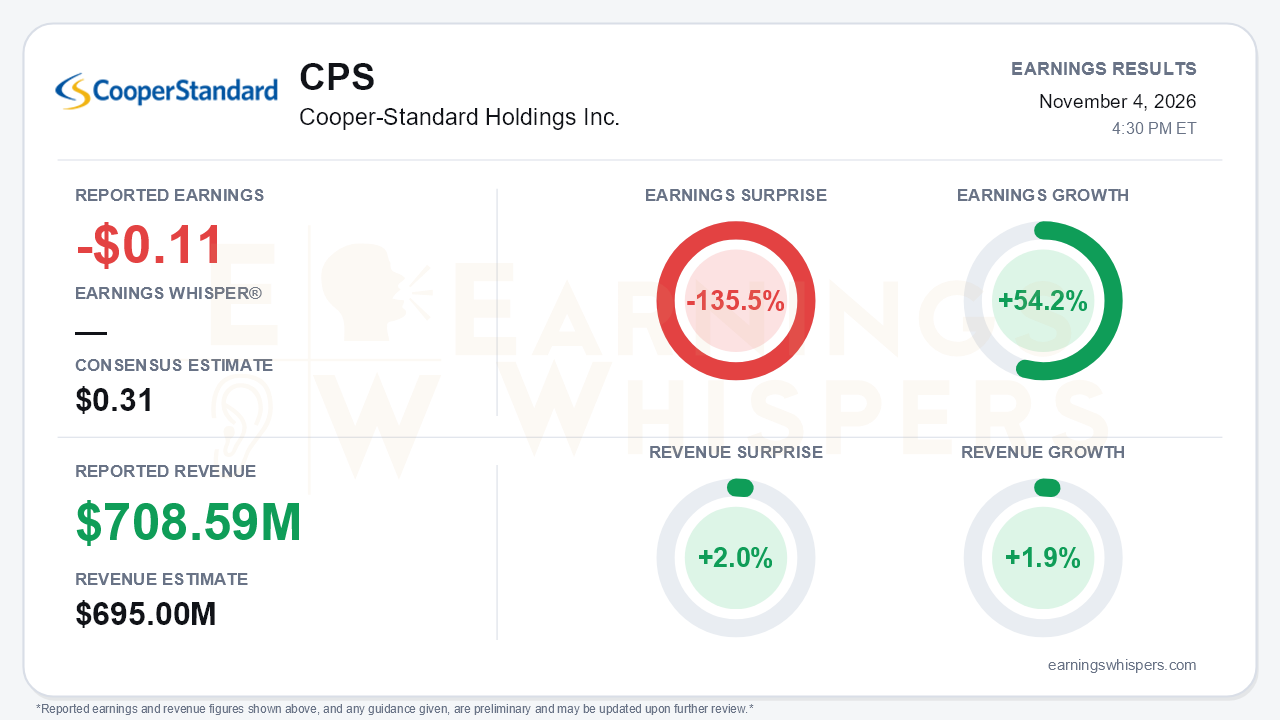
Cooper-Standard's third quarter was a clear earnings miss. The company posted an adjusted loss of $0.11 per share against a consensus estimate calling for a $0.31 profit, a 135.5% shortfall. Revenue of $708.59 million beat the $695.0 million consensus by 2.0% and rose 1.9% year over year. Adjusted earnings improved 54.2% from the year-ago period, when the loss was $0.24 per share. That improvement is real, but the central story is the outlook. Management cut full-year adjusted EBITDA guidance to $235-$245 million from $265-$295 million, which takes roughly $40 million off the midpoint. Commodity costs and general inflation overwhelmed the cost program that was supposed to carry the second half. Earnings Whispers classifies the guidance as in line, which suggests Street models had already moved down. Against the company's own prior framework, however, this was a substantial reset.
The quality of the quarter deserves scrutiny. Sales grew even though global light vehicle production fell 2.3%, helped by favorable volume, mix and pricing. Gross profit still fell to $77.8 million from $87.1 million as material costs and inflation outran pricing. The narrower adjusted loss came almost entirely from below the gross line. SGA&E dropped to $47.0 million from $55.4 million, and lower compensation expense and tariffs also helped. Adjusted EBITDA of $52.8 million was essentially flat with $53.3 million a year ago, and margin slipped to 7.5% from 7.7%. The segments split:
- **Fluid handling:** EBITDA rose about $3.0 million. Roughly $15.6 million of cost savings offset an $11.2 million volume/mix headwind.
- **Sealing:** EBITDA declined about $1.8 million.
On a GAAP basis, the net loss widened to $20.4 million, or $1.13 per share, from $7.6 million. Restructuring charges of $19.2 million drove much of that, as the company deepened Western European workforce reductions.
The call made the deterioration in the plan explicit. In August, management reaffirmed its EBITDA midpoint. It also talked about second-half margins above 12% and roughly $100 million of second-half free cash flow, with commodity recoveries starting July 1. Instead, Q3 brought a $10.8 million free cash outflow, compared with a $27.4 million inflow a year ago and a $16.3 million inflow in Q2. Year-to-date free cash flow stands at negative $87.6 million. In the quarter:
- Material costs were a roughly $15 million headwind.
- Inflation cost about $12 million.
- Volume/mix net of recoveries subtracted roughly $13 million.
Oil is running near $100 a barrel against a plan of about $65. Some recoveries have slipped into 2027, and the lean savings target was trimmed to about $80 million from $90 million. The tone shifted noticeably. Earlier in the year, management said it would "achieve or exceed" targets; this quarter it described an "inflation crisis" and hedged on full-year cash generation.
The offsetting strength is demand. Net new business awards of $148.8 million brought the year-to-date total to $395.1 million, essentially at the $400 million annual goal and well above the $298 million booked in all of 2025. Of the year-to-date awards, $96.6 million came from battery electric or full-hybrid platforms. Management reiterated its path to $3.5-$3.7 billion in sales and a roughly 15% EBITDA margin by 2030-31. It also pointed to several structural moves:
- renegotiating index-based commodity agreements;
- pushing back on customer tooling financing;
- launching an AI process initiative under a newly appointed Chief AI Officer.
The risk is execution and timing. Hitting the new guidance requires roughly $82 million of fourth-quarter EBITDA, far above Q3's $52.8 million. That jump depends on the lean savings ramp and commercial recoveries arriving on schedule. Higher launch costs, with plant launches more than double last year, add friction.
The balance sheet leaves little room for another slip:
- Cash fell to $112.3 million from $191.7 million at year-end.
- Long-term debt sits at about $1.1 billion.
- Total equity is negative $165.3 million.
- Quarterly net interest expense of $27.5 million consumes more than half of adjusted EBITDA.
The upsized $200 million ABL, now extended to 2031, lifts liquidity to $305.4 million and buys time, but it does not replace cash generation.
The market had already priced in much of this pain. Shares closed at $22.04 on the report date, down 25.1% from the open following the August report and 22.7% below the 200-day moving average of $28.51. That snapshot predates the November 5 conference call, so it does not capture any reaction to management's commentary. Price trend and AVWAP readings remain negative. Investor sentiment moved from slightly negative (-0.056) to modestly positive (0.181) heading into the report. That is a meaningful improvement, likely reflecting the steep sell-off and the bookings momentum, but positioning is far from euphoric.
The bottom line is that Cooper-Standard is booking business at a record pace while failing to convert it into the margins and cash it promised just one quarter ago. The revenue beat and narrower adjusted loss are overshadowed by an EBITDA guidance cut, abandoned second-half margin and cash targets, and an outlook that hinges on a steep fourth-quarter ramp. With a leveraged balance sheet and negative equity, the burden of proof now sits squarely on Q4 recoveries and cash flow, not on new awards.
Read our earnings preview for Cooper-Standard Holdings Inc.: https://www.earningswhispers.com/article/CPS/21811
This earnings review was originally published on Earnings Whispers.
This article is for informational purposes only and is not investment advice. Earnings Whispers and its staff may hold positions in the securities mentioned. It is AI-assisted, based on proprietary Earnings Whispers data and company reports, and edited by Earnings Whispers staff.
Mentioned In This Article
Latest News
| Nov-05 | |
| Nov-04 | |
| Nov-04 | |
| Nov-02 | |
| Oct-29 | |
| Oct-27 | |
| Oct-21 | |
| Sep-24 | |
| Sep-10 | |
| Sep-02 | |
| Aug-05 | |
| Aug-05 | |
| Aug-04 | |
| Jul-21 | |
| Jul-09 |
