Navient's Peak In-School Season Tests Whether Fair-Value Shift Can Offset Legacy Credit Drag
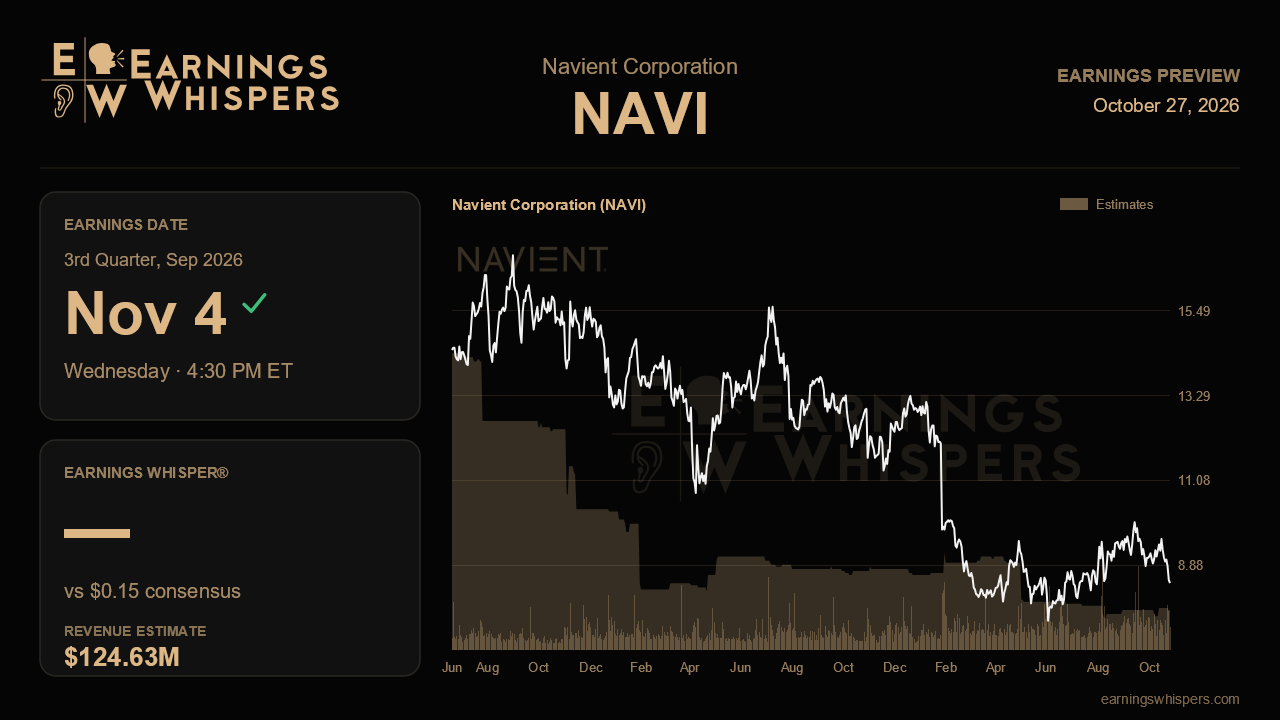
Navient enters its third-quarter report with a growth story that looks better on the ground than it does in the stock price. Under CEO Ed Bramson, the student lender has been originating loans at a pace it has not seen in years, cutting costs sharply and reshaping its balance sheet. Yet the shares have slipped since the last report, and Wall Street is bracing for earnings to roughly halve. The question for the November 4 release, due after the close, is whether the September quarter, traditionally the heart of in-school lending season, shows that the new playbook is gaining traction or that legacy credit is still setting the tone.
Consensus calls for earnings of $0.15 per share, down about 48% from $0.29 a year ago and well below the $0.29 reported last quarter, which was itself flattered by a one-time $12 million investment gain. Excluding items, the prior quarter came in at $0.25, so the Street is modeling a meaningful step down even from that cleaner base. Revenue is pegged at $124.6 million, an 84% drop from the year-ago $800 million. A decline that steep likely reflects how revenue is being measured rather than a collapse in the business, so per-share earnings and the operating details matter far more here than the top line. Management has not issued fresh formal guidance beyond its full-year targets.
The most important evidence will come from in-school originations. Last quarter's $80 million was up 40% from a year earlier, and management spoke confidently about building into the second-half peak, helped by expansion into graduate and Grad PLUS replacement lending. Just as important is the accounting change that took effect for in-school loans originated after June 30. By electing fair value treatment, Navient no longer has to book large upfront loss reserves under CECL as volume grows. In past years, a strong peak season punished near-term earnings; this quarter is the first real test of whether rapid growth can now flow through without that drag. Refinance volume, which topped $1.5 billion through midyear and was tracking the annual outlook, should confirm it is still on pace, though management has already signaled that refi spreads in the back half will look like the first half rather than expand.
Credit is the swing factor that could challenge the narrative. Navient built a $23 million reserve on its remaining private legacy book last quarter after the improvement in borrower performance slowed as the quarter went on. Private charge-offs of 1.8% and 31-plus day delinquencies of 5.4% were still edging better, but another reserve build would suggest the moderation is turning into deterioration. Investors should also look for progress on the $528 million of legacy loans moved to held for sale, since completing that sale would free capital for the newer lending products. On costs, expenses of $167 million through June leave room under the reaffirmed cap of $350 million, and continued discipline would support margins as marketing spend rises to fuel growth. Shareholder returns, which fell to $17 million last quarter, will reveal how much capital management is choosing to hold back for lending.
Sentiment has softened its bearish edge, moving from 23.1% bearish before the last report to 5.6% bearish now, yet the stock tells a less forgiving story. Shares are down 4.2% since the prior release, trailing the S&P 500 by 3.5 points, and at $8.42 they sit below the 200-day moving average of $9.02 and just above the post-earnings low of $8.34. That positioning means expectations are modest, but it also means the stock is perched near support that a disappointment could break.
Ultimately, this report hinges on whether peak-season origination growth, now freed from upfront reserve charges, can show up in earnings while the legacy portfolio stays quiet. Strong in-school volume alongside stable credit would validate the strategic pivot; another reserve build would keep the market focused on the past rather than the growth Navient is trying to sell.
This earnings preview was originally published on Earnings Whispers.
This article is for informational purposes only and is not investment advice. Earnings Whispers and its staff may hold positions in the securities mentioned. It is AI-assisted, based on proprietary Earnings Whispers data and company reports, and edited by Earnings Whispers staff.
Mentioned In This Article
Latest News
| Oct-27 | |
| Oct-21 | |
| Oct-07 | |
| Sep-25 | |
| Sep-18 | |
| Aug-13 | |
| Aug-06 | |
| Aug-06 | |
| Jul-17 | |
| Jul-02 | |
| May-21 | |
| May-19 | |
| Apr-30 | |
| Apr-29 | |
| Apr-29 |
