Lincoln International Needs A Big Sequential Jump To Meet Street, And Skeptics Are Circling
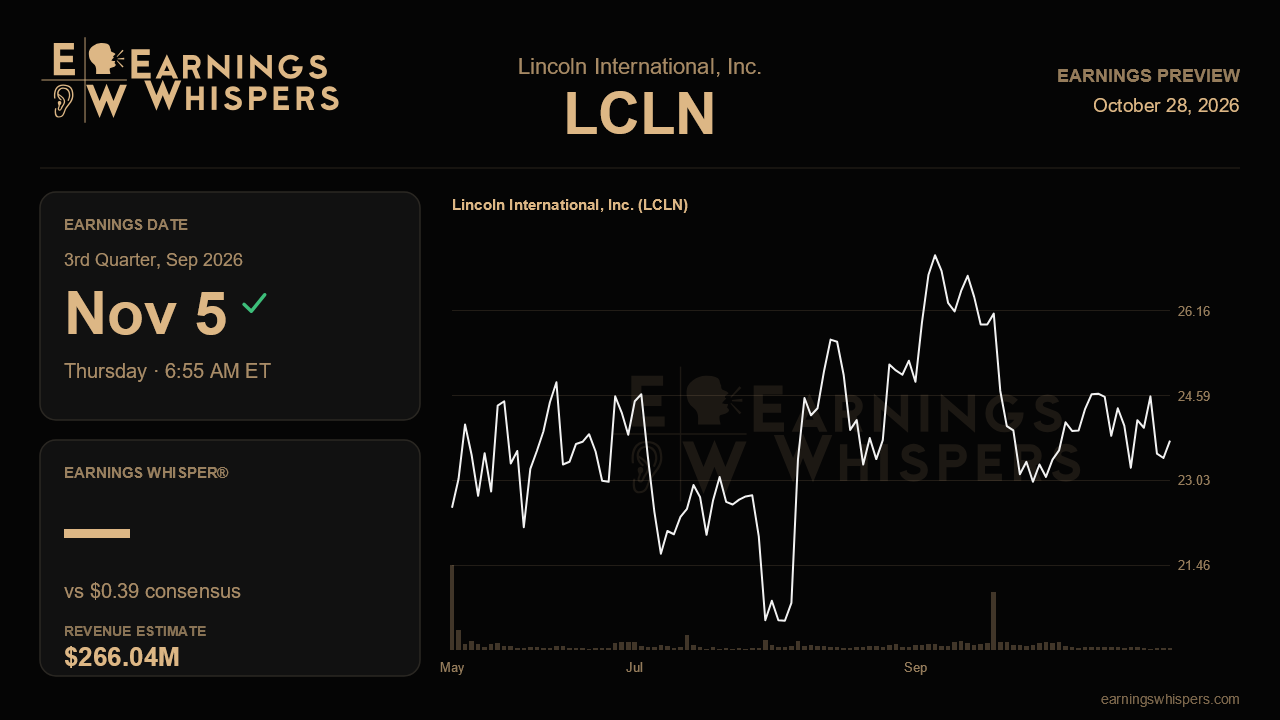
Wall Street is asking Lincoln International for a meaningful step up in a single quarter, and the crowd is getting less convinced it will happen. When the company reports before the open on November 5, consensus calls for earnings of $0.39 per share on revenue of $266.0 million. That compares with $0.26 and $225.7 million in the quarter just reported. Revenue would have to climb roughly 18% sequentially, while per-share profit would need to rise about 50%. That gap is the story. The Street is not just modeling more business. It is modeling a lot more profit from each additional dollar of revenue.
That kind of operating leverage is plausible for a brokerage and transaction-oriented financial firm, where much of the cost base is fixed in the short run and incremental revenue can fall disproportionately to the bottom line. It also cuts both ways. If revenue arrives closer to the prior quarter's level than to the $266 million target, the leverage that flatters the bull case would work in reverse, and the earnings shortfall could be larger in percentage terms than the revenue miss. In practice, the first number that matters is the top line. A revenue print near or above consensus would suggest activity levels have genuinely improved. A print that lands in the $240 million range would make the $0.39 target very hard to reach.
With no formal outlook from management on the record, the Street's estimates stand on their own rather than being anchored to a company range. That puts more weight on what management says this time. The most useful disclosures would be any color on how activity trended through the quarter, whether the pipeline of pending business is building or being drawn down, and how compensation and other expenses scaled against revenue. Investors should look closely at whether expense growth stayed well below revenue growth. If costs rose roughly in line with sales, the higher earnings bar would be met through volume alone, which is a less durable foundation than improving margins. Commentary about the coming quarter matters too, because a strong period followed by a cautious tone would signal the jump was pulled forward rather than structural.
The mood around the stock has soured noticeably. Sentiment readings now sit at 59.2% bearish, compared with just 15.3% bearish heading into the prior report. That is a sharp swing toward pessimism, and it sits awkwardly beside the share price. The stock has gained 5.5% since the last report while the S&P 500 was essentially flat, so the market has rewarded the company even as the conversation around it has turned skeptical. That mix suggests investors who own the shares are willing to give management the benefit of the doubt, while a growing group doubts the earnings ramp is achievable. Heavy skepticism can lower the bar for a positive reaction if results simply hold up.
The chart reflects that indecision. At $23.76, the stock is sitting almost exactly on its 200-day moving average of $23.83 and well inside its post-earnings range of $21.10 to $27.55, roughly 14% below the high. It is neither breaking out nor breaking down, which leaves the report to choose the direction.
Ultimately, the quarter comes down to whether Lincoln International can show that revenue really stepped up toward the $266 million mark and that expenses lagged behind. Deliver both, and the bears will have to reconcile their caution with a business demonstrating real leverage. Fall short on revenue, and the outsized earnings expectation will look like it was built on optimism rather than evidence.
This earnings preview was originally published on Earnings Whispers.
This article is for informational purposes only and is not investment advice. Earnings Whispers and its staff may hold positions in the securities mentioned. It is AI-assisted, based on proprietary Earnings Whispers data and company reports, and edited by Earnings Whispers staff.
Mentioned In This Article
Latest News
| Oct-28 | |
| Oct-27 | |
| Oct-15 | |
| Aug-13 | |
| Aug-06 | |
| Jul-17 | |
| Jul-16 | |
| Jun-04 |
The Anything-Goes Era in Private-Credit Lending Is Coming to an End
LCLN LCLN -5.98%
The Wall Street Journal
|
| May-21 | |
| May-20 | |
| May-20 |
