Bausch Health Crushes Estimates And Raises 2026 Again, But Slowing Xifaxan Demand And An Unchanged 2027 Outlook Temper The Beat
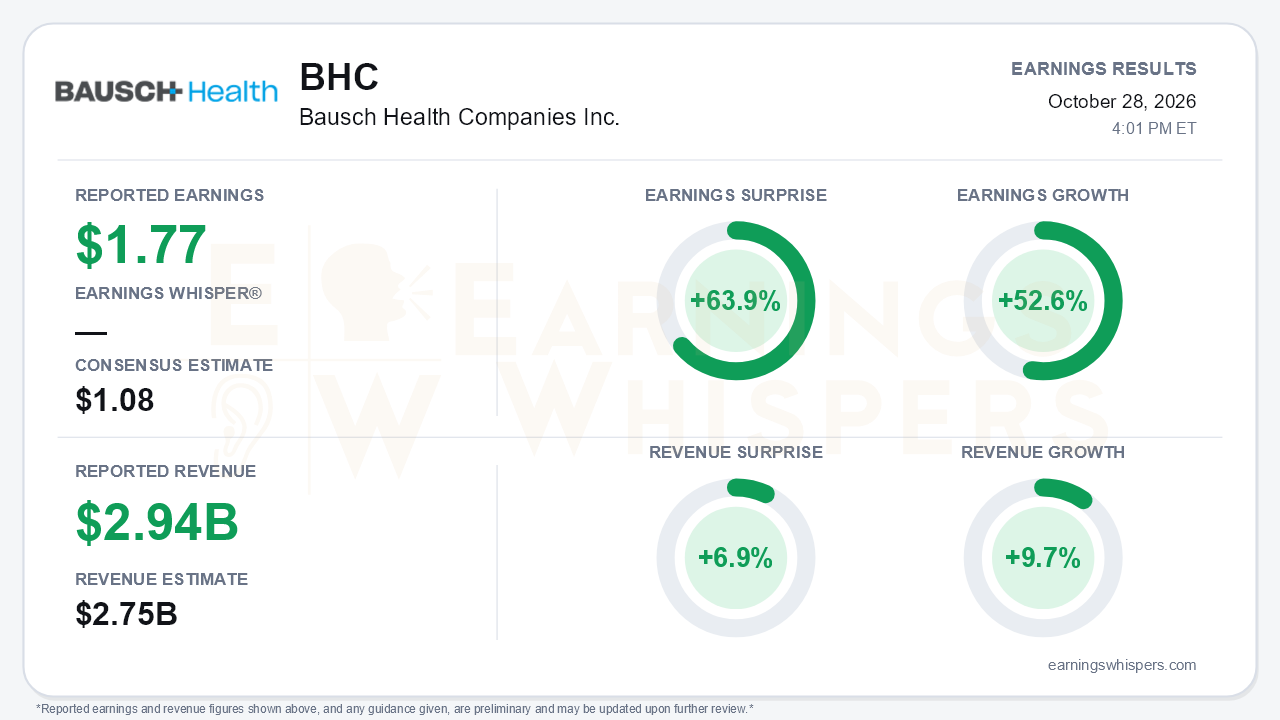
Bausch Health delivered one of its cleanest headline quarters in years, but the beat is mostly a 2026 story that does little to change the 2027 problem. Adjusted EPS of $1.77 topped the $1.08 consensus by 63.9% and grew 52.6% year over year. Revenue of $2.941 billion beat the $2.75 billion estimate by 6.9% and rose 9.7%. GAAP diluted EPS was $1.15 versus $0.48, so the improvement was not just an adjusted-earnings construct. Management raised full-year guidance for revenue, adjusted EBITDA and adjusted operating cash flow for the second consecutive quarter. Yet the call also showed decelerating Xifaxan demand, a weak quarter at Solta and an implied 2027 EBITDA figure of roughly $2.7 billion that was left unchanged. That is the central tension.
The quality of the beat deserves scrutiny. Consolidated adjusted EBITDA attributable to Bausch Health rose 32% to $1,305 million, and Bausch Health excluding Bausch + Lomb crossed $1 billion in quarterly adjusted EBITDA for the first time at $1,022 million. However, the prior-year quarter absorbed an $81 million acquired IPR&D charge, which flatters the comparison. Margin expansion was still genuine. Adjusted cost of goods sold was essentially flat at $721 million while revenue grew $260 million, and consolidated adjusted gross margin climbed from 70.9% in Q1 to 72.9% in Q2 and 75% in Q3. Cash generation was the strongest part of the release. Operating cash flow doubled to $813 million, and net debt fell $521 million in the quarter and more than $1 billion year to date. Still, total debt of about $20.2 billion and nearly $400 million of quarterly interest expense keep leverage at the center of the story.
The operating picture beneath the headline is weaker. Revenue growth excluding Bausch + Lomb slowed to 12% from 16% in Q2. Xifaxan growth fell to 16% from 26%. Retail prescriptions excluding Medicaid grew only 1.8%, down from 6% in Q1 and 4% in Q2. Management acknowledged that Q3 Xifaxan volume benefited from a channel inventory build it expects to normalize. Solta was the clearest soft spot. Reported growth of 18% depended on the acquisition of its China distributor, while organic revenue fell 4%, down from +19% in Q1. Management cited softer Chinese consumer spending, local and Korean competition in skin tightening, and flat U.S. sales amid pricing pressure. There were offsetting bright spots. Canada swung to 7% organic growth from -9% in Q2, Diversified grew 5% on double-digit dermatology gains, and Bausch + Lomb grew 7% organically, led by 11% growth in Pharmaceuticals.
The forward setup is where bears have legitimate ammunition. Management outlined explicit Q4 headwinds. A gross-to-net accrual of more than $100 million ahead of the January 1, 2027 Medicare negotiated price for Xifaxan is expected to cost about 800 basis points of revenue growth and about 1,400 basis points of EBITDA growth. Inventory normalization should take at least another 300 and 500 basis points, respectively. Management also quantified the 2027 IRA impact for the first time at roughly $400-500 million year over year. Against raised 2026 adjusted EBITDA guidance of $3.225-3.275 billion for the business excluding Bausch + Lomb, the ~$2.7 billion 2027 figure implies a meaningful step down. The Xifaxan patent litigation also remains unresolved, with no timeline for a ruling. On the positive side, management plans to use about $2 billion of cash to redeem 2027 notes early and repurchase up to $100 million of debt. It also launched a modest $50 million buyback, aimed mainly at offsetting dilution. CEO Tom Appio's added role as interim Bausch + Lomb CEO prompted speculation about a closer combination, though it also raises questions about management bandwidth.
Investors arrived far less skeptical than a quarter ago. Earnings Whispers sentiment moved from -0.18 to +0.17, a meaningful shift from mildly negative to mildly positive, though hardly euphoric. Shares closed at $6.31 the day before the report, 27% above the $4.97 open following the July release and 10.7% above the 200-day moving average of $5.70. They also sat 13.6% below the $7.30 inter-earnings high set in early August, so the stock had given back part of its post-Q2 surge. Trend readings are mostly positive on price and momentum, but the negative AVWAP reading suggests buyers since that August peak remain underwater.
The bottom line is that Bausch Health beat decisively, expanded margins and turned stronger cash flow into real deleveraging, all of which justify the improved sentiment. But the quarter was partly flattered by an easy prior-year comparison and an inventory build. Xifaxan demand is clearly slowing, and the newly quantified IRA hit leaves 2027 earnings expected to fall. The 2026 story keeps improving, while the 2027 story has not changed.
Read our earnings preview for Bausch Health Companies Inc.: https://www.earningswhispers.com/article/BHC/20907
This earnings review was originally published on Earnings Whispers.
This article is for informational purposes only and is not investment advice. Earnings Whispers and its staff may hold positions in the securities mentioned. It is AI-assisted, based on proprietary Earnings Whispers data and company reports, and edited by Earnings Whispers staff.
Mentioned In This Article
Latest News
| 5 hours | |
| 6 hours | |
| 6 hours | |
| 7 hours | |
| 7 hours | |
| 7 hours | |
| Oct-20 | |
| Oct-12 | |
| Oct-12 | |
| Oct-06 | |
| Sep-24 | |
| Sep-08 | |
| Sep-01 | |
| Aug-27 | |
| Aug-17 |
