MSC Income Fund Needs Loan Growth To Outrun Yield Squeeze And Rising Non-Accruals
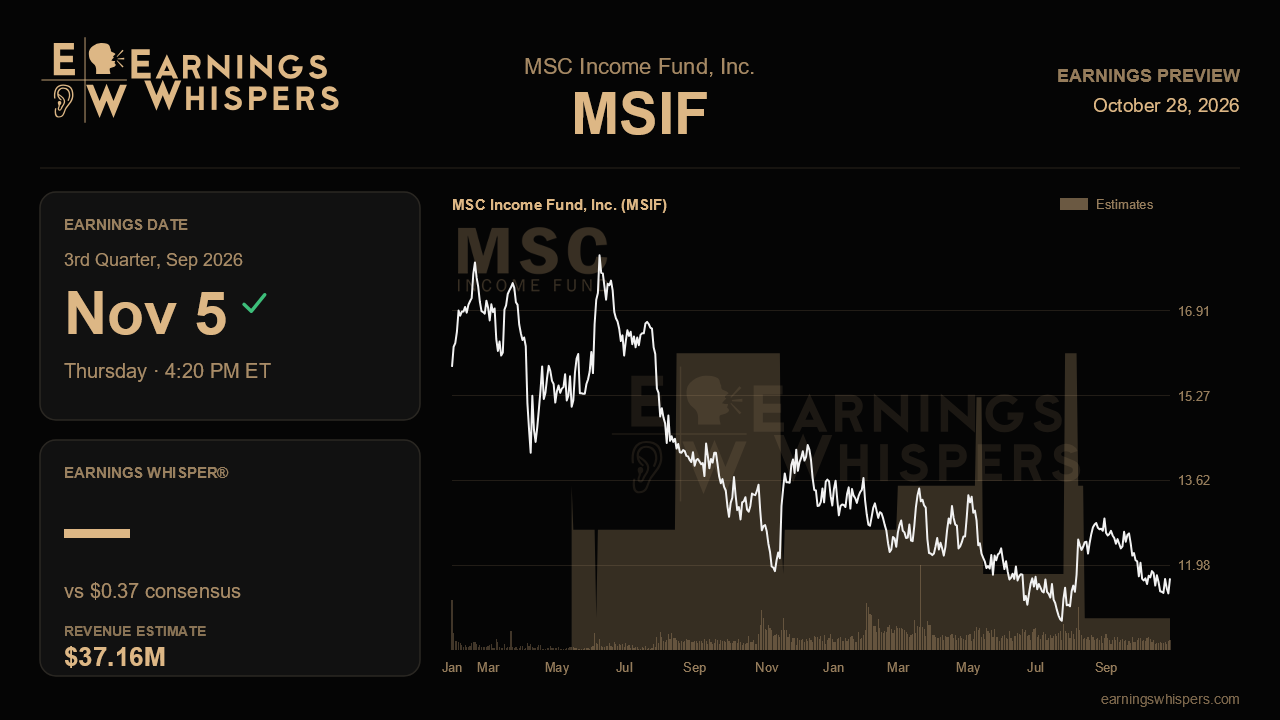
MSC Income Fund heads into its third-quarter report with a stock trading near 71% of its last stated net asset value of $16.51 per share, a fresh $40 million buyback program in motion, and a loan book that has been growing more slowly than management would like. That combination makes this an unusually telling quarter. The buyback is designed to close the gap between price and book value. The operating results will show whether the earnings engine underneath deserves a narrower discount.
The Street expects earnings of $0.37 per share on revenue of $37.2 million, up 5.7% and 5.1% from a year ago. That is modest growth, but it asks for more than the last quarter delivered. Total investment income was $35.7 million, so consensus implies a sequential gain of roughly $1.5 million. Adjusted net investment income before taxes has been stuck at $0.36 per share for two quarters, down from $0.37 a year earlier. The $0.36 matches the quarterly dividend, now paid monthly, which management effectively reaffirmed. A $0.37 print would restore a sliver of coverage above the payout. Another quarter at $0.36 would leave the dividend covered but with no cushion.
Getting there depends on deployment winning a tug of war with yields. Last quarter, private-loan originations improved to $62 million. Repayments absorbed most of that, and net growth was only $10 million, down from $17 million the prior quarter and $57 million the quarter before. Weighted-average private-loan yields slid again to 10.4%, from 11.3% a year earlier. Management also cut its description of the pipeline to roughly normal, from better than normal in late 2025. On the positive side, it reported closing three new private-loan companies after quarter end and said it expects more M&A activity in the second half. Net portfolio growth well above last quarter's $10 million, with yields holding near 10.4%, would back up that optimism. Another quarter where repayments cancel out new loans and yields slip again would suggest the revenue consensus is leaning on hope.
Credit is the second test. Non-accruals rose to 5.8% of cost and 1.9% of fair value, up from 4.2% and 1.1% one quarter earlier. Management acknowledged that is about two points above its long-term norm. Because non-accrual loans stop contributing interest, a further increase would weigh directly on income and could offset the benefit of any portfolio growth. Stabilization, or resolutions that bring the figure down, would help show that last quarter was a blip rather than a trend. The strong NAV gain, helped by an $11.6 million realized gain on the Center Technologies exit, raised the bar. Holding NAV near $16.51 without a similar one-time gain would be a credible result.
Balance-sheet housekeeping matters too. The $150 million notes maturing October 30 fall between quarter end and the report, so the release should show how they were refinanced and at what cost. Higher funding costs could quietly eat into the spread that supports the dividend. Investors should also watch how much of the buyback was used in its first weeks. Repurchases at roughly a 29% discount to NAV add to book value per share, but they compete with new loans for capital. The report will also be the first with Nick Meserve's move to CEO approaching, though that handoff has been presented as orderly.
Sentiment has warmed noticeably, moving to moderately bullish from slightly bearish before the last report. The stock has not followed. Shares are down 1% since the last report, a bit worse than the S&P 500. At $11.73, they sit below the 200-day moving average of $12.30 and closer to the bottom of the post-earnings range of $11.25 to $13.02 than the top. Expectations are not stretched, but the market has not given credit for the NAV gains either.
The central question is whether net investment income can move off its $0.36 plateau. If loan growth finally outpaces repayments while non-accruals level off, the story of steady earnings plus capital return holds and the discount looks too wide. If yields and credit keep eroding the gains, the buyback may end up supporting a business that is simply treading water.
This earnings preview was originally published on Earnings Whispers.
This article is for informational purposes only and is not investment advice. Earnings Whispers and its staff may hold positions in the securities mentioned. It is AI-assisted, based on proprietary Earnings Whispers data and company reports, and edited by Earnings Whispers staff.
Mentioned In This Article
Latest News
| Oct-28 | |
| Oct-16 | |
| Oct-08 | |
| Oct-02 | |
| Sep-16 | |
| Sep-01 | |
| Aug-07 | |
| Aug-06 | |
| Aug-06 | |
| Aug-06 | |
| Aug-05 | |
| Aug-03 | |
| Jul-17 | |
| Jul-09 | |
| Jun-30 |
