Tyler Technologies Edges Past The Whisper On Margins And Cash, But A Trimmed SaaS Outlook And Static EPS Guide Muddy The Growth Story
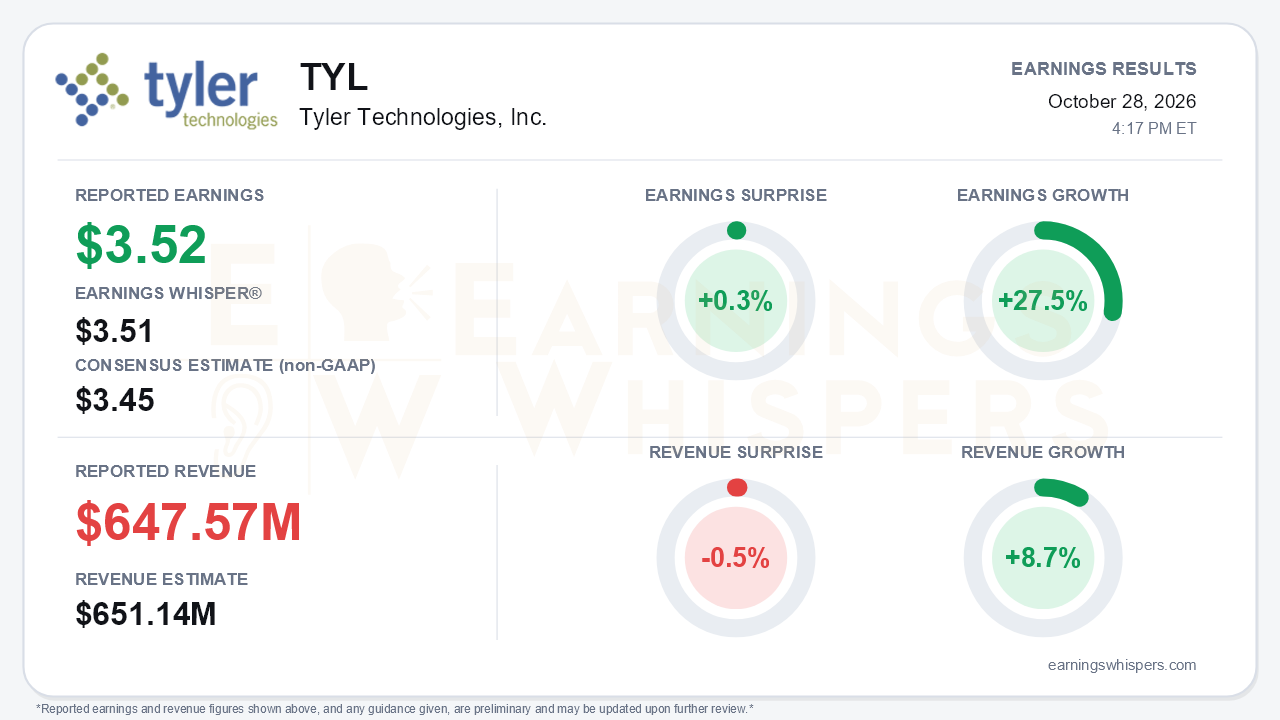
Tyler Technologies delivered a quarter that was stronger on profitability than on growth. Third-quarter earnings of $3.52 per share topped the $3.45 consensus and edged past the $3.51 Earnings Whisper number, a 0.3% beat, and grew 27.5% year over year. Revenue of $647.57 million rose 8.7% but missed the $651.14 million consensus by 0.5%. That is the central tension: margin expansion, record cash generation and aggressive buybacks are driving the bottom line, while the top line, and especially the SaaS engine investors pay up for, is showing signs of strain. Tyler lowered the high end of its full-year SaaS revenue guidance, which narrows the range, and left EPS guidance unchanged.
The quality of the beat deserves scrutiny. The earnings release itself was largely a pointer to prepared remarks and supplemental materials, so the operating detail comes mainly from the call. On profitability, the evidence is clearly favorable. Operating margin expanded 150 basis points year over year, ahead of the roughly 100 basis-point full-year midpoint management cited on the second-quarter call. Free cash flow reached a record $277 million, following record free cash flow in the second quarter. That cash funded a sharp step-up in repurchases, with buybacks reaching about 8.5% of shares year to date, compared with more than 5.5% at the second quarter and 2.5% at the first. About $1.4 billion of authorization remains. A shrinking share count is helping turn high-single-digit revenue growth into earnings growth in the high twenties, which flatters per-share results relative to underlying demand.
Beneath the headline, the SaaS trajectory softened. Reported SaaS revenue growth was 21.2%, down from 21.7% in the second quarter. Organic SaaS growth was only about 16%, below the company's 20% target for 2030. Total SaaS bookings grew just 14% after record second-quarter bookings. Management attributed the gap to two factors: contract durations shortening from roughly three years to two, and a shift toward transaction-funded deals. Neither necessarily reflects weaker demand. Annual contract value from new SaaS deals and flips grew more than 30%, up from about 22% for new SaaS ACV in the second quarter. Transaction revenue outside Texas accelerated to about 14% from roughly 10%, helped by deals such as the New Jersey State Police contract. Still, larger deals are signing later in quarters and later in the year, and that back-end loading is what forced the guidance trim. In the second quarter, management had said there was no meaningful change to the outlook. Holding EPS guidance rather than raising or narrowing it also breaks Tyler's usual third-quarter pattern.
The forward catalysts are real and getting more concrete. Cloud migration has moved from carrots to sticks. Tyler issued the first end-of-support notice and final on-prem release for a flagship product, made AI features cloud-only, and achieved multi-tenant cloud living for its first existing enterprise ERP client, with a broader rollout on track for early 2027. Roughly 1,500 of about 2,500 on-prem clients who received a July CEO letter have been contacted directly, and transitional pricing is being developed. AI now appears in roughly 300 deals, with 11 agents generally available and a target of 25 by year-end. Federal work is returning as post-DOGE contracting resumes, including VA, DOJ and USDA deals. Public-safety leads from the IACP conference roughly doubled, and Tyler added Kodi Systems through acquisition. Bears have legitimate ammunition, however. AI revenue is not expected until the back half of 2027, and AI uplift remains in the single digits. A planned sales and marketing step-up could cap 2027 margin leverage. Transaction-funded deals carry volume risk. Election-year transitions and political hesitancy around AI could slow state decisions. Management also cautioned against pinpointing when flip activity will accelerate in 2027.
The market setup is more constructive than the guidance trim might suggest. Investor sentiment remained negative but improved meaningfully, rising from -0.28 at the prior report to -0.07. Shares have gained 12.0% since the open following the July report, to $360.90, and sit about 7% above their 200-day moving average of $337.43. Price and AVWAP trend readings are both positive. In short, the stock entered this report with recovering momentum and less pessimism, which raises the bar for a quarter whose growth signals were mixed.
The bottom line is that Tyler delivered on what it controls most directly: margins, cash flow and capital return. Its cloud-migration levers also look more forceful than they did three months ago. However, decelerating organic SaaS growth, soft bookings, a lowered SaaS ceiling and an unraised EPS guide mean the growth narrative now depends on deal timing and 2027 migration execution. After a 12% run, investors are being asked to look through a softer near term on the strength of a credible but still-unproven longer-term story.
Read our earnings preview for Tyler Technologies, Inc.: https://www.earningswhispers.com/article/TYL/21012
This earnings review was originally published on Earnings Whispers.
This article is for informational purposes only and is not investment advice. Earnings Whispers and its staff may hold positions in the securities mentioned. It is AI-assisted, based on proprietary Earnings Whispers data and company reports, and edited by Earnings Whispers staff.
Mentioned In This Article
Latest News
| Oct-29 | |
| Oct-28 | |
| Oct-28 | |
| Oct-28 | |
| Oct-27 | |
| Oct-21 | |
| Oct-20 | |
| Oct-20 | |
| Oct-13 | |
| Sep-29 | |
| Sep-28 | |
| Sep-16 | |
| Sep-14 | |
| Sep-01 | |
| Aug-27 |
