Xcel Energy Beats And Stretches Its Growth Runway With A $70 Billion Plan, But Shareholders Will Help Fund It
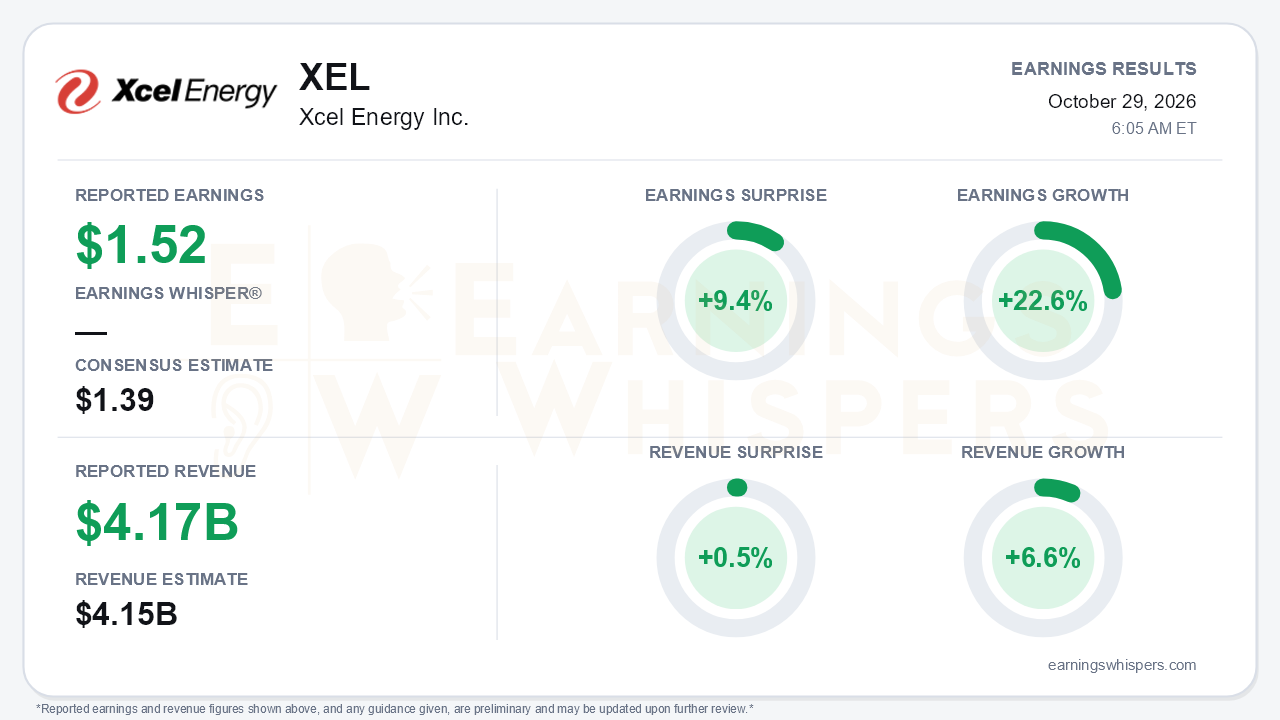
Xcel Energy (NASDAQ: XEL) delivered a clean third-quarter beat. The more consequential news, though, was the five-year roll-forward that came with it. Ongoing and GAAP earnings were both $1.52 per share, 9.4% above the $1.39 consensus and up 22.6% from the prior year's ongoing $1.24. Revenue of $4.172 billion rose 6.6% and edged past the $4.15 billion estimate by 0.5%. That growth rate extends the step-up that began in the second quarter. Q1 ongoing EPS was $0.91 versus $0.84. Q2 jumped to $0.93 from $0.75. Q3 held a similar double-digit pace. Management then raised its outlook: base capital spending rises to $70 billion for 2027-2031 from a $60 billion base, and 2027 guidance of $4.48 to $4.62 sits roughly 10.7% above the 2026 midpoint. The central tension is that the faster growth path comes with heavier dilution, a slower dividend and a balance sheet that is visibly stretching.
The quality of the beat deserves scrutiny. The GAAP comparison flatters the result because last year's quarter absorbed a $287 million Marshall Wildfire charge. Even on an ongoing basis, a meaningful share of the $0.28 improvement came from sources unlikely to recur cleanly:
- Weather added roughly $0.06 versus 2025.
- Higher equity-method earnings contributed $0.09, driven by unrealized gains on investment funds' stakes in energy technology companies.
- AFUDC added $0.11. This allowance for funds used during construction is a non-cash accrual that grows alongside the capital program.
The core engine was still evident. Higher electric revenues contributed $0.32, led by $93 million from non-cash riders and $88 million from rate outcomes. The drags were just as structural. Interest charges cost $0.13 as quarterly interest rose $100 million. Equity issuance diluted results by $0.10, with diluted shares climbing to 632 million from 595 million. Higher O&M subtracted $0.08. Debt rose to 62% of total capitalization from 59% at year-end.
Underlying demand is the strongest part of the story:
- Weather-normalized retail electric sales grew 3.0% in the quarter.
- Year-to-date normalized growth reached 2.5%, up from 2.1% through the second quarter.
- SPS led with 5.6% normalized growth in Q3, fueled by energy-sector and manufacturing activity.
- PSCo managed just 1.0%.
Management guided 2027 normalized electric sales growth to about 5%, citing SPS oil and gas demand and a large load coming online. The near-term EPS framework moves to 10%+ average annual growth for 2027-2030, from 9%+ previously, with 9%+ extended through 2031. The 2026 range was narrowed to $4.10-$4.16, lifting the low end. Notably, the capital plan excludes new data center load. Management identified a fresh pipeline of more than $10 billion beyond it, spanning 6-8 GW of RFPs, infrastructure for 4 GW of data centers and $2-4 billion of transmission.
Bears have legitimate ammunition on financing and execution. The equity need rises to $8 billion from $7 billion, and only about 40% is pre-funded, versus roughly 85% of the prior requirement. Dividend growth was guided to the low end of the 4-6% range. Moody's carries a negative outlook on the parent and PSCo, and S&P is negative on PSCo. Colorado remains the weak link:
- PSCo's rate base growth slows to about 5%.
- The CPUC granted $184 million against a $356 million electric request, at a 9.3% ROE.
- Colorado data center deals await large load tariff hearings.
The data center contracting target is unchanged, with 1 GW still in negotiation for year-end. Smokehouse Creek estimated losses and costs now total $525 million, matching the annual insurance coverage. The Texas Attorney General's suit is still in discovery. Minnesota's proposed 2027-2028 base-rate freeze addresses affordability concerns, but it requires regulatory approval.
The market had not been rewarding the growth narrative. Shares closed at $77.18 before the report, down 4.5% from the $80.83 open after the July release, which also marked the inter-earnings high. The stock hit a 52-week low of $68.72 on September 25 and had since rebounded 12.3%. It entered the print about 1.3% below its 200-day moving average of $78.19. Investor sentiment improved slightly, to -0.089 from -0.107, but remained modestly negative. That reads as lingering skepticism rather than capitulation. Momentum and AVWAP trend readings were positive while the price trend was neutral, consistent with a recovery from the September low that has not yet reclaimed the summer highs.
The bottom line is that Xcel answered the growth question decisively, with a larger plan, a stronger EPS framework and accelerating load forecasts. However, the quarter's beat leaned partly on weather and investment-fund gains. The new plan also shifts more of the funding burden onto shareholders through dilution and slower dividend growth. Investors now need to see the unsigned data center gigawatts converted, the equity need executed without further credit pressure, and Colorado stabilized before the higher growth targets translate into a re-rating.
Read our earnings preview for Xcel Energy Inc.: https://www.earningswhispers.com/article/XEL/21155
This earnings review was originally published on Earnings Whispers.
This article is for informational purposes only and is not investment advice. Earnings Whispers and its staff may hold positions in the securities mentioned. It is AI-assisted, based on proprietary Earnings Whispers data and company reports, and edited by Earnings Whispers staff.
Mentioned In This Article
Latest News
| 3 hours | |
| 12 hours | |
| 13 hours | |
| Oct-21 | |
| Oct-16 | |
| Oct-09 | |
| Oct-08 | |
| Oct-07 | |
| Oct-06 | |
| Sep-30 | |
| Sep-15 | |
| Aug-27 | |
| Aug-22 | |
| Aug-12 | |
| Aug-06 |
