Telesat's Normalized Beat Masks A Quarter Defined By Lightspeed Slippage, GEO Erosion And Unresolved Debt
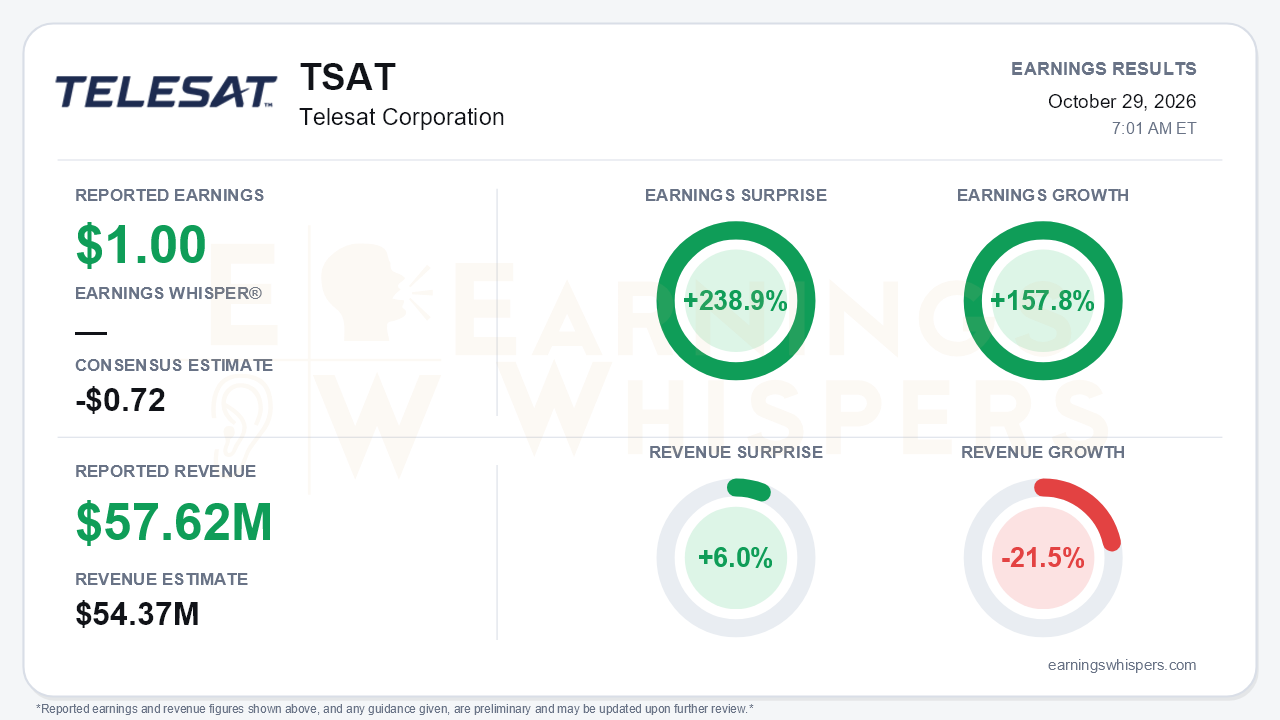
Telesat (NASDAQ: TSAT) cleared a low bar on the Earnings Whispers normalized figures for the third quarter. Reported earnings were $1.00 per share against a consensus estimate of -$0.72, a 238.9% surprise and 157.8% year-over-year earnings growth. Revenue of $57.62 million topped the $54.37 million consensus by 6.0%, even as it fell 21.5% from a year ago. That headline is hard to square with the company's IFRS results, and the gap is the first thing investors need to understand. Telesat reported a net loss of C$157 million, or C$3.09 per share attributable to shareholders, which is wider than the C$121 million loss, or C$2.38 per share, a year earlier. The beat reflects the normalized earnings basis, not an improving bottom line. The operating story underneath is one of contraction in the legacy business and delay in the growth business, partly offset by a major cash inflow.
The quality of the quarter deserves scrutiny. Consolidated revenue fell 20% to C$81 million, and adjusted EBITDA collapsed 74% to C$12 million, leaving a 15.0% adjusted EBITDA margin versus 46.3% a year earlier. Debt-refinancing expenses explain part of the decline. They totaled C$25 million in the quarter, up from C$14 million in Q2. Even excluding those costs, adjusted EBITDA fell 41%. In the GEO segment, revenue dropped 21% to C$79 million because of:
- broadcast non-renewals and capacity reductions;
- reduced service to a North American broadband customer;
- satellites retired from service.
GEO margin excluding refinancing costs held at 78%, versus 79% a year earlier, so cost discipline is intact. The revenue base, however, keeps shrinking. GEO backlog slipped to roughly C$800 million from C$900 million at Q2, and utilization edged down to about 59%. The wider net loss also reflects a further C$90 million fair-value loss on the Lightspeed financing warrants. Management characterized this as a byproduct of program de-risking, but it still weighs on reported results.
The call preserved the strategic narrative while chipping away at its timetable. The $2.7 billion ESCP-P agreement with Canada's Defence Investment Agency is already producing cash. Telesat received about C$510 million in milestone payments in Q3, with roughly C$1.5 billion more tied to development and deployment benchmarks through 2028. That pushed cash to C$814 million, alongside about C$1.5 billion of undrawn Lightspeed financing. LEO backlog held at approximately C$5.6 billion, which management described as nearly all take-or-pay. Demand commentary was the brightest spot. Management expects meaningful sovereign and allied contract signings mostly over 2027, and cited the Starshield/Ukraine episode as sharpening allied interest in independent capacity.
The schedule is where bears have legitimate ammunition. The press release reiterates that high-latitude commercial service should begin around the end of Q1 2028. On the call, however, management indicated that global service has slipped to the end of Q2 2028. That is the second delay from an original end-of-2027 target. The Pathfinder launch moved from late 2026 to mid-2027, with hardware and software still incomplete, and the first full 15-satellite launch is now around September 2027. The cut in 2026 Lightspeed spending guidance to C$1.1-1.3 billion from C$1.3-1.5 billion is a timing shift tied to that slippage, not a cost saving. Management said the ESCP-P delay carries no penalties, but the pattern of repeated slips is the central tension in a story that depends on execution. On the GEO side, guidance was reiterated for revenue of C$300-320 million and adjusted EBITDA of C$210-230 million excluding refinancing costs. The Bell Nimiq 6 renewal expected in mid-2027 is likely to come at a lower rate.
The GEO debt overhang may matter most in the near term. Maturities begin late this year, litigation with lenders continues, and management was more guarded than in Q2. It declined to discuss settlement proposals and would not rule out an equity issuance. The balance sheet shows C$2.75 billion of current indebtedness, which underscores that the refinancing outcome is not a side issue.
Investors had already grown wary heading into the report. Earnings Whispers sentiment fell from essentially neutral (0.0049) to -0.2578, a meaningful shift into negative territory. Shares ended at $45.55 on the eve of the report, down 20.6% since the open after the August release. The stock peaked at $60.24 on that first post-report day and has not recovered that ground. It sits 24.4% below that high but has rebounded 19.6% from its October 22 low of $38.10, and it remains 6.7% above its 200-day moving average. The Earnings Whispers trend readings lean negative, with sequential growth and AVWAP negative, although momentum is positive following the recent bounce.
The bottom line is that the normalized beat is the least informative part of this report. Telesat is converting its sovereign opportunity into real cash and backlog, and defence demand appears to be strengthening. Against that, Lightspeed has slipped again, GEO revenue and backlog continue to erode, and the debt refinancing remains unresolved with possible dilution on the table. Until the Pathfinder launch and a GEO debt resolution remove those uncertainties, the stock's direction is likely to hinge more on execution and capital structure than on quarterly earnings surprises.
Read our earnings preview for Telesat Corporation: https://www.earningswhispers.com/article/TSAT/21334
This earnings review was originally published on Earnings Whispers.
This article is for informational purposes only and is not investment advice. Earnings Whispers and its staff may hold positions in the securities mentioned. It is AI-assisted, based on proprietary Earnings Whispers data and company reports, and edited by Earnings Whispers staff.
Mentioned In This Article
Latest News
| Oct-29 | |
| Oct-29 | |
| Oct-29 | |
| Oct-26 | |
| Oct-24 | |
| Oct-23 | |
| Oct-14 | |
| Oct-09 | |
| Sep-17 | |
| Sep-15 | |
| Sep-09 | |
| Sep-09 | |
| Sep-02 | |
| Sep-01 | |
| Aug-14 |
