KKR Real Estate Finance Trust Beats A Low Bar, But Credit Warnings And Thin Dividend Coverage Dominate The Quarter
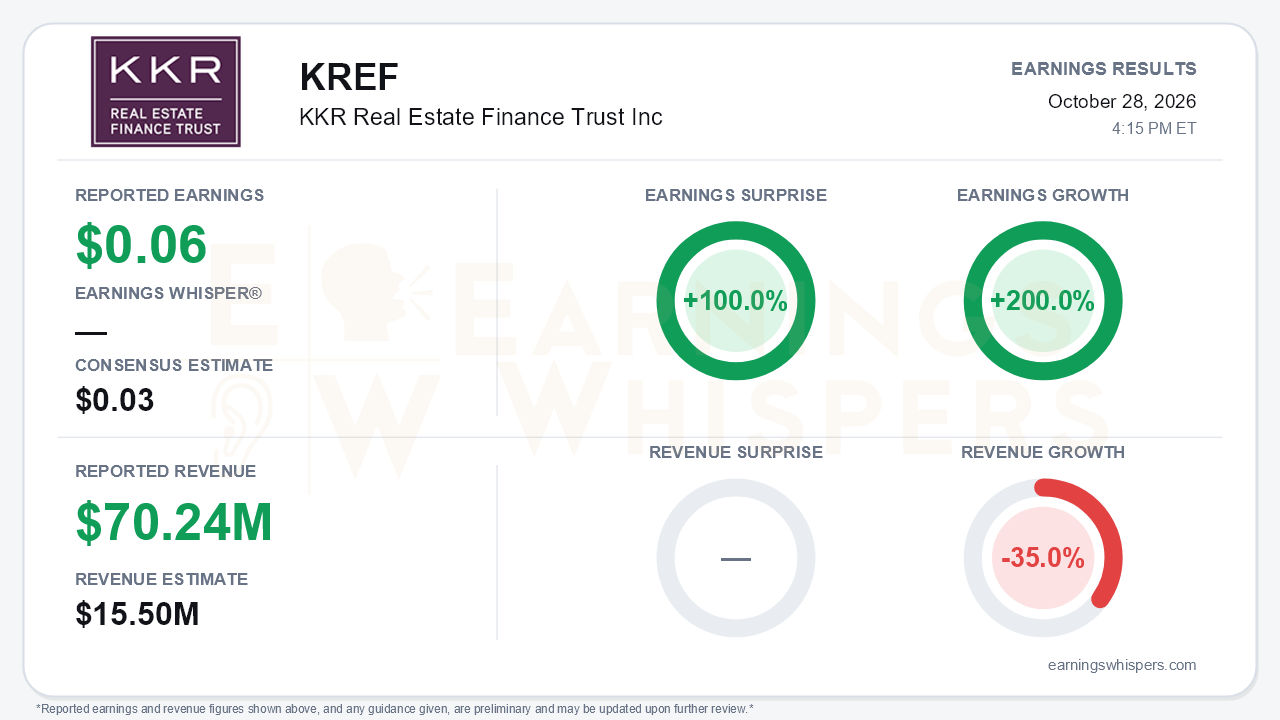
KKR Real Estate Finance Trust (NYSE: KREF) cleared consensus for the third quarter, reporting earnings of $0.06 per share against a $0.03 estimate, a 100.0% surprise. Earnings grew 200.0% from the prior year. Revenue of $70.24 million beat the $15.5 million consensus by 353.1% but fell 35.0% year over year. The headline beat is the least important part of this report. Management used the call to walk back its view that the worst of the book-value damage had passed. It warned that reserves could rise and more credit losses are likely, and it disclosed that core earnings no longer cover the dividend. That is the central tension: the balance-sheet cleanup is ahead of schedule, but credit visibility deteriorated.
The quality of the beat deserves scrutiny because KREF's other earnings measures tell different stories. GAAP results showed a loss of $0.11 per share, a sharp improvement from the $1.95 loss in the second quarter but still a loss. Distributable earnings were a $152 million loss, or $2.64 per share, driven by realized losses. Those included a Boston life science loan that was assigned back to its non-recourse lender. Investors should not read the normalized $0.06 figure as a picture of the lender's economic earnings power. The more telling figure is distributable earnings before realized losses and strategic review expenses. That measure fell to $0.09, down from $0.22 in the fourth quarter of 2025, $0.20 in the first quarter and $0.10 in the second, and it now sits below the $0.10 quarterly dividend.
The operating picture splits cleanly into two parts. On the positive side, repayments reached $1.2 billion in the quarter and $2.4 billion year to date. That already exceeds the more-than-$2 billion full-year target set earlier in the year, and more than 80% came from the troubled 2021-22 vintages. Liquidity rose to roughly $853 million, among the highest levels in company history, up from about $700 million in the second quarter and $653 million in the first. Debt-to-equity fell to 2.2x from 2.6x, and both remaining CRE CLOs were redeemed. Three more watch-list loans were resolved, and book value per share slipped only modestly, to $10.14 from $10.24. The cost of that deleveraging, however, is shrinking earnings power. Total leverage of 3.1x is now below the 3.5-4x target, and originations slowed to $157 million from about $350 million in the second quarter. Higher rates offer little relief because loan floors are binding and foreclosed real estate earns nothing.
The forward risks have shifted in an unfavorable direction. Management said renewed rate hikes are pressuring property values. It flagged rising borrower capitulation in 2021-22 multifamily loans, with some debt yields at just 5.5-6%. Multifamily was supposed to be the safer part of the book, so this broadens the credit concern beyond office and life science. Some watch-list resolutions are slipping from year-end 2026 into the first half of 2027, which undercuts the earlier goal of a full cleanup by year-end. Buybacks were halted after July pending a strategic review. That review has retained a financial advisor and legal counsel, but management offered no further detail. Its expenses will rise in the fourth quarter on a full-quarter basis, further pressuring a payout that is already uncovered. The review is a potential catalyst, and new senior housing originations show some offensive activity, but neither offsets the near-term credit warning.
Investors had already turned sharply against the stock. Earnings Whispers investor sentiment fell from -0.28 at the prior report to -0.92, a genuinely severe deterioration that leaves sentiment near the bottom of the scale. Shares closed at $5.63, down 25.5% from the $7.56 open after the July report. They sit 18.5% below the 200-day moving average of $6.91 and about 29% below the inter-earnings high of $7.91 set in mid-August. The stock entered the report just 3.2% above its quarterly low of $5.46, reached on October 21. The Earnings Whispers trend signals are uniformly negative, consistent with a stock that has been sold steadily through the quarter.
That positioning complicates the setup. With sentiment this depressed and shares near their lows, much bad news is arguably reflected in the price. The strategic review also adds optionality that a pure credit story would lack. Still, bears have legitimate ammunition: a reversed book-value message, an uncovered dividend, slipping timelines and rising costs.
The bottom line is that KREF's earnings beat is largely irrelevant next to what management said about credit. The company has done the hard work on liquidity and leverage faster than promised, but it is now warning of higher reserves and widening multifamily stress. Core earnings have fallen below the dividend, so the investment case increasingly rests on the outcome of a strategic review management is not yet discussing.
Read our earnings preview for KKR Real Estate Finance Trust Inc: https://www.earningswhispers.com/article/KREF/20952
This earnings review was originally published on Earnings Whispers.
This article is for informational purposes only and is not investment advice. Earnings Whispers and its staff may hold positions in the securities mentioned. It is AI-assisted, based on proprietary Earnings Whispers data and company reports, and edited by Earnings Whispers staff.
Mentioned In This Article
Latest News
| Oct-29 | |
| Oct-29 | |
| Oct-28 | |
| Oct-20 | |
| Oct-20 | |
| Oct-14 | |
| Sep-18 | |
| Sep-17 | |
| Aug-20 | |
| Jul-23 | |
| Jul-22 | |
| Jul-21 | |
| Jul-21 | |
| Jul-17 | |
| Jul-16 |
