Piper Sandler Misses As Rate Shock Guts Muni Financing; Record Advisory Pockets Can't Offset A Softer Q4 Outlook
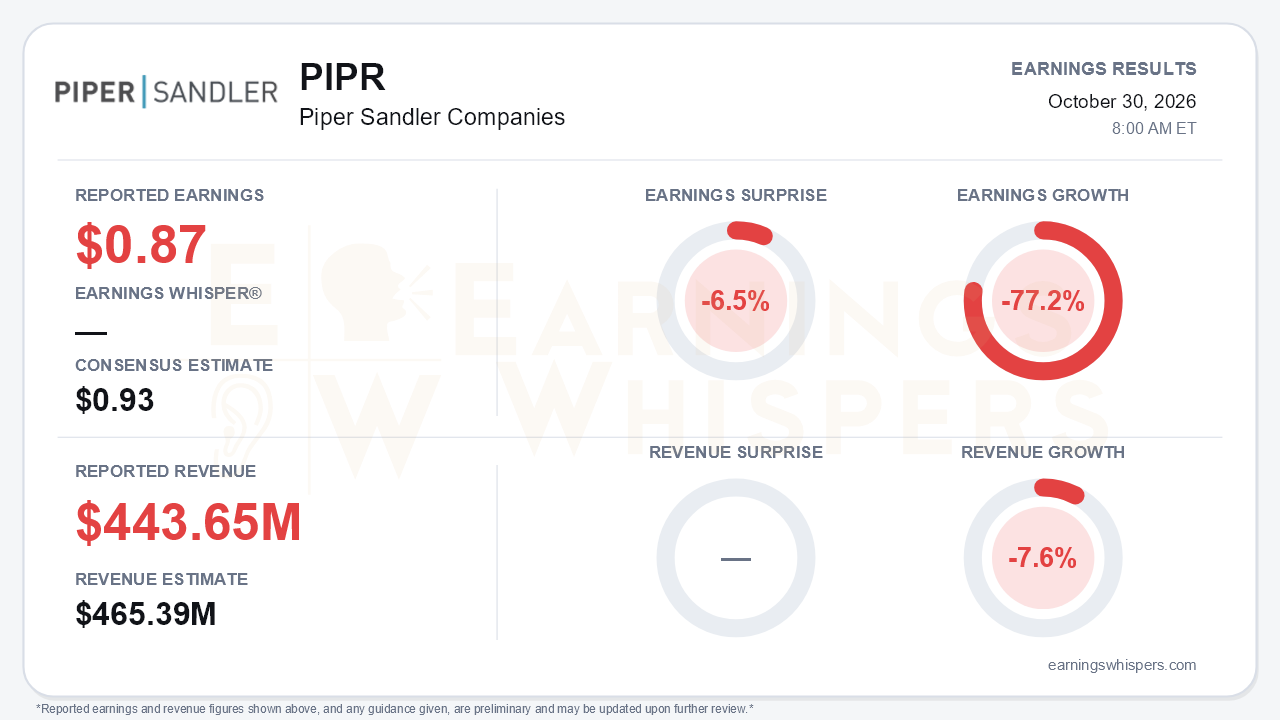
Piper Sandler (NYSE: PIPR) delivered a third-quarter miss that matters less for its size than for what it signals: the first-half surge is fading. The firm earned $0.87 per share, short of the $0.93 consensus by 6.5%. Revenue of $443.65 million missed the $465.39 million estimate by 4.7%. On Earnings Whispers' normalized basis, earnings fell 77.2% year over year and revenue declined 7.6%. Sequentially the trend is unambiguous. Adjusted EPS slid from $1.04 in Q2 and $1.00 in Q1, and adjusted operating margin compressed to 19.8% from 21.8%. The central tension is that Piper's best franchises are still producing records while the rest of the platform and the near-term outlook are weakening at the same time.
The quality of the miss deserves scrutiny, because the headline mixes market-driven weakness with accounting noise. Management framed adjusted net revenue at $456 million, down from $491 million in Q2 and $470 million in Q1. It described that figure as only modestly higher year over year, a sharp slowdown from 22% growth in Q1. The roughly $12 million gap between that adjusted figure and the reported $443.65 million lines up with a $13.5 million investment-income loss on internal private equity funds. Management treated that loss as GAAP noise. That explains why the call describes modest growth while the normalized comparison shows a decline. Even setting the investment loss aside, the operating picture deteriorated. The non-comp ratio jumped to 18.7% from 16.7%, while the comp ratio held at 61.5%.
The damage was concentrated in rate-sensitive and capital-markets businesses. A sharp rise in rates hit public finance hard. Municipal financing revenue collapsed to $25 million, down 50% sequentially and 36% from a year ago. Corporate financing came in at $57 million, below the prior year. Equity brokerage fell 13% sequentially to $54 million, and management flagged fee compression as volume shifts toward program and electronic trading. Against that backdrop, advisory remained the engine. Advisory revenue reached $250 million, up 18% year over year, though that growth has cooled from 34% in Q2. Corporate investment banking posted a record Q3 at $307 million. Advisory revenue from private equity clients accelerated to 17% growth from 10%. The diversified energy group closed a record 19 deals, more than double last year, on AI data-center power demand. Private capital advisory had its best quarter and has already surpassed its full-year 2025 revenue. Fixed income also rebounded to $60 million, up 23% sequentially, a notable turn from the 'challenging' outlook management offered in Q1.
The forward commentary is where bears have the most ammunition. Management expects corporate financing to slow in Q4 and come in below the year-ago level, citing a weak October equity capital markets fee pool. Q4 advisory is expected to trail the record Q4 2025. Full-year non-comp ratio guidance moved above 2025 levels because of the New York office move, legal fees, and an ongoing legal matter. Earlier in the year, management had guided that ratio to be similar to 2025. Bank M&A deal counts likely will be down versus 2025, and the consolidation rush management anticipated earlier has not arrived. The tone shifted from 'strong momentum' to 'increasingly selective' markets with uncertain timing. Managing director headcount slipped to 191 from 193. On the other side of the ledger, management announced several offsetting catalysts:
- a new $200 million buyback authorization running through 2028;
- a European equities trading launch;
- a renewed push to recruit managing directors;
- openness to larger acquisitions, amid press reports of interest in another advisory firm.
Investor sentiment had already soured heading into the print. The Earnings Whispers sentiment reading fell from -0.17 to -0.61, a substantial deterioration rather than a marginal shift. Shares closed at $68.72 before the report, down 5.5% from the open after the July release. They have traded between a mid-August high of $78.80 and a 52-week low of $61.35 set on October 14. Entering earnings, the stock sat about 12% above that low and well below its 200-day moving average, a gap of roughly 49%. That distance is unusually wide, and investors should verify it against the stock's share history before drawing conclusions. The internal trend readings are mixed, with momentum positive but AVWAP still negative.
The bottom line is that Piper Sandler's quarter exposed how much of its 2026 strength depended on favorable financing markets. The sharp rise in rates, a soft ECM calendar, and rising expenses are now weighing on results, while the advisory franchise, energy, and private capital advisory keep the long-term growth story credible. Investors were already pessimistic, which tempers the surprise. However, guidance points to a softer Q4 against tough comparisons and higher non-comp costs. That leaves the burden on advisory execution and the buyback to carry the setup until capital markets reopen.
Read our earnings preview for Piper Sandler Companies: https://www.earningswhispers.com/article/PIPR/21298
This earnings review was originally published on Earnings Whispers.
This article is for informational purposes only and is not investment advice. Earnings Whispers and its staff may hold positions in the securities mentioned. It is AI-assisted, based on proprietary Earnings Whispers data and company reports, and edited by Earnings Whispers staff.
Mentioned In This Article
Latest News
| Oct-30 | |
| Oct-30 | |
| Oct-27 | |
| Oct-26 | |
| Oct-22 | |
| Oct-21 | |
| Oct-20 | |
| Oct-15 | |
| Oct-15 | |
| Oct-14 | |
| Oct-13 | |
| Oct-02 | |
| Oct-02 | |
| Sep-29 | |
| Sep-29 |
