Alkermes Beats Its Own Guidance, But Lybalvi Pricing Dilution And Takeda's Orexin Launch Cloud A Stronger Quarter
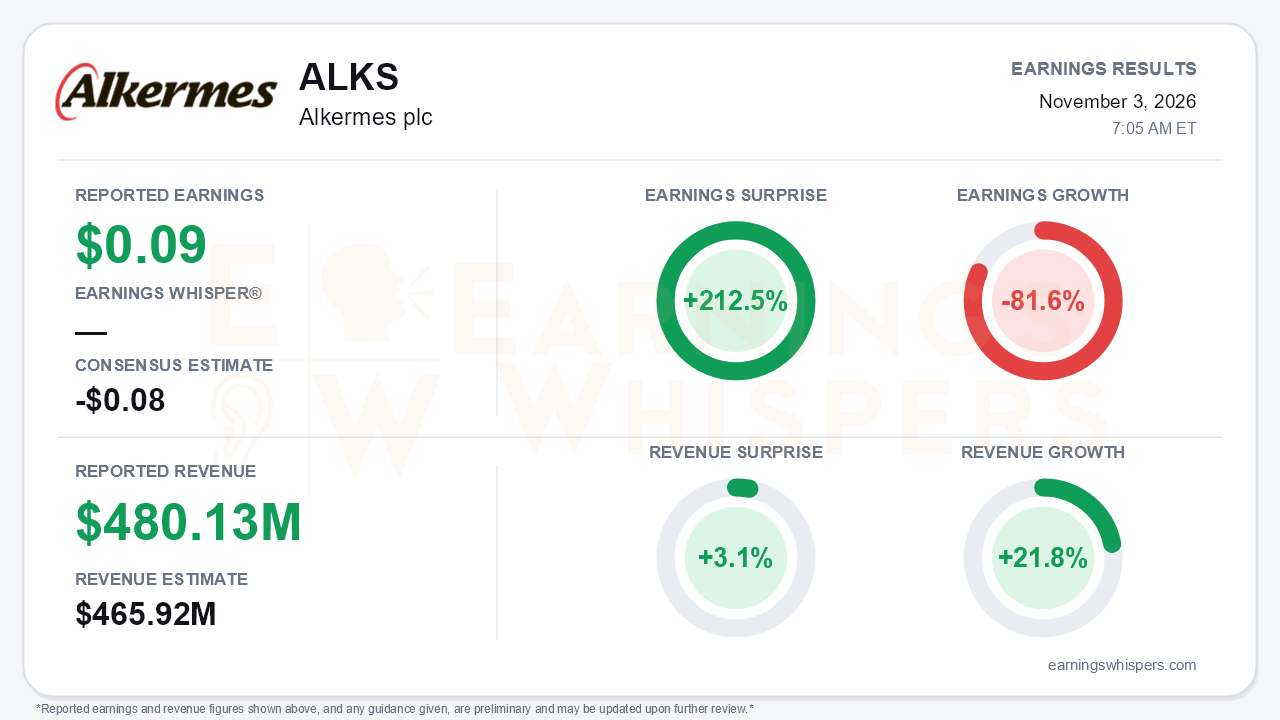
Alkermes (NASDAQ: ALKS) delivered a clean beat on the scoreboard investors were watching. The company earned $0.09 per share in the third quarter, where consensus had expected a loss of $0.08, an earnings surprise of 212.5%. Revenue of $480.13 million topped the $465.92 million consensus by 3.1% and grew 21.8% year over year. Management also reaffirmed full-year 2026 guidance and raised the bar for the fourth quarter. The more complicated part sits below the headline. Earnings still fell 81.6% from a year ago. Several of the quarter's best numbers were helped by items that will not repeat, and the product with the clearest volume momentum is giving back more of that growth through pricing. That is the central tension: commercial demand is improving while the quality of net revenue and the competitive landscape are getting harder to read.
The press release itself offered little detail and directed investors to the full results, so most of the operating story came from the call. Against its own targets, Alkermes executed well. Total revenue of $480.1 million beat the $450-470 million guided on the second-quarter call. Adjusted EBITDA of $120.1 million cleared the $80-100 million guide by a wide margin. Both figures were nonetheless down sequentially from $496 million and $139.2 million in Q2, after Risperdal Consta manufacturing revenue ended. The year-over-year earnings decline also reflects a much heavier cost base. R&D rose to $121.1 million from $81.7 million a year earlier. Results also carried an acquisition-related inventory step-up in cost of goods and transaction costs that management excluded when previewing 2027. Because the earnings basis behind the consensus comparison is not specified, the size of the beat says more about how low expectations were than about how profitable the business is.
The proprietary franchise is the real engine. Net sales of $417.3 million rose 31% year over year and continued climbing from $338.1 million in Q1 and $411.7 million in Q2.
The mix within that franchise deserves scrutiny:
- **Vivitrol and Aristada** posted $127.6 million and $103.9 million, both up sequentially. However, those results were again flattered by roughly $8 million and $7 million of gross-to-net and inventory favorability, which is not structural.
- **Lumryz** added patients, rising to about 4,100 on therapy from 3,900 in Q2, 3,600 in Q1 and 3,500 at year-end 2025. Yet net sales slipped to $89.9 million from $96.6 million, partly on a roughly $7 million inventory drawdown plus seasonality.
- **Lybalvi** is the bigger concern. Prescription growth held at 18% and access reached about 80% of covered lives. But gross-to-net deductions widened from about 33% in Q1 to 36% in Q2 and 42% in Q3, with roughly 45% guided for 2027. Net sales will lag volume for the foreseeable future.
The forward story rests heavily on orexin, and the call broadened it meaningfully. ALKS 7290 produced its first adult ADHD data from a 50-patient Phase 1b study. The drug was generally well tolerated, with dose-dependent improvements on AISRS and CGI-S from day 6. Analysts, however, questioned the inpatient, split-dose design with no disclosed placebo comparison. A new 150-patient Phase 2 in adjunctive MDD extends the program into a large indication. Vibrance-3 in idiopathic hypersomnia is fully enrolled, with topline data around year-end 2026 or early 2027. Management flagged six orexin readouts over roughly the next year, including all three Brilliance Phase 3 narcolepsy studies starting mid-2027. Lumryz also has a planned IH sNDA with a potential March 2028 launch. Against that, Takeda's oveporexton, the first orexin-2 agonist, launches this month in narcolepsy type 1. Its pricing could set the corridor for the class and pressure Lumryz new starts. Some timelines also drifted later, including the ALKS 4510 fatigue data, now framed toward end-2027.
This was the first quarterly call under new CEO Blair Jackson, and his tone was execution-focused and confident. He argued that Alkermes can flex its pricing once Takeda sets its price. The 2027 framework he outlined supports a margin recovery narrative:
- lower cost of goods as the inventory step-up rolls off;
- broadly flat SG&A excluding transaction costs;
- strong adjusted EBITDA and cash generation, even as R&D keeps rising.
Cash and investments climbed to $787.6 million from about $690 million in Q2 and $538 million in Q1, supporting debt paydown.
Investors entered the report far less enthusiastic than they were three months ago. Earnings Whispers sentiment fell from 0.21 to -0.04, a meaningful shift from modestly positive to slightly negative. Shares were at $44.89 on the eve of the report, 11.0% below the $50.42 open after the prior release and 14.5% below the inter-earnings high of $52.51 set that same day. The stock had rebounded 15.2% off its October 14 low of $38.98 and sits about 10.8% above its 200-day moving average. Momentum and AVWAP trend readings are positive, suggesting the recent recovery had some footing before the print.
The bottom line is that Alkermes beat both consensus and its own guidance, and the call preserved a credible growth story built on proprietary demand, cash generation and a crowded orexin catalyst calendar. Bears still have legitimate ammunition. Lybalvi's widening discounts, one-time favorability in Vivitrol and Aristada, a sequential Lumryz dip and an imminent Takeda launch all suggest the next few quarters will be judged less on beats and more on net pricing and pipeline execution.
Read our earnings preview for Alkermes plc: https://www.earningswhispers.com/article/ALKS/21453
This earnings review was originally published on Earnings Whispers.
This article is for informational purposes only and is not investment advice. Earnings Whispers and its staff may hold positions in the securities mentioned. It is AI-assisted, based on proprietary Earnings Whispers data and company reports, and edited by Earnings Whispers staff.
Mentioned In This Article
Latest News
| 1 hour | |
| 5 hours | |
| 6 hours | |
| Oct-30 | |
| Oct-26 | |
| Oct-20 | |
| Oct-16 | |
| Oct-13 | |
| Sep-22 | |
| Sep-21 |
How Alkermes Used Its Narcolepsy Playbook In ADHD - And Seemingly Won
ALKS
Investor's Business Daily
|
| Sep-21 | |
| Sep-16 | |
| Sep-10 | |
| Aug-24 | |
| Aug-06 |
