Cognition Therapeutics Heads Into Q3 With A Wider Loss Expected And A Sub-Dollar Stock
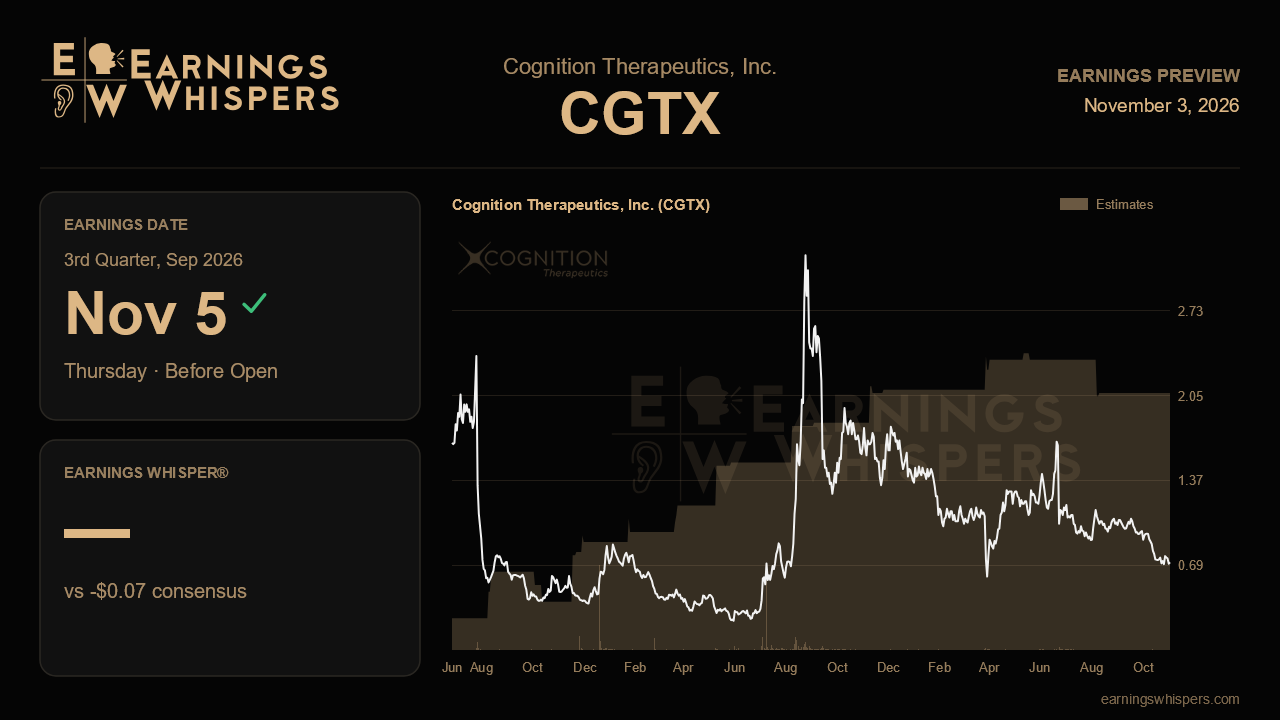
For a clinical-stage drug developer with no product revenue, a quarterly report is less about beating a number and more about answering a simpler question: how much is the science costing, and how long can the company keep paying for it? That question carries extra weight for Cognition Therapeutics this time. The shares have lost more than a third of their value since the last report and now trade near $0.71, close to the bottom of their post-earnings range.
Wall Street expects a loss of $0.07 per share for the September quarter. That would be wider than the $0.06 loss a year earlier, a roughly 17% deterioration, and notably deeper than the $0.04 loss posted last quarter. There is no revenue consensus, which fits a company whose income statement is essentially a ledger of research, clinical and administrative spending. With no formal guidance to anchor the estimate, the Street's number reflects an assumption that spending rises from last quarter's unusually light level. The gap between $0.04 and $0.07 is the most interesting detail in the setup. Either last quarter benefited from timing effects or lower trial activity that analysts expect to reverse, or the company is entering a more expensive phase of development.
That distinction matters more than the headline figure. Cognition is developing small-molecule treatments for age-related degenerative diseases of the brain and retina, a field where trials are long, costly and binary in their outcomes. A loss in line with or wider than consensus is not inherently bad if it reflects programs moving forward. A loss that widens without a clear explanation, or without a credible plan to fund the work ahead, would be harder to defend. The most useful parts of the release will likely be the cash balance, the implied runway, and any commentary on clinical timelines, partnering or financing. A narrower-than-expected loss would also need context. Investors would want to know whether it reflects deliberate cost control or simply slower progress.
Sentiment has softened noticeably. Heading into the prior report, the mood was firmly negative, with a bearish reading of about 61%. It has since eased to roughly 10% bearish. That is still below neutral, but it suggests far less hostility than a quarter ago, even as the stock has fallen. One reading is that much of the bad news has already been absorbed into a share price that has dropped from a prior-quarter range of $0.88 to $1.76 down to a current band of $0.65 to $1.12. The stock trails the S&P 500 by about 33 percentage points over the period and sits well below its 200-day moving average of $1.06. That is not a picture of momentum.
Technically, the $0.65 low is the line to watch. A report that raises funding concerns could push the shares through that floor, while a reassuring cash update could stabilize a stock that has had little to cheer about. A sub-dollar price also tends to sharpen focus on capital structure, because any equity raise at these levels would be more dilutive.
In the end, this report will not settle Cognition's investment case. Only clinical data can do that. What it can do is show whether the company has the financial footing to reach those data points without heavily diluting shareholders. If the expected rise in spending comes with a clear runway and a coherent development timeline, the existing narrative of a cash-consuming biotech progressing toward key readouts remains intact. If not, the market's recent skepticism may prove justified.
This earnings preview was originally published on Earnings Whispers.
This article is for informational purposes only and is not investment advice. Earnings Whispers and its staff may hold positions in the securities mentioned. It is AI-assisted, based on proprietary Earnings Whispers data and company reports, and edited by Earnings Whispers staff.
Mentioned In This Article
Latest News
| Nov-05 | |
| Nov-05 | |
| Nov-03 | |
| Nov-02 | |
| Oct-22 | |
| Oct-13 | |
| Oct-13 | |
| Sep-29 | |
| Sep-08 | |
| Aug-06 | |
| Jul-13 | |
| Jun-24 | |
| Jun-24 | |
| Jun-24 | |
| Jun-16 |
