JBT Marel Squeezes Out An EPS Beat On Record Margins, But A Revenue Miss And Guidance Cut Expose Deepening CPG Weakness
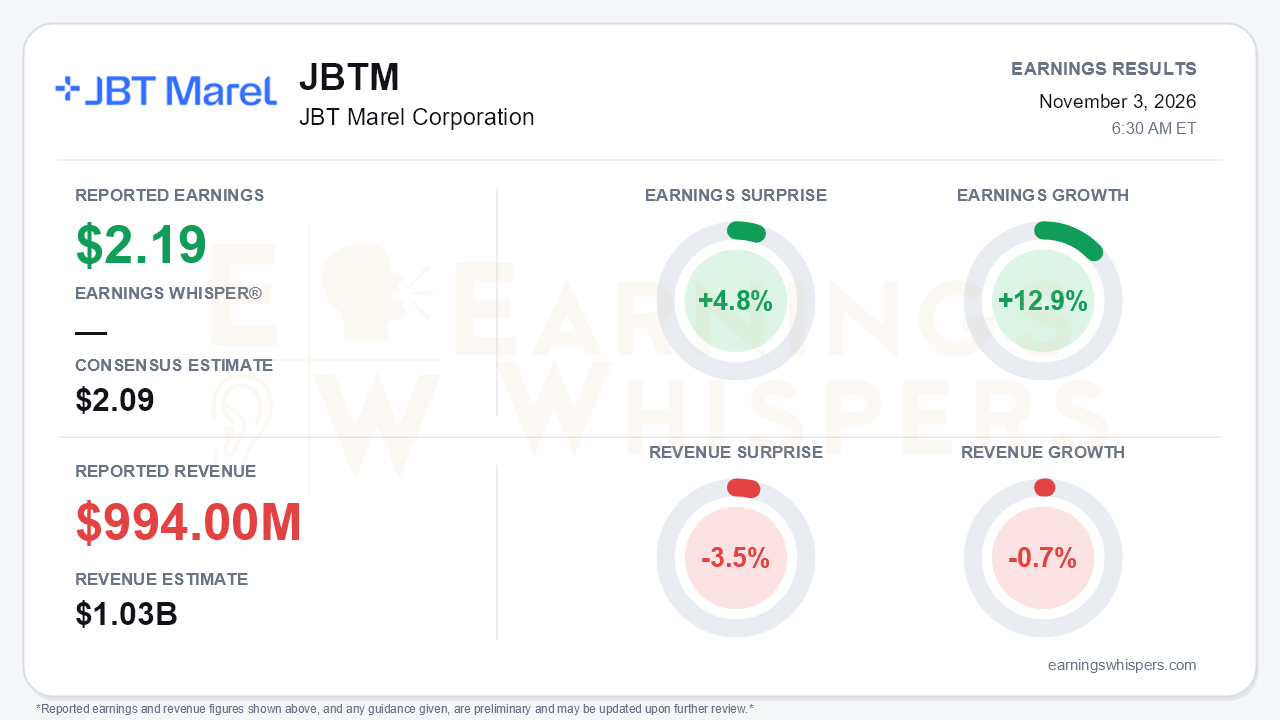
JBT Marel delivered the kind of quarter that looks better on the earnings line than on the top line. Adjusted EPS of $2.19 beat the $2.09 consensus by 4.8% and grew 12.9% year over year. Revenue of $994.0 million missed the $1.03 billion consensus by 3.5% and slipped 0.7%. The company also missed its own Q3 framework of 2-4% organic growth less about 1% FX. That leaves the central tension: management is producing record margins while the revenue base, particularly in consumer packaged goods, is eroding faster than it planned. The full-year revenue cut makes clear this is not just a timing slip.
The quality of the beat deserves scrutiny. Adjusted EBITDA rose 5% to a record $179 million, and the 18.0% margin topped the 17-17.5% guide. However, adjusted EPS grew more than twice as fast as EBITDA. Much of that gap came from below the operating line. Net interest expense fell to $13 million from $21 million after debt repayment, and diluted shares declined to 51.6 million from 52.3 million. On a GAAP basis, operating income actually dipped to $100 million from $102 million, and gross margin narrowed to 35.5% from 35.9%. Lower SG&A, at $253 million versus $258 million, did the heavy lifting. GAAP diluted EPS still improved to $1.34 from $1.26. The margin story is real, but it is coming from cost synergies, five completed facility closures and restructuring, not from volume leverage.
The segment split shows where the business is diverging. Protein Solutions grew revenue 6% to $469 million, led by poultry, and its margin expanded 110 basis points to 22.4%. Management described poultry momentum entering Q4 as very strong. Prepared Food and Beverage Solutions fell 6% to $525 million, its third straight quarter of negative organic revenue, as CPG-related book-and-ship business softened. That segment's margin still rose 90 basis points year over year and 170 basis points sequentially, helped by the restructured warehouse automation business. More concerning is the shift in narrative. On the Q2 call, management framed the PF&B shortfall as internal and logistics-driven, and it cited record backlog covering more than 90% of the second half. Now the weakness is customer-driven. CPG conditions worsened from Q2 to Q3 against an assumption of flat demand, and Diversified Food and Health is tracking down more than 10% for the year.
Guidance reflects the trade-off. Full-year revenue is now $3.95-4.0 billion, or roughly 5% growth at the midpoint including a 1.5% FX benefit. The prior outlook called for 5-7% growth with a 1% FX benefit and had been reaffirmed on three consecutive calls. The adjusted EBITDA margin range moved up to 17.25-17.5%, and adjusted EPS narrowed to $8.10-8.40 from $8.00-8.50. The release describes the EPS midpoint as increased, citing lower interest, taxes and share count. Measured against the prior adjusted range, however, the midpoint stays at $8.25. Bears have legitimate ammunition beyond the cut. Order growth decelerated to 3% from 10% in Q2 and 17% in Q1. Revenue-synergy orders have stalled near $75 million. Tariff and logistics work diluted supply-chain savings. The Q4 guide implies a roughly 7% sequential revenue ramp.
The call did preserve credible longer-dated catalysts. Diversified Food and Health booked its best orders quarter since the merger on larger 2027 CPG projects, and backlog stands at $1.52 billion versus $1.34 billion a year ago. Meat margins have climbed to high single digits from roughly zero at the merger, and fish has moved from negative territory to 5-10%. The 20% 2028 EBITDA margin target was reaffirmed. The USDA poultry line-speed ruling is an upgrade opportunity sized at 250-275 U.S. lines at $3-10 million each, but it slipped again and is now hoped for in Q4. Capital returns are the most tangible lever. Year-to-date free cash flow reached $252 million versus $163 million, and the company repurchased about 800,000 shares for $94 million. It also expanded the buyback authorization to $700 million while keeping leverage near 2.45x, at the top of its 2.0-2.5x target.
The market had already priced in skepticism. Shares entered the report at $114.78, down 10% since the open after the prior release. They sat 12.2% below the 200-day moving average and 14.3% below the $133.88 high set the day after the Q2 report. The stock hit a 52-week low of $102.97 on October 20 before rebounding about 11.5%. Investor sentiment was mildly negative and essentially unchanged, at -0.2763 versus -0.2667. Price and AVWAP trend readings remain negative even as sequential growth reads positive.
The bottom line is that JBT Marel is beating on cost execution and financial engineering while its demand picture weakens. Record margins, strong cash flow and an aggressive buyback give the earnings story support. However, decelerating orders, a reframed CPG problem and a back-end-loaded fourth quarter mean revenue credibility now has to be rebuilt.
Read our earnings preview for JBT Marel Corporation: https://www.earningswhispers.com/article/JBTM/21489
This earnings review was originally published on Earnings Whispers.
This article is for informational purposes only and is not investment advice. Earnings Whispers and its staff may hold positions in the securities mentioned. It is AI-assisted, based on proprietary Earnings Whispers data and company reports, and edited by Earnings Whispers staff.
Mentioned In This Article
Latest News
| Nov-03 | |
| Nov-03 | |
| Nov-03 | |
| Oct-26 | |
| Oct-21 | |
| Sep-16 | |
| Aug-25 | |
| Aug-17 | |
| Aug-06 | |
| Aug-04 | |
| Aug-03 | |
| Aug-03 | |
| Aug-03 | |
| Jul-31 | |
| Jul-21 |
