Safehold Misses By A Penny As The Rate Spike Stalls Originations And Puts The Dividend Under Scrutiny
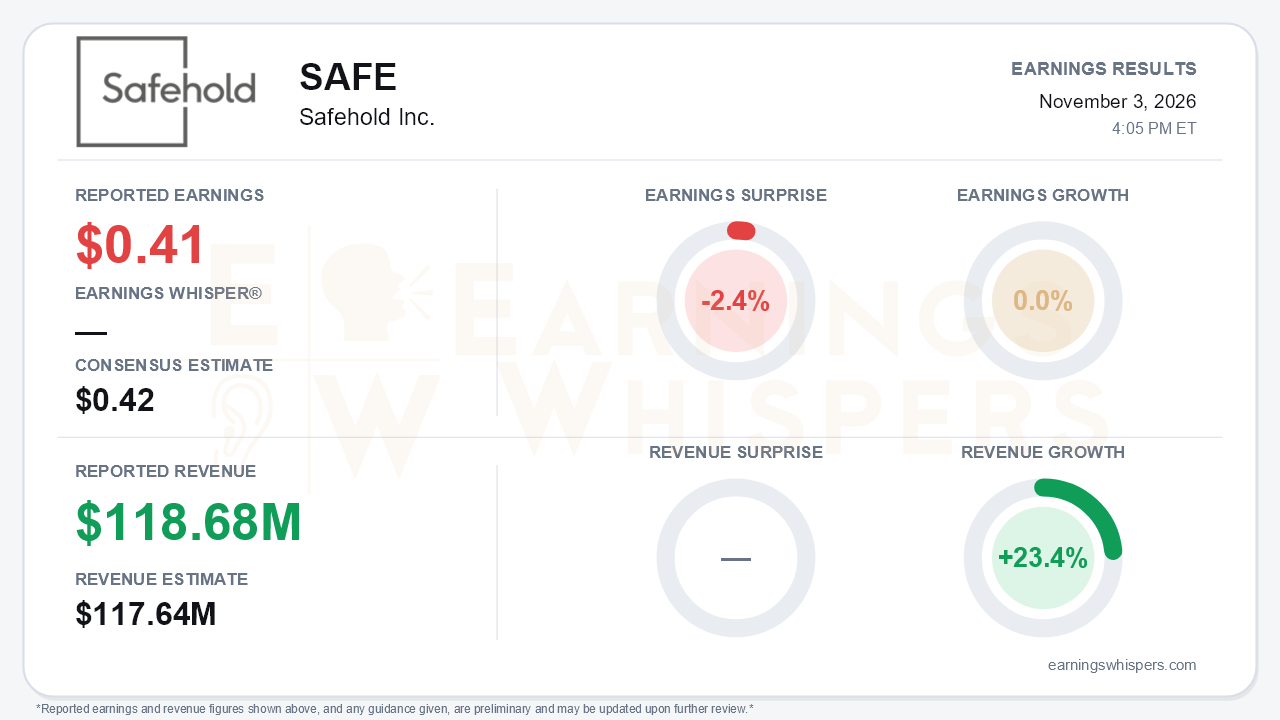
Safehold's third-quarter headline was a narrow miss, but the bigger story was the sharp break in deal flow. The ground-lease REIT earned $0.41 per share, short of the $0.42 consensus by 2.4% and flat year over year. Revenue rose 23.4% to $118.68 million, edging past the $117.64 million estimate by 0.9%. That gap is the central tension. The top line keeps compounding, but none of that growth reached per-share earnings. Meanwhile, the origination engine that is supposed to drive future growth nearly stopped as long-term rates jumped.
The quality of the quarter deserves scrutiny. Revenue has climbed steadily, from $110.9 million in the first quarter to $114.6 million in the second and $118.7 million now. Net income attributable to common shareholders still fell to $28.8 million from $30.2 million, and EPS slipped from $0.42. On the call, management tied the flat year-over-year result to lower management fees from Star Holdings, weaker earnings from unconsolidated joint ventures and higher reserves. New business was thinner than the $38 million headline suggests. That figure includes $13 million of forward commitments that are not yet funded and remain subject to conditions. Estimated Unrealized Capital Appreciation rose to $9.9 billion, but the roughly $100 million gain was well below the approximately $260 million added in the second quarter.
The call marked a clear change in tone. After the second quarter, management talked about continuing the momentum. This time it described conditions as "definitely rough right now." The 10-year Treasury rose roughly 70 basis points from late August to early October. Management said that move triggered retrades, repricing and closing uncertainty. Originations fell to $38 million across two deals, down from $150 million in the second quarter, which was the best quarter since 2022, and $68 million in the first. The pipeline of letters of intent cited earlier in the year has not converted at the hoped-for pace. Management also acknowledged a pricing ceiling: pushing yields materially above about 7% would choke off demand. With funding costs rising, that implies a squeeze on both volume and spreads.
The balance-sheet discussion gave bears legitimate ammunition. Leverage rose to 2.04x from 2.01x, at or above the 2.0x target. Liquidity dipped to $1.3 billion from $1.4 billion. The revolver draw climbed to $765 million from $621 million, partly to fund buybacks. With the shares trading at a discount to net asset value, issuing equity is unattractive. Analysts pressed on the cost of capital and the dividend. Management called taxable income "quite low" and described the dividend as discretionary. That is a notable retreat from the confidence of last quarter, when management said no equity was needed. Legacy issues also linger, with no progress on the 50th Street office conversion litigation and slow movement in the Park Hotels dispute.
The call did preserve a credible long-term story. Affordable housing volume this year is nearly double the full-year totals for 2024 and 2025. The third-quarter deals carried a 7.3% economic yield, a 39% ground-lease-to-value ratio and 2.7x coverage. Portfolio credit remains steady:
- ground-lease-to-value of 52% and coverage of 3.4x;
- ratings stable at A3/A-/A-;
- debt with an average maturity of about 18 years at a 4.4% effective cost, carrying roughly $800 million of embedded mark-to-market value.
Management also pointed to several forward catalysts. The amended Star Holdings loan added economics and improved credit. Recapitalization opportunities should emerge as low-cost debt from earlier vintages matures. CPI lookbacks on 2018-2019 deals begin hitting in coming years, and more than 90% of leases carry inflation protection. Buybacks are continuing into the fourth quarter.
The market had already priced in much of the deterioration before the release. Shares fell 29.9% from the $16.48 open after the July report to $11.55 as of November 2. That leaves them 21.4% below the 200-day moving average of $14.69. The stock set its quarterly high of $16.69 the day after the prior report. It slid to a 52-week low of $10.61 on October 21 and entered earnings only 8.9% above that low. Investor sentiment moved from roughly neutral at -0.02 to clearly negative at -0.23, a meaningful shift. The trend readings are mixed: price and AVWAP trends are negative, while sequential growth and momentum readings are positive, consistent with rising revenue against a damaged chart.
The bottom line is that Safehold's quarter was less about the penny miss than about how exposed its model is to long-term rates. Revenue growth, credit quality and the long-dated liability structure remain intact. However, originations stalled, leverage is at its target, earnings are flat and the dividend is now openly discretionary. Near term, investors will likely focus on whether the deal pipeline revives as rate volatility settles. The capital-appreciation and inflation-protection thesis may need that revival before it gets renewed credit.
Read our earnings preview for Safehold Inc.: https://www.earningswhispers.com/article/SAFE/21622
This earnings review was originally published on Earnings Whispers.
This article is for informational purposes only and is not investment advice. Earnings Whispers and its staff may hold positions in the securities mentioned. It is AI-assisted, based on proprietary Earnings Whispers data and company reports, and edited by Earnings Whispers staff.
Mentioned In This Article
Latest News
| Nov-03 | |
| Nov-03 | |
| Nov-03 | |
| Oct-26 | |
| Oct-20 | |
| Sep-15 | |
| Sep-08 | |
| Aug-19 | |
| Aug-14 | |
| Aug-07 | |
| Jul-30 | |
| Jul-30 | |
| Jul-17 | |
| Jul-14 | |
| Jun-25 |
