MITT Misses As EAD Falls Below The Dividend And Book Value Drops 7.3%, Overshadowing A Still-Scaling Home Equity Engine
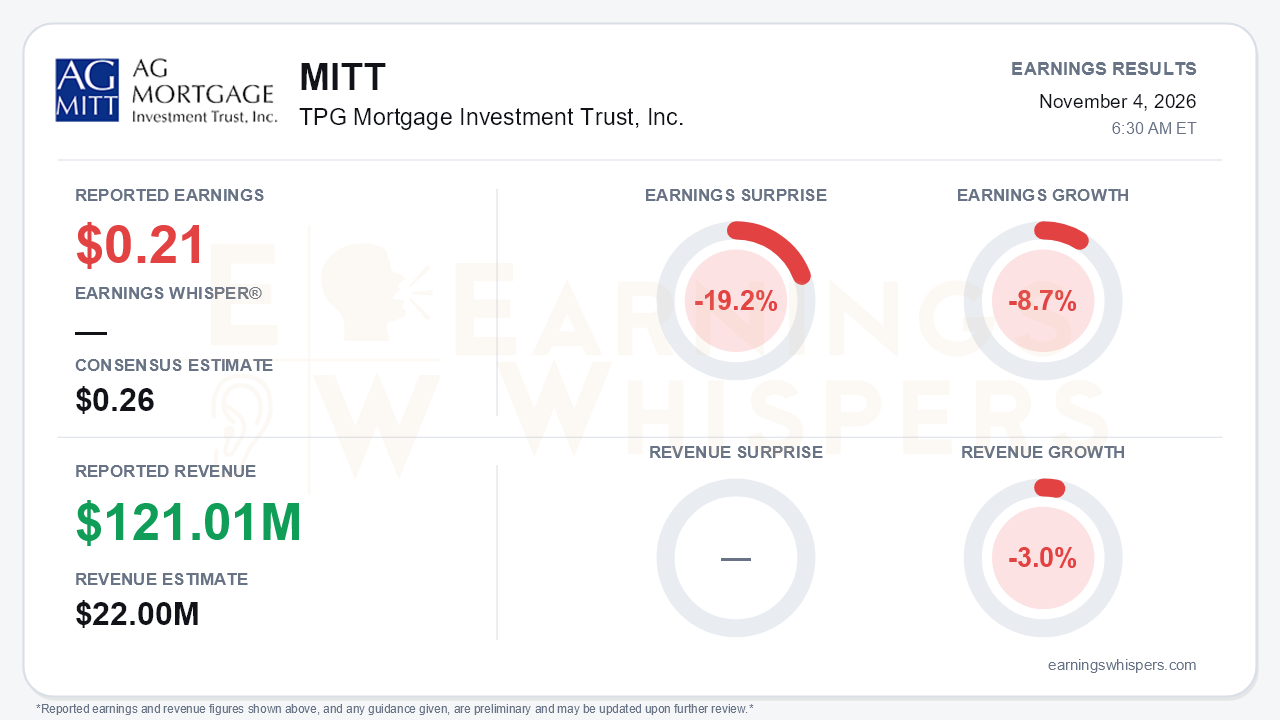
TPG Mortgage Investment Trust delivered a third quarter that turned a dividend-coverage question from theoretical to real. Earnings available for distribution (EAD) of $0.21 per share missed the $0.26 consensus by 19.2% and fell 8.7% from a year ago. It also dropped below the $0.24 common dividend, which the conference-call evidence identifies as the first shortfall in recent quarters. That is the central tension. The residential credit strategy management is building kept scaling, but September rate and spread volatility hit book value, wiped out the mortgage-origination affiliate's contribution, and pushed out the catalysts meant to lift earnings.
The quality of the quarter deserves scrutiny beyond the EAD miss. On a GAAP basis, MITT lost $0.49 per diluted share, a sharp reversal from the $0.29 profit in the second quarter. The loss was driven largely by $19.9 million of net unrealized losses and $4.2 million of transaction-related expenses. Book value per share fell 7.3% to $9.27 from $10.00, producing a -4.9% economic return after a +2.7% return in Q2. Only 0.6 percentage points of that decline came from the $2.0 million in Cherry Hill deal costs, so most of the damage reflects mark-to-market pressure rather than one-time merger expense.
The headline revenue figure needs context. Revenue of $121.01 million beat a $22.0 million consensus by 450%. A gap that wide more likely reflects a difference between gross revenue and the net figure analysts model than genuine operating upside. Revenue fell 3.0% year over year, the call characterized the revenue trend as flat, and net interest margin was a thin 0.8%. Investors should not read the revenue beat as evidence of operating strength.
Beneath the damage, the core engine held up better than the headline suggests. Net interest income including hedges ticked up to $0.66 per share from $0.65 in Q2. Management said portfolio ROEs held near 20%. MITT executed three home equity securitizations totaling roughly $1.25 billion, delivering what was guided on the Q2 call, and home equity rose to 37% of equity allocation. Arc Home originated about $1 billion, up roughly 19% year over year, and is ramping home equity products to offset a first-lien pullback. Management also argued that higher rates widen the financing advantage of second liens over cash-out refinancing.
The problem is the bridge from that engine to reported EAD:
- Arc Home's contribution fell from $0.04 per share in each of the first two quarters to roughly zero, and management declined to give a fourth-quarter read.
- EAD has now slid for three straight quarters, from $0.26 in Q1 to $0.24 in Q2 to $0.21.
- Liquidity fell to $84.7 million from $112 million in Q2.
- Economic leverage edged up to 2.0x from 1.8x.
The forward catalysts also slipped, and bears have legitimate ammunition here. In Q2, management targeted two hospitality CRE resolutions by the end of Q3 and a retail close by year end, framing about $0.05 of near-term EAD uplift starting in Q3. Now one hospitality buyer's deposit has gone hard with closing expected by year end. The second deal is a quarter or two away, and the retail sale moved to "coming months," though management still expects proceeds at carrying values. Redeployment is now pitched as a 2027 story worth roughly $0.15 to $0.20 of incremental annual EAD.
The Cherry Hill merger, with stockholder votes scheduled for December, adds scale but brings its own baggage, since Cherry Hill posted roughly a 13% book value decline in the quarter. Management's tone shifted from Q2's "transformational" framing to a defensive one. Executives called the quarter "not reflective of our long-term trend" but offered no commitment to cover the dividend in Q4.
The market had already started pricing in trouble. Shares fell 13.3% from the $6.54 open after the August report to $5.67 heading into this release. That leaves the stock about 22.8% below its 200-day moving average of $7.34. The stock set a 52-week low of $5.20 on October 19 and has recovered only about 9% from that level, while sitting 17.2% below the September 8 high of $6.85. Investor sentiment swung meaningfully, from slightly positive (0.07) to clearly negative (-0.38). That is a substantial move on a -1 to +1 scale and shows expectations souring well before the dividend shortfall was confirmed.
The bottom line is that MITT's quarter was a genuine setback layered on top of an intact but slower-to-pay-off strategy. The home equity securitization machine, steady net interest income, and growing Arc Home originations support management's long-term thesis. However, EAD falling below the dividend, a 7.3% book value hit, thinner liquidity, and CRE resolutions slipping into 2027 shift the burden of proof onto execution. Until the CRE capital is redeployed, Arc Home's contribution recovers, and the Cherry Hill deal closes cleanly, dividend coverage will remain the variable investors watch most closely.
Read our earnings preview for TPG Mortgage Investment Trust, Inc.: https://www.earningswhispers.com/article/MITT/22425
This earnings review was originally published on Earnings Whispers.
This article is for informational purposes only and is not investment advice. Earnings Whispers and its staff may hold positions in the securities mentioned. It is AI-assisted, based on proprietary Earnings Whispers data and company reports, and edited by Earnings Whispers staff.
Mentioned In This Article
Latest News
| Nov-04 | |
| Nov-04 | |
| Nov-04 | |
| Nov-02 | |
| Oct-29 | |
| Oct-28 | |
| Oct-28 | |
| Sep-17 | |
| Sep-15 | |
| Aug-17 | |
| Aug-11 | |
| Aug-10 | |
| Aug-10 | |
| Aug-10 | |
| Aug-10 |
